
AI writes almost all of Relai's code, and an engineer can build a new feature faster than the company can judge whether customers want it.
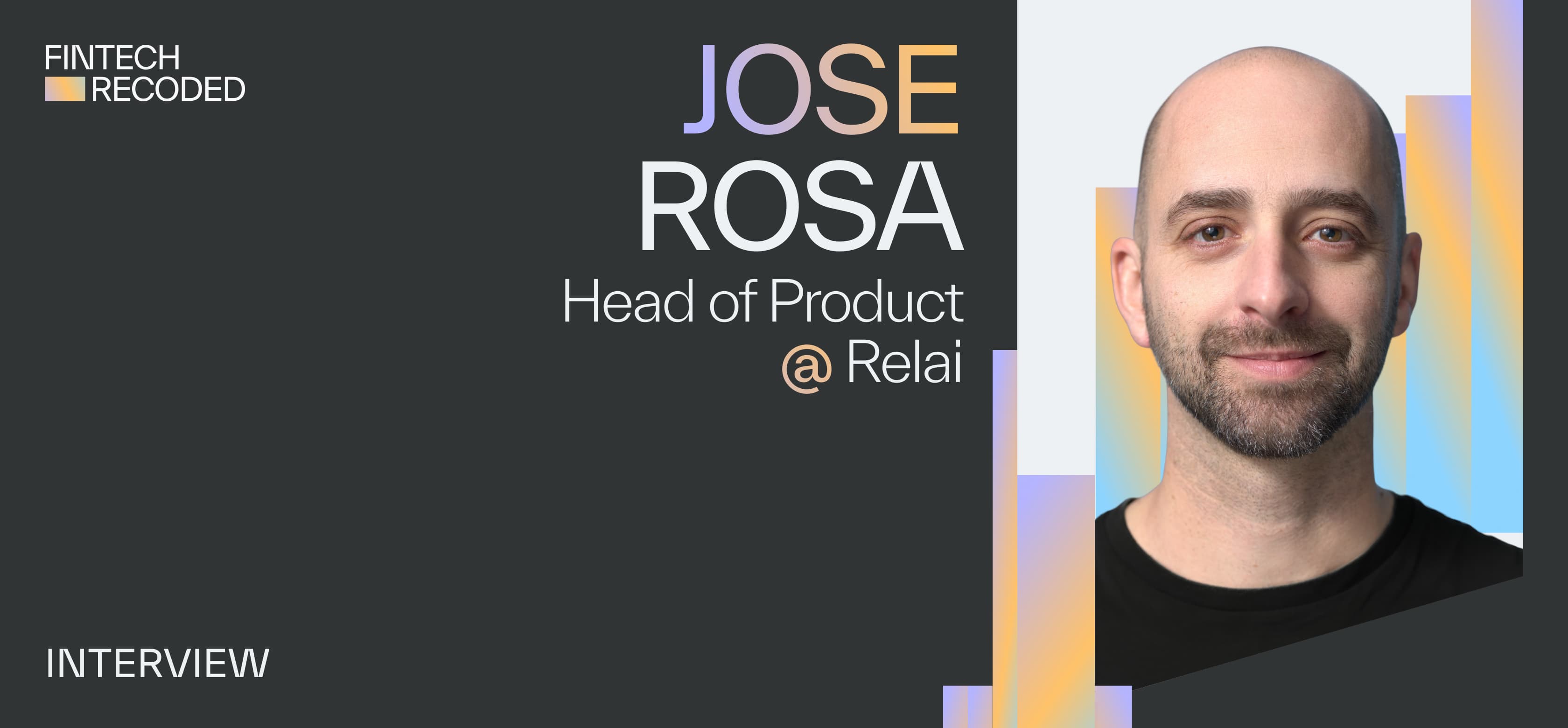
Jose Rosa, Relai's Head of Product, explains how he and his CTO keep weak work away from customers now that writing software is the cheap part.
Fintech Recoded interviews demonstrate how experienced product and technology leaders make difficult decisions in an environment where resources are constantly constrained, market changes are sudden, and deadlines are non-negotiable.
Shipping more stopped being an advantage
Jose Rosa says a Head of Product cannot do the CTO's job, so the 2 of them decide together which problems the engineers work on.
He brings the problem and the evidence of what customers want solved, and his CTO ensures the team produces enough solutions so the best one wins.
What you'll learn
Why he sets the problem and leaves the solution to the engineers,
How he uses a Claude skill and a waitlist to stop a weak idea early,
How Relai cut median onboarding from 16 hours to 14 minutes and lifted conversion by close to 15%.
About Jose & Relai
Engineers start after the research is done
Michał Szehidewicz: Relai has more than 100,000 users after 6 years, which is fast for a Bitcoin-only app in Europe. Which part of that story impresses you most?
Jose Rosa: We committed to one asset only, first in Switzerland and then across Europe.
Relai bet on Bitcoin alone when almost nobody else in the market was willing to.
The company moved fast and earned customer trust in the process.
I joined after most of that groundwork was already done, but I get to build on it now.
The part I'm proudest of is what comes next: optimizing the Relai app and improving the experience for savers.
Alex Mifsud, Weavr's CEO, told us here that knowing what to build is the hard part now. What does a CPO and a CTO each have to learn about the other's side?
My own background is in design, where cross-functional teams have worked together for nearly 20 years.
The cross-functional model hasn't really changed with AI because design, engineering, business, and compliance still need to be part of the same conversation.
What has changed is the judgment AI imposes on that conversation, since speed alone no longer determines whether something should be built.
A CPO has to keep asking that question, and a CTO has to keep turning a clear product strategy into the smallest number of solutions worth shipping.
In this series, Ross Harty, VP Product at 10x Banking, described teams where a product person and a tech lead write the plan, and only then does an agent build it. Has AI moved the boundary between what product owns and what engineering owns at Relai?
Ownership hasn't moved from one function to the other, because the teams have always shared the product they build.
Faster coding tools have changed how Relai's engineers spend their day, giving them room to try several approaches to a problem.
I hand engineering the problems that deserve the effort, so the engineers spend the time they save on a better solution.
Customers commit money before development starts
Writing code got a lot cheaper, but checking whether a feature is worth building didn't. What happens when engineering moves faster than the product team can validate a new feature?
An early-stage startup can move fast and loose, building everything that seems needed to reach the next stage.
Relai is past that stage now, so speed on its own stops being the goal.
Scaling up doesn't mean the developers get faster while the product gets slower.
Product and engineering work together more effectively once processes are in place, and both sides exercise good judgment.
Skip that discipline, and a team can launch 30 ideas in a day and ship every one, straight into the problems that come with scaling.
In a scale-up, the product team's job is due diligence, so building never gets ahead of customer validation.
Marilyn McDonald, Thredd's CTO, says her team spends more time deciding what to build than on building it. When a feature is easy to build but its value is uncertain, who makes the final call?
We recently had exactly this discussion internally about building a new feature.
The product and engineering teams agreed the idea was good, but the value was uncertain, so we compared the cost to other work and dropped it.
Before we spend our precious resources on a new feature, I ask what would be more impactful than that and what the cost of not doing it would be.
I built a Claude skill and told it not to be agreeable, to cut a bad idea outright rather than flatter it, and I run every idea through it before trusting my own gut alone.
Next, we validated with the community itself by running a short set of surveys: one to gauge interest, one to check whether the idea fits the brand, and a waitlist to see who would actually commit.
2,000 people said they wanted the idea, and half said they would pay for it before we wrote a line of code.
A signal that strong is a green light, but the question that follows is always whether this is the right moment, not just whether the idea is good.
The regulator can overrule the plan
When speed, regulatory safety, and customer value pull in different directions, how should the CPO and CTO decide which one wins?
Regulation wins, and that tension runs through the whole year.
Customers hate being asked for a tax identification number, and the regulator backs that requirement with a fine.
A scale-up can't afford many fines, so we add a requirement, like a tax number, at the last responsible moment.
Meeting those requirements built the trust of more than 100,000 users, because a customer can see this isn't an app where you open an account and nobody knows what happens.
People underestimate how much product work hides inside a compliance requirement. Can you walk us through how a new regulation goes from a legal document to something the product team can actually build?
At Relai, someone posts a new rule in an open channel the moment it appears, and the first question is always whether we can afford to leave it until later.
Compliance has to understand the business as well as the rules, so the conversation is never a handover in which one side tells the other what to implement.
I push back with my own research, asking why we need a piece of data or why a rule can't be phased in, and compliance pushes back on me.
I keep a running playbook of what the rules require, who owns each one, and what we can challenge, and I update it after a weekly meeting with the head of compliance.
Relai holds a MiCA license for the European Union and operates in Switzerland as a VQF member, under two different sets of rules. How much of the product stays the same in both markets?
The overall product strategy stays the same in Switzerland and the EU, since Relai already had customers in each before I joined.
Compliance is a business enabler for Relai, because a crypto app that cannot meet Europe's rules ends up closing its doors.
Where the Swiss and EU rules diverge, the backend applies each market's own requirements, and customers see the same product.
The European Union adds another layer, because each member country still runs its own banking rules and onboarding documents.
We build in-house where we can, and we partner where a specialist already knows which documents a market accepts, from residence permits to the new EU digital identity.
A shared knowledge base serves four teams
You've argued that faster shipping isn't a strategy on its own, and in fintech, the hard-to-copy part is usually the slow work, the licenses and the bank integrations. Where does AI give you an advantage beyond speed?
AI's biggest value at Relai goes beyond engineering, because it also helps compliance, customer support, legal, and finance stay aligned on where the product is going.
Everyone stays aligned through a shared knowledge base, so nobody has to re-explain a decision department by department.
On the engineering side, AI now writes almost all of Relai's code, and the people training it keep the standard high.
Shipping is fast now, and the slow part is raising the quality until the product can scale.
Would you say Relai is an AI-first organization?
Yes, because everyone here builds and shares their own AI skills, and we want a repository the whole team can rely on.
Use AI to word your reply better if you need the help, but never let AI answer a teammate for you.
Replies inside the company kept getting longer, and our CEO pushed the rule through the channels himself.
Some CTOs I've spoken with deliberately keep a few AI skeptics around at the table. Marilyn McDonald has a team of “guardians of the past.” Does Relai have anyone like that?
I haven't met anyone here who isn't using AI.
We ask for judgment because adopting AI at close to 100% still leaves a person to decide whether the output is true or needs improvement.
Nobody at Relai is defending the old way of working, because the pace we want only works if the team learns as fast as the tools change.
Neither the CPO nor the CTO can work alone
Bitcoin sits around 35% below its October 2025 peak, and your customers save on a schedule while the market falls. Does customer experience matter more when prices keep sliding?
Yes, because trust is the differentiator when Bitcoin moves this much and is this hard to understand.
Search interest in Bitcoin sits near a low, because people pay attention when the price swings hard in either direction.
We focus on savings behavior, in which people make small purchases on a regular schedule.
A customer who keeps saving for the next 15 years means more to us than a single large trade.
Relai cut median onboarding from 16 hours to 14 minutes. How much of that came from technology, and how much from seeing where customers were stuck?
The fix started with data, tracing every drop-off back to the exact screen where people left.
Customer support flagged the step people couldn't get through, and I went to compliance and legal to ask why it existed and whether another route would satisfy the rule.
Once we agreed on a fix, conversion rose by close to 15% straight away, and one customer bought their first Bitcoin within 7 minutes of finishing onboarding.
Every week since, we repeat the same loop, reading the data, asking compliance and product why a step exists, and removing the ones we no longer need.
Google's research this year found that teams adopting AI raise both productivity and stability. Where is the CPO-CTO relationship heading now that some people hold a combined CTPO title?
I don't think product and technology should merge into a single title, even though I understand the appeal.
I could not live without the CTO, because I could not learn the whole tech stack and still improve the product.
I can focus only on the product because nobody expects me to master the stack, security, and the architectural decisions that come with running engineering.
Merging the roles removes friction between the two specialists, and that friction produces better answers than a single person running the show.
Better agents don't remove that friction because a founder running alone still ends up building CTO and CPO skills.
Even then, an idea gets better when a partner talented in a different field pushes back on it.
3 moves worth making
Prove people will pay for a feature before you build it
Write all three surveys first, then run them with your existing customers, and let no engineer open a ticket until the answers are in.
The first survey should describe the feature in one sentence and ask customers whether they want it; the second should ask whether it suits the brand they already buy from.
The third should be a waitlist at a stated price, and development starts only if half of the respondents to that survey say yes.
Decide what you build and what you buy
Pick an outside provider for identity checks in each market you enter, because the required documents shift with every rule change and drain time from your engineers.
A good provider can tell you today whether a German customer can sign up with a residence permit or a passport, and update that answer as the law changes.
Your engineers then spend their time on the parts customers notice, and entering the next market starts with asking whether your provider already supports that country.
Delete the step customers quit on
Pull the drop-off metrics for your signup and find the screen where the largest share of people close the app without finishing.
Take that screen to your compliance and legal colleagues and ask them which law requires it, and whether a different document or a later prompt would satisfy that law.
At Relai, deleting steps that way reduced median signup time to 14 minutes, down from 16 hours, and nearly 15% more people finished the flow over the next 30 days.
Authors

Michał Szehidewicz
I'm a product delivery consultant with 12 years of experience across enterprise and scaleup businesses in financial services, SaaS, and software development. I help CTOs, CPOs, and CEOs unblock their software delivery, and I have worked in C-level management and B2B sales myself. Today, my focus is GTM engineering. I also host Fintech Recoded, an interview series with senior product and technology leaders at fintech companies. At tsh.io/fintech-recoded, you can read how these leaders make hard calls under real market constraints and uncertainty. Outside work, I'm a father of 2 with a newborn daughter and 1 unruly border collie. Everything else I love is in the mountains except the NBA.

Michael Sols
Content fixer: B2B Copywriter, Marketer, Strategist. Often questioning reality — to find facts that make business decisions good, of course. Connected with technology since training his family in the basics of Windows 98. Authored brand stories out and about the software market that were published by WIRED UK, Silicon Republic, The Sun, and Vanity Fair. Also, you deserve a raise.