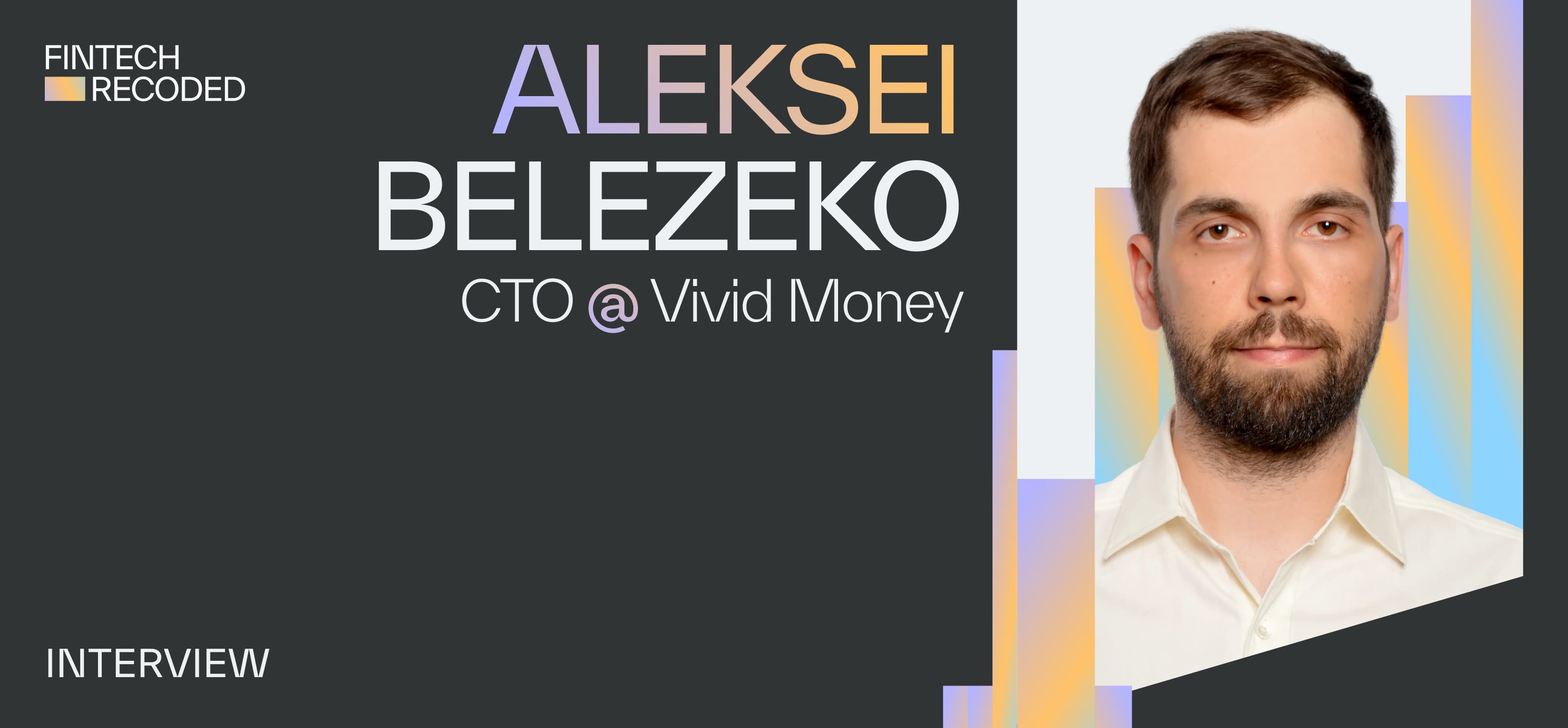

Aleksei Belezeko stays skeptical of every AI agent's judgment until it proves itself with an actual payment or transfer.
At Vivid, that skepticism shapes how a fintech engineering team builds banking automation without breaking European financial rules.
Fintech Recoded interviews demonstrate how experienced product and technology leaders make difficult decisions in an environment where resources are constantly constrained, market changes are sudden, and deadlines are non-negotiable.
Building trust in AI at Vivid
Aleksei Belezeko runs engineering at a fintech that pivoted from retail customers to small businesses 2 years ago.
Vivid never slowed down after that pivot, and AI adoption became the next test.
His engineering team went from fearing AI coding tools to relying on them as a standard part of daily work, then built the guardrails needed to keep that use compliant under European financial law.
Those same guardrails now determine how far a banking agent can go when handling a customer's money, from suggesting a payment to sending one.
What you'll learn
How Aleksei's team went from mostly skeptical about AI to nearly all-in on it within a year.
How Vivid decides which financial actions an AI agent can execute on its own.
Why Vivid gave every engineer permission to reject bad AI-generated code on sight.
About Aleksei & Vivid
Turning a skeptical team AI-native
Michał Szehidewicz: What makes you the proudest when it comes to building an AI-native engineering team?
Aleksei Belezeko: This is the biggest achievement of the year for me.
We run a small, effective team, and I'm proud of how we adapted so much AI tooling into our workflow.
We changed how we work without ever stopping delivery of new features or fixes for our customers.
Was becoming AI-native an easy transition for the engineering team?
No, not at all.
Any transition like this takes real work and effort from every single employee.
The biggest challenge wasn't technical. It was changing the team's mindset.
When a tool like AI works well for coding, people start fearing it will take their job, and that fear leads them to avoid the tool to hold onto the part of the work they enjoy most
That's a people problem, not a technical one, and everyone on the team had to work through it.
The developer community has been split since the first serious AI coding models arrived; some engineers were excited from day one, and others were deeply skeptical.
How did the skepticism inside the team shift as AI tools got better?
At the start of 2025, the split was about 20 to 80.
Just 20% of the team was excited about AI, and the rest were skeptical.
Every developer I talked to, inside Vivid or at other companies, said the same thing.
The code AI produced wasn't good enough for production. Opus 4.5 changed that.
Today, I don't think there's a single developer on the team who doesn't use AI.
Some people still enjoy writing code by hand, and that's fine, as long as their output matches what an AI-assisted developer delivers. We don't force a tool preference. We care about the result.
Deciding what a banking agent can do
How did the engineering team help Vivid reach 100,000 SME customers?
We obsess over every client.
Every developer tries, all the time, to do the best they can for every client, even if it's a single person with one problem.
Because of that obsession, we fix issues and ship the fix as fast as we can.
A deliberate choice to keep the team small, instead of scaling it with the client base, also explains that fast turnaround.
That choice gives us less coordination overhead, tighter control over every change, and enough flexibility to change direction.
With that flexibility, we pivoted from retail banking toward SMEs about 2 years ago and reached 100,000 SME clients in that time.
Vivid is also building a shared banking agent with support for MCP. What do you want that agent to do for a customer, and what shouldn't it do yet?
For anyone working in fintech today, AI as an assistant is the new normal.
Most people have at least tried ChatGPT, even if that's not true for the whole customer base.
A chat interface isn't the best way to interact with software, but it's simple and effective, so we're moving toward interfaces like MCP, CLI, and APIs that let people bring their own AI agent, whether that's Claude, Cursor, or something else.
In principle, an agent can take on any task a person is willing to hand off.
In practice, Europe's regulations set the real limit on what an agent is allowed to do.
Suggesting a financial action and actually carrying it out are two very different levels of autonomy to hand to an agent.
How much do you trust an agent to execute a financial action for a customer, instead of just suggesting one?
Trust isn't something I extend to a tool by default.
Personally, I trust an agent no more than any random stranger. As a manager, you train that trust muscle over time.
The same logic that applies to a new employee applies to an agent.
Agents are more exposed to things like prompt injection and other security risks, but the underlying relationship is the same.
We work in Europe, so PSD2 already draws a hard line on what can and can't be automated.
Any fintech handles sensitive data, money transfers included, but read access is far less restrictive for an agent than write access.
An agent should be able to attempt anything, but a human has to stay in the loop.
Our job as a fintech is to design that approval step, through good UI, so the customer genuinely understands what they're approving.
Engineering under regulatory pressure
That's the policy side, and the operational side looks different day to day. What does responsible AI use look like day-to-day for the engineering team at a regulated fintech like Vivid?
Our codebase splits into two parts: the core and the peripheral.
The core has strict rules around AI, because for that part, quality and uptime matter more than speed.
We run heavy end-to-end test coverage across our platforms, and every piece of code that reaches production has already passed a human review.
All of our engineers are in-house, with the exception of external security review and audit consultants, which we sometimes rely on.
Can you tell us about a moment when trusting AI-generated code, or an AI decision, put something real at risk?
Vivid is a regulated entity, so any real incident has to be reported to the regulator.
No risky AI decision has ever reached production, because any change that goes out requires review from a human engineer and multi-step testing.
We follow the procedure for every merge request, and that's where bugs get caught well before anything is near a customer.
Still, the real damage came from asking non-technical employees to open merge requests too, which flooded the engineers with reviews.
Those reviews strained my relationship with the team.
That's because nobody on the team wants to spend their day reading code that skipped proper testing or careful work.
The models and our own tooling were also less mature then, so more of the filtering fell to the reviewer.
We fixed it with one simple rule. If a merge request is genuinely bad, you're allowed to close it without hesitation, no discussion needed.
Better tooling, better documentation, and better models since then have made this a non-issue.
That fix worked, but not every CTO gets there this cleanly. What's the biggest mistake you see other CTOs make when they introduce AI agents into customer-facing financial workflows?
In my experience, two mistakes stand out.
The first is locking yourself into one provider, one tool.
If you use only one coding assistant, you end up locked into that vendor, with no room to cut costs or switch when something better comes along.
The second is letting hype from social media drive your decisions instead of your own due diligence.
It's easy to see a post claiming some huge breakthrough and react to it right away, when the real story turns out more complicated once you look closer.
The details matter, and you only find them by going deeper than a headline.
Keeping the AI hype in check
Vivid builds a money-management interface for tracking AI spend.
How does token spend management fit into the picture when it comes to making sure Vivid doesn't spend itself into trouble on AI?
Everyone knows the story of Uber's engineering team, which burned through its AI budget in the first 2 months of the year.
You don't want to be that CTO.
You still need to try new models and stay close to major releases, but the moment you're using several tools at once, tracking your total spend gets hard fast.
The goal is for AI usage to go up while the total spend stays flat, or even falls.
We decided that the CFO should own that visibility, the same way they own any other spend, so a banking application is the right place to track it.
We built the tracking tool for our own internal use first, and now we think it's worth turning into a product for other companies struggling with the same problem.
Between the shared banking agent, MCP support, and token spend management, which do you expect customers to notice first?
Token spend management will land first, because the moment you start tracking spend and get insight into where it's going, like caching, you can act on it right away.
As for direction, Vivid is moving toward more autonomy overall.
Agent loops are only a few weeks old, and they're not the hype anymore, but you still need a human somewhere in that loop, with less effort required from that person over time.
In terms of what ships next, Vivid will improve MCP and its API first, so clients can use its banking features inside their own agents.
Vivid also wants to release a single unified agent inside its own app that handles customer support and simple tasks instead of a handful of separate agents.
The spend management product will roll out in parallel, aimed mostly at enterprise and mid-size clients.
As we wrap up, what advice would you give other engineering professionals right now?
Watch out for FOMO.
It's easy to read AI news and posts from people deep in the field and feel like you're falling behind.
You do have to check AI news every day.
But you shouldn't believe everything you see on social media.
There's a lot of noise out there, including benchmarks that don't hold up.
The better move is to go deeper and find a small number of people worth trusting and following.
Some people have too many sources to single one out. Is there anyone specific you'd recommend following?
Just one name comes to mind, Dax, one of the founders of OpenCode, one of the oldest AI startups in Silicon Valley.
It's almost funny, because he builds one of the most popular AI tools out there, and he's still an open skeptic of AI.
He shares posts about what AI won't replace, and where it can go wrong.
That combination, building the technology and staying honest about its limits, is the kind of voice worth following.
3 moves worth making
Let engineers reject bad AI merge requests without asking permission.
Aleksei's team gives every engineer the standing right to close a bad merge request on the spot, no discussion required.
That single rule undid the damage caused by forcing non-technical staff to open pull requests. It also protects the engineer-review relationship that broke down in the first place.
Give one person clear ownership of AI spend.
Vivid put its CFO in charge of tracking token spend the same way they track any other cost. That ownership is what keeps a token bill from turning into an Uber-style surprise.
Waiting until spend gets out of control to assign that ownership costs real money.
Let regulation set your risk line instead of guessing at one.
PSD2 already tells Aleksei's team which actions are critical enough to need a human, so nobody has to debate it case by case.
Read access stays open to agents.
Write access waits for a person, except for the narrow, whitelisted repeats regulation already allows.
Authors

Michał Szehidewicz
I'm a product delivery consultant with 12 years of experience across enterprise and scaleup businesses in financial services, SaaS, and software development. I help CTOs, CPOs, and CEOs unblock their software delivery, and I have worked in C-level management and B2B sales myself. Today, my focus is GTM engineering. I also host Fintech Recoded, an interview series with senior product and technology leaders at fintech companies. At tsh.io/fintech-recoded, you can read how these leaders make hard calls under real market constraints and uncertainty. Outside work, I'm a father of 2 with a newborn daughter and 1 unruly border collie. Everything else I love is in the mountains except the NBA.

Michael Sols
Content fixer: B2B Copywriter, Marketer, Strategist. Often questioning reality — to find facts that make business decisions good, of course. Connected with technology since training his family in the basics of Windows 98. Authored brand stories out and about the software market that were published by WIRED UK, Silicon Republic, The Sun, and Vanity Fair. Also, you deserve a raise.