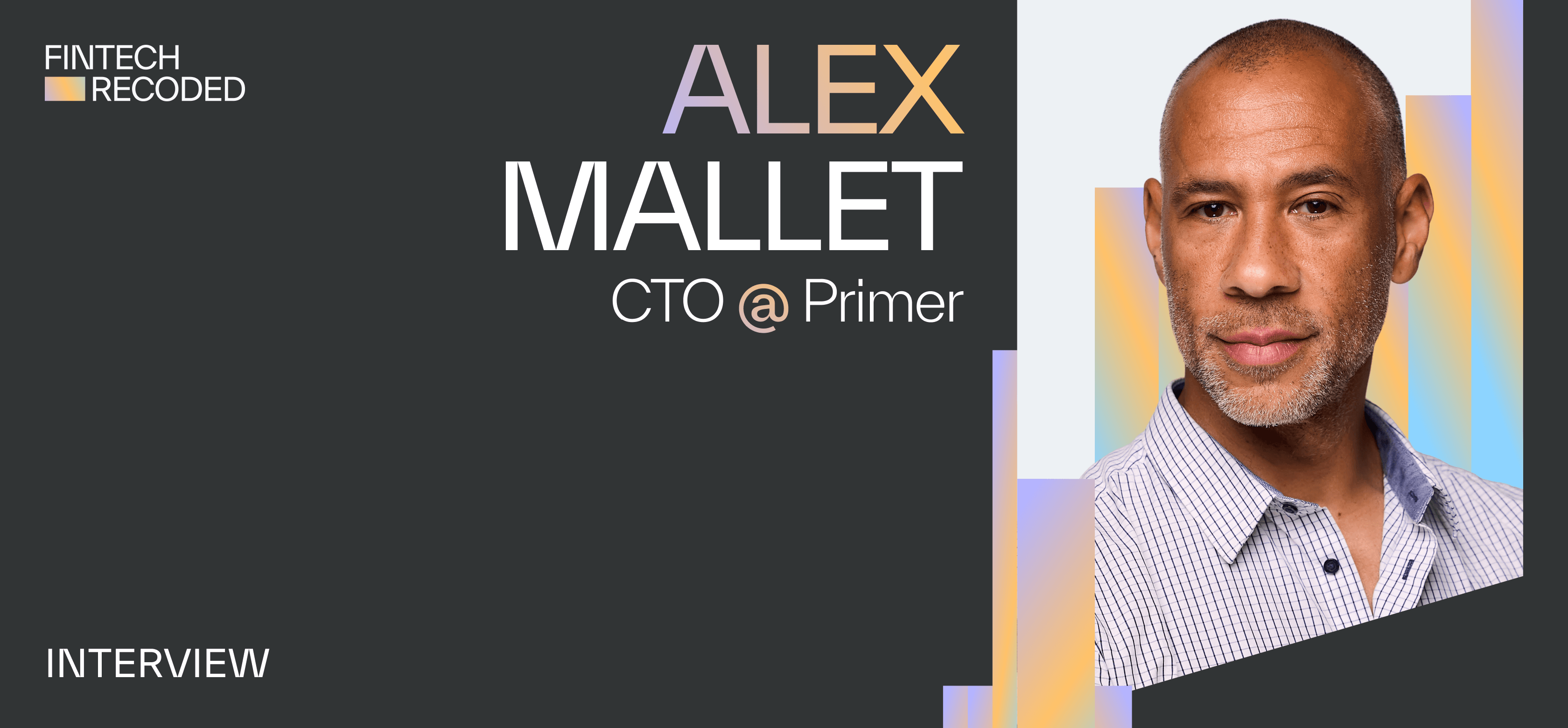

AI has made engineering work cheaper, yet a payments platform’s engineers can’t take on a large new request without delaying or dropping other work.
Alex Mallet explains how he has made every large request come with a trade-off since becoming the first CTO at Primer in 2024.
Fintech Recoded interviews demonstrate how experienced product and technology leaders make difficult decisions in an environment where resources are constantly constrained, market changes are sudden, and deadlines are non-negotiable.
Fully booked engineers have to trade one request for another
Merchants rely on Primer’s platform to process their payments, so its engineers have to keep the platform running while they build new features.
When those engineers are fully booked and take on one more request, an older commitment goes unfinished and nobody notices it.
Alex Mallet’s answer is to hold a trade-off discussion for any request that needs more than 2 weeks of work.
With every commitment explicit, engineering and the teams asking for work can hold each other accountable.
What you'll learn
What Primer gave up to make payments faster,
Why good candidates sometimes get a no,
Which first-year decision Alex would take back.
About Alex & Primer
Each added request costs an older one
Michał Szehidewicz: Most leaders I interview grew up inside fintech. You spent more than 25 years in engineering leadership at Microsoft, Amazon, and Forto before joining a payments company of around 150 people across more than 30 countries with no office. What drew you to Primer?
Alex Mallet: My LinkedIn profile won’t tell you this, but at Microsoft and Amazon I was always drawn to small teams building new products.
At Microsoft, I joined the team building the company’s web server, back when a web server counted as a new product.
After that, I worked on first versions of a tool for managing server clusters, a peer-to-peer networking toolkit, and a file-sharing service.
At Amazon, I was involved in the Relational Database Service a couple of years after its launch.
When I moved to retail, I joined a team of 20 to 30 people working on the international business.
I’ve always thrived where both the product and the team are getting started, because I get to help build them out.
By the end of my time at Amazon, I ran an organization of several hundred people, which took me away from that kind of work.
I was ready for something new after a long time at Amazon, but I couldn’t find another small team I wanted to join inside Amazon in Europe.
We lived in Berlin, and my wife and I didn’t want to move back to the US.
So I looked outside Amazon and joined Forto, a logistics company and my first startup.
A couple of years in, I realized software wasn’t what made the difference in logistics, at least at the time.
I almost turned Primer down.
When a recruiter contacted me about Primer, I told him I knew nothing about fintech or payments, had always found payments pretty boring, and wasn’t interested.
The recruiter came back and asked me to read the information pack before we talked again.
Once I read it, I realized Primer is an infrastructure company that sells APIs, much like the work I did at AWS.
The technical challenges drew me into payments because the systems we all take for granted for moving money are far more complicated than they look on the surface.
Was it risky for Primer’s founders to hire a CTO with no payments or fintech experience?
Of course it was.
My track record helped, because my career had taken me from web servers and databases to retail and logistics.
I’d shown I could come into a new area and learn it.
If I’d spent more than 20 years in one area before asking to move into an unrelated field, the conversation would have been much harder.
Spendesk CTO Alan Wright told me he met every engineer across every squad in his first weeks. You joined Primer in September 2024 as its first CTO, after a technical co-founder had run engineering since the company’s start. How would you describe Primer’s engineering team in your first month?
The engineering team was very strong when I arrived, because Primer had hired very good people before it had an official CTO.
After digging into what was going well and what wasn’t, I found no people problems at all.
The gaps were in how the team organized its work.
There was some lack of rigor in how it set goals and delivery time frames, and in whether its commitments matched its available capacity.
Engineering had no settled process for the constant stream of incoming requests.
The rest of the company had no clear interface into engineering that set out how the team operates, what goes in, and what comes out.
What changes did you introduce to Primer’s engineering after you joined?
One of the first rules I set was that there’s no free lunch.
If you want something new on the roadmap, we have to agree on what we take off it or push back.
When we’ve planned our capacity and the team is full, saying yes to one more item means we’ll drop something without telling anyone.
So we need to know at all times what we’ve committed to.
With our commitments clear, any new ask becomes a conversation about what we deprioritize, do less of, or slow down.
We put structure around how engineering takes in work, what it commits to, and what other teams can hold it accountable for.
Without explicit, capacity-based commitments, nobody can hold anyone accountable.
Otherwise, when an item slips, engineering can always answer that it never made a formal commitment or that the requester added the item to a full roadmap.
Neither side ends up happy with that outcome.
What discipline buys and what postponed fixes cost
You set your no-free-lunch rule before agentic engineering became popular. Does it hold up now?
Yes, though AI has changed some of the equations.
AI speeds up some of the work, but big asks still require trade-offs.
We never held a trade-off discussion for small items, because we can squeeze those in.
A request that needs over 2 weeks of commitment merits one.
With AI, the bar for that discussion is a little lower, because the work has become somewhat cheaper.
But in payments, correctness is paramount, so there’s no free lunch.
We can’t hand a ticket to an AI agent, let it merge and deploy the code, and never look at that code again.
People have to understand what an AI agent changed and deployed, and that review holds back some of our speed.
We’re getting smarter about which changes need human review and which don’t.
For a payments company, there will always be a limit on how much work agents can do without supervision.
Closing a pull request from a bot is easy, but stopping a project a team has spent 6 months on is a different conversation. Have you ever had to tell Primer’s engineers to stop work they believed in?
No, not since I joined.
Primer canceled a few projects before I arrived, but we haven’t pulled the plug on anything we’ve started since.
We’ve avoided canceling work by being more disciplined about what we say yes to and doing the due diligence before we invest.
Canceling a project means we’ve decided it’s a bad idea or won’t work.
Reprioritizing means we put fewer people on a project or push it to the next cycle, and we do that all the time.
You made a lot of calls in your first year at a company that was new to you. Is there a decision from that year you would take back?
Having lived with my decisions since 2024, I’d say I underinvested in clearing up friction points in our developer experience.
Primer is a much larger organization in 2026, and we continue to pay for that choice.
The price has gone up because more engineers run into the same roadblocks.
If we’d cleared those friction points before building more code and services on top of them, we’d be in a somewhat better spot.
Did you underinvest in developer experience on purpose, or was there not enough capacity to fix it?
Capacity was part of the reason.
In 2024, Primer was a much younger company with different constraints, since 2 years is 33% of its 6-year lifetime.
Scaling the business and onboarding new merchants put different pressures on us at that stage.
We couldn’t afford to take engineers off core feature work for problems that were painful but that we could live with.
A new CTO decides when to bring in a process from Amazon
Leaders I’ve spoken to who moved from a firm like Visa into a scale-up described having to unlearn its careful, incremental pace. You went from Amazon to a company of 150 people, so what lesson that you learned at Microsoft or Amazon turned out not to work at Primer?
The pace wasn’t the problem for me.
When I was there, Amazon ran like a set of startups with a high internal pace, so moving to a fast-moving smaller company felt natural.
The harder question is which of a big company’s processes belong at a smaller one.
Large companies set up most of their processes and safeguards for good reasons, and those become relevant as a small company scales.
You arrive with experience that can help a company grow, and the tricky part is deciding at what rate to introduce it.
No practice is wrong for a smaller company in principle, but some don’t fit its current size.
Size is part of the answer, and culture is the other part.
For example, Amazon is famous for written documents instead of PowerPoint, and meetings there start with everyone reading the document before the discussion.
I think a written document is a good way to share dense information and make decisions, because writing forces you to think things through.
For the habit to work, people have to write with the right rigor and context and change how they take in information.
If people are used to being walked through PowerPoint decks, you can write documents until you’re blue in the face and nobody will read them.
Written documents weren’t what Forto worked with when I joined from Amazon, so I didn’t bring them in at first.
Over time Forto moved toward them, but the habit needed time to bed in.
Is Primer aiming to become a big company itself?
Our ambition is to rule the world, like for most companies!
Editor: Alex surely meant that as a joke.
The harder question is how big a company needs to be to earn huge revenue.
Microsoft offering buyouts to part of its workforce shows how open that question is.
We’ll see how it shakes out, but Primer has to become a lot larger than it is.
Primer has no physical office. Should a CTO joining a remote-only company copy anything from a big office-based employer?
Your question feels like a gotcha, so let me start with what makes Primer work as a remote company.
One of our core values is distributed yet unified.
We’re spread across the world, but we act as one company.
Close relationships matter to us, especially when you only meet colleagues in person once or twice a year.
One way we build them is Donuts, an internal automation that pairs you with another colleague for a 15-minute chat.
The one rule is no work talk, because the point is to get to know each other as people.
How many people at Primer take part in Donuts, the 15-minute chats with no work talk?
About 70% to 80% of our people take part, and I accept almost every Donut I get.
Our second practice is the workation, where each team gets together twice a year for about a week in a city of its choosing.
Some would call it an offsite, but it’s an on-site, because everybody’s in the same place.
Teams have gone to London, Budapest, Krakow, and Munich, depending on the budget and where team members live.
For a team spread around the world, a city that’s far for some people can be the most convenient meeting point for everyone.
Nothing replaces meeting people in person.
The highest-value interactions happen when people spend time in one room and brainstorm around a whiteboard, and remote work can’t match that bandwidth.
To answer your question, I see whiteboard sessions as the big-company habit worth copying.
Remote companies should invest in giving their people the same chance in person.
Primer pays for reliability and for a stronger team
In your 2025 write-up, you reported that latency on Primer’s payment platform fell by about half, while payment volume continued to grow. The number of incidents fell by 25%, and availability held steady. Results like that rarely come for free, so did your engineers give up anything to make the platform twice as fast?
Yes, and the team put a lot of hard work into those numbers.
The obvious trade-off was that we spent less time on what you’d think of as product features.
For a payments infrastructure company, reliability and speed are key product features.
You can have all the bells and whistles you want, but if the platform isn’t up and processing payments, nobody cares.
Some people call reliability, availability, and latency non-functional requirements, but for an infrastructure provider they’re very much functional.
I consider giving up additional functionality to maintain reliability a very worthwhile trade-off.
Reliability sounds like a long-term investment for Primer. Do you see it that way?
To me, reliability is an immediate concern and something we're continuing to build upon.
If you’re down, your merchants are going to leave, and there’s nothing long-term about that.
In your 2025 write-up, you said Primer expects every new hire to raise the technical, operational, and cultural standards. Somebody has to decide whether a claim that strong holds. Who makes that call for a new engineer, and is it you, the hiring manager, or someone else?
Nobody decides alone.
Each interviewer receives a set of rubrics, and part of the job is to judge whether the candidate raises the bar in that area.
We want every hire to bring something new, whether on values and behavior or on the technical side.
Every interviewer has to write down whether the candidate raises our bar, in which area, and what evidence supports that view.
Once everyone has interviewed the candidate, we meet for a joint debrief to go through all the feedback.
As a group, we decide where the candidate meets our standard, where they raise it, and whether to make an offer.
The decision doesn’t have to be unanimous.
With 4 yes votes and 1 no, we’d expect to proceed with the hire, while 1 yes against 4 no votes would point to a no.
I believe Amazon expects every new hire to be a bar raiser. Did you bring that practice with you to Primer?
I did, because I was a bar raiser at Amazon, and I pushed for it at Primer from day one.
As a company scales, it has to keep improving what it can do.
For every candidate, we ask how and where that person would make us better.
Sometimes the answer is nowhere, and we’ve made painful calls on capable candidates who added nothing our current team lacked.
A no is a tough discussion, especially for a hiring manager under pressure to fill an open role.
We’ve held the line and accepted the occasional false negative, because we want to be stringent about who joins.
We try to give every candidate we turn down as much actionable feedback as we can disclose.
US merchants change what Primer’s engineers build
Primer raised $100 million in a Series C round led by Sofina and plans to grow its US revenue from about a fifth of the total to more than a third by 2028. Do the roles Primer plans to open in the US, up to 50 of them, change how you run engineering?
Not directly, because Primer isn’t hiring engineers in the US right now.
Most of our US hires will work in sales and go-to-market, because you need boots on the ground to meet prospective merchants and attend industry events.
Part of the $100 million will go into other product lines, so the US won’t drive all of our growth.
The US changes engineering through its merchants.
We have some US merchants and want more.
As we talk to more of them, we’re finding their needs differ somewhat from those of our customers in EMEA and APAC.
Their requirements are shaping our engineering roadmap.
Engineering leaders often tell me the job shifts from what they ship themselves to what their teams ship, which changes where their hours go. What takes most of your attention at Primer in 2026?
The biggest thing on my mind in 2026 has been how to adopt AI, so we get the upsides with as few downsides as possible.
AI is an amazing technology, but it comes with pitfalls.
To get the benefits across a whole organization, you have to treat adoption as change management.
We all tried giving everybody a Claude Code license and hoping magic would happen, and it didn’t work.
The company has to invest in shared processes and tooling, so the gains compound and nobody reinvents the wheel.
Much of my year has gone into laying that groundwork and keeping up with the state of the art.
AI labs keep moving the frontier, so part of my job is telling hype from reality.
Staying a couple of months behind is fine, because otherwise you end up chasing shiny models.
So we’ve standardized on Claude Code.
People ask whether that locks us into Anthropic if OpenAI or Google releases a better model.
My answer is that it’s a game of leapfrog, from OpenAI to Anthropic to Gemini and back.
Wait a month, and your model will be at the top again.
Getting good at one tool pays off, because some of what works with Claude may not work with Codex.
At some point, using multiple model providers or routing requests based on cost may make sense, but we want to get the basics right first.
Let’s finish by looking ahead. How will Primer change as a platform and as an engineering-driven organization by late 2027?
By late 2027, I expect Primer to have several new products in production and to be much further into its US expansion.
AI is a core part of our workflow, and once it covers every step, the gains in engineering speed should compound.
Alongside AI, I’m pushing to keep raising availability and cutting latency.
Availability work never ends, because the ideal is 100% and nobody gets there.
You keep chipping away at it.
The work also shifts as merchant and customer behavior changes.
When a provider goes down, we have to decide how much redundancy we need for it and whether to add a backup.
The curveballs keep coming.
3 moves worth making
Agree on a trade-off before every big request
An engineering team planned to full capacity can lose older commitments without a decision whenever it accepts another large request on top.
Alex Mallet made anyone who asked Primer’s engineers for over 2 weeks of work to agree first on what to deprioritize, slow down, or remove.
An engineering leader can set a size threshold for new requests and make an agreed cut to existing work the condition for accepting anything above it.
Fix developer friction before the team grows
Small annoyances in a developer workflow can look cheap to ignore while a company scales, yet every engineer who joins after that hits the same obstacles.
Primer kept its engineers on core features and merchant onboarding in 2024, and the cost of postponed developer-experience fixes grew as the team expanded.
An engineering leader can schedule fixes for developer friction while fewer engineers and services depend on the current setup.
Treat AI adoption as a company-wide change
Handing every engineer an AI coding license can leave each team inventing its own prompts and workflows, with few gains spreading beyond the team that found them.
Alex Mallet treated AI at Primer as a change management project, putting effort into common processes and tools that every team could build on.
An engineering leader can turn the AI workflows that work in one team into shared defaults, so every other team starts from the same footing.
Authors

Michał Szehidewicz
I'm a product delivery consultant with 12 years of experience across enterprise and scaleup businesses in financial services, SaaS, and software development. I help CTOs, CPOs, and CEOs unblock their software delivery, and I have worked in C-level management and B2B sales myself. Today, my focus is GTM engineering. I also host Fintech Recoded, an interview series with senior product and technology leaders at fintech companies. At Fintech Recoded, you can read how these leaders make hard calls under real market constraints and uncertainty. Outside work, I'm a father of 2 with a newborn daughter and 1 unruly border collie. Everything else I love is in the mountains except the NBA.

Michael Sols
Content fixer: B2B Copywriter, Marketer, Strategist. Often questioning reality — to find facts that make business decisions good, of course. Connected with technology since training his family in the basics of Windows 98. Authored brand stories out and about the software market that were published by WIRED UK, Silicon Republic, The Sun, and Vanity Fair. Also, you deserve a raise.