
Bahr wants to connect doers with fixers
Nowadays, we’re used to having products and services accessible through the internet. Most of humanity (if not everyone) can’t imagine not getting their favorite goods online, because we’re so used to shopping there. T
here’s still finite space on the marketplace arena for the taking. You must have a hot website customers lurk around to buy a watch or a snowboard or to reach a plumber or a social media campaigner. There’s only the question of if the demand is there.
In Saudi Arabia, there’s a successful product called Bahr.sa. It’s a lively marketplace connecting various freelancers with customers to fill the buy/sell gap for the country.
:quality(75))
The number of pages per visit shows Bahr's website is already highly useful. Source: SimilarWeb
Bahr.sa is in the portfolio of a Saudi conglomerate producing proxy marketplaces for suppliers, handicraft artists, and similar professionals. The Software House has been their development company of choice for years now. As our continuous reliability earned more of the client’s trust, we got a chance to redesign their Bahr platform from the ground up. If anybody asks, we had the utmost enthusiasm, which hopefully you’ll see.
Step 1: Any creative process starts with user research
To understand how users travel across the marketplace, our duo connected a heat map analysis tool “under” the website. Heat maps record user behavior on a visual overlay displayed above the page where blue shows low activity that goes all the way to red if the users are highly engaged.
:quality(75))
Heatmap example mockup
Blue, green, and red spots allowed us to define web page elements that get visitors stuck. We started further product development by exploring how to fix them.
Improving the user experience required us to consider the browsing goal a visitor has. For that to happen, we defined the freelancer’s user persona and potential website usage scenarios represented by what’s called the user flow. If that sounds like futuristic slang to you, just imagine that each scenario represents a complete website visit.
:quality(75))
User actions needed detailed mapping to see where we can remove roadblocks such as confusing UI
This first auditing stage is very necessary. We caught some unexpected usage issues. The combined knowledge of heat maps, the persona, and user flows allowed everyone to work on objective facts rather than a half-certain feeling.
Step 2: Workshop knowledge turned into designs
Hours of lively client discussions shaped a working timeline as precise as a bank heist plan. Together, we defined an entirely new user path that was missing before. Now, any freelancer can add an offer describing the scope of work and pricing.
:quality(75))
Do you remember Bahr wanted more completed projects after the redesign? One way to reach that goal was to reduce the number of steps for freelancers to add an offer
The client simply places an order for the freelancer’s service to order a product from an e-store.
We then removed and merged elements in the sign-up process, which made account creation noticeably simpler. In the meantime, inspiration from Bahr helped us with idea generation for in-platform project management improvements.
Step 3: Website flipping starts now
We closed the scope and built a marathon’s length of backlog tasks in Jira. Time to bring it on.
We kicked off work by designing new information architecture and new user paths to simplify and add clarity to navigation. Barh’s team wanted a fresher website look, so we compiled two smooth mood boards for them to pick one design for further work.
:quality(75))
Two mood boards. Pick — which one did Bahr choose?
Using the insights discovered during the workshop, we prepared UX documentation in Miro, and UX/UI designs got prepared in everybody’s top design tool called Figma. Sometimes, we even had to replace the Mac and mouse with a pencil and a sketchbook.
The client defined the workload for each two-week design sprint with some tasks registered in the scope. We designed all screens in two stages.
First, we carved out wireframes to define on-page functions and their routing
:quality(75))
Before digital products become fancy-looking, designers decide which pages need to be linked together for users not to get lost (left). Then you add the secret sauce (right)
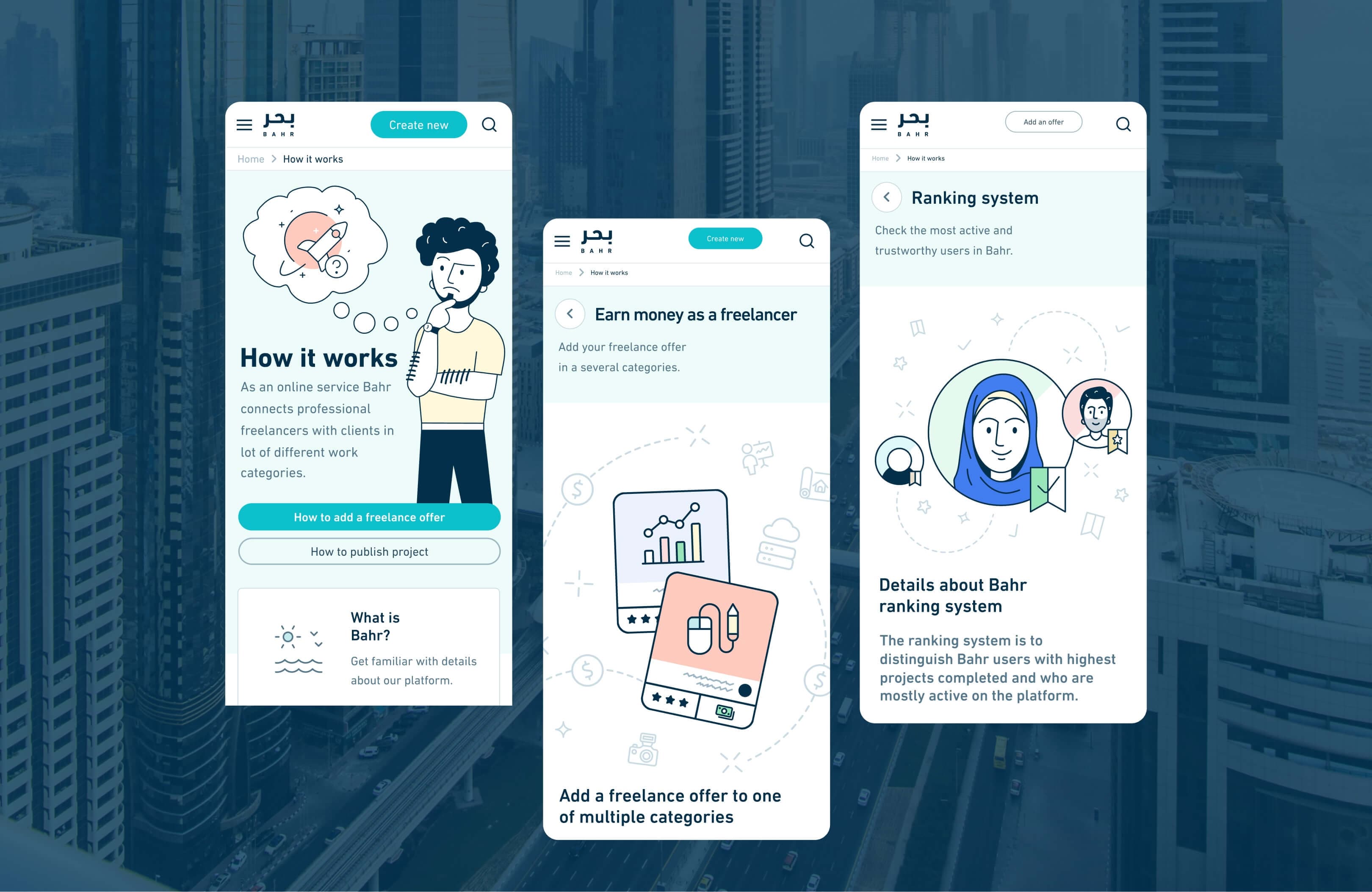
Then, we clothed wireframes with neat graphics, including several handmade drawings for that cool branding touch
:quality(75))
Vector illustrations based on sketches gain this distinct character that eyes recognize in an instant
To keep everybody on track, we assembled a vast design system with key elements in one place, which aided us in fast element-swapping. We based our style guide on the principles of Atomic Design that front-end developers follow. Have you heard of it?
The goal is to let any designer who enters the project pick up the work in no time. Having a design system we shared with Bahr was a large part of our success, as it made designing way easier.
:quality(75))
All-in-one design center that answers any doubts about the style we used
Comparing the before and after
Bahr went with us through an extensive audit, user profiling, design system construction, and a series of steps along the way. Was it worth it? You can judge that by comparing the old and the new. Since the domain’s parked in our garage, for now, let’s just quickly recap the changes.
:quality(75))
One thing that definitely optimizes conversions? Increased readability. That's what the redesign introduced.
Before our work
Users had a tough time figuring out how the website works
Buyers would often drop projects midway through
Users had to rely on external communication methods like calls or texting
Freelancers had to deduct what the buyer wants (most weren’t sure)
Freelancers couldn’t differentiate themselves
The previous graphic design was kinda meh
After our work
Buyers and freelancers use one profile view without switching between role accounts
The platform registers project changes that both sides can review
Now freelancers can pitch in their service
Buyers can now see freelancers’ work samples in search results
Freelancer profiles have more custom fields for the portfolio or certifications
The new design is fire, right?
Several months and dozens of meetings later, Bahr’s Product Owner stamped our work as approved, unable to hide appreciation in her uplifting feedback to the combined team that revitalized the service:
We knew from analytics that Bahr.sa needed a usability upgrade under the latest UX/UI recommendations. It was tough for our team to figure out how to provide similar ease of usage for buyers and freelancers where a client can work under both roles.
Deciding to involve The Software House in the redesign was a fast decision. As we've worked together before, we trusted that the next edition of Bahr will be richer in cross-industry usability practices their team brought in from other projects.
Looking back, I feel they did their best to overhaul how the website works for people.
Sahar Badah
Product Manager, <a href="https://bahr.sa">Bahr</a>
Authors
Aleksander Chmura
He has been dabbling in branding, UI/UX, and naming design since 2007. Still busily employed. Alek has too much energy, which he (so far) channeled into being 2x a founder, 1x a co-founder, and 2x an art director. Whew. He's interested in making advertising prettier with a fondness for admiring great branding and digital products work like it's museum art. See his works on Dribbble
Magdalena Tomsia
UX/UI work enthusiast turned full-stack designer that likes to transform complex information into beautiful visuals. With traditional arts education as her asset, she's a detailed illustrator, bringing depth and balance into any drawing.