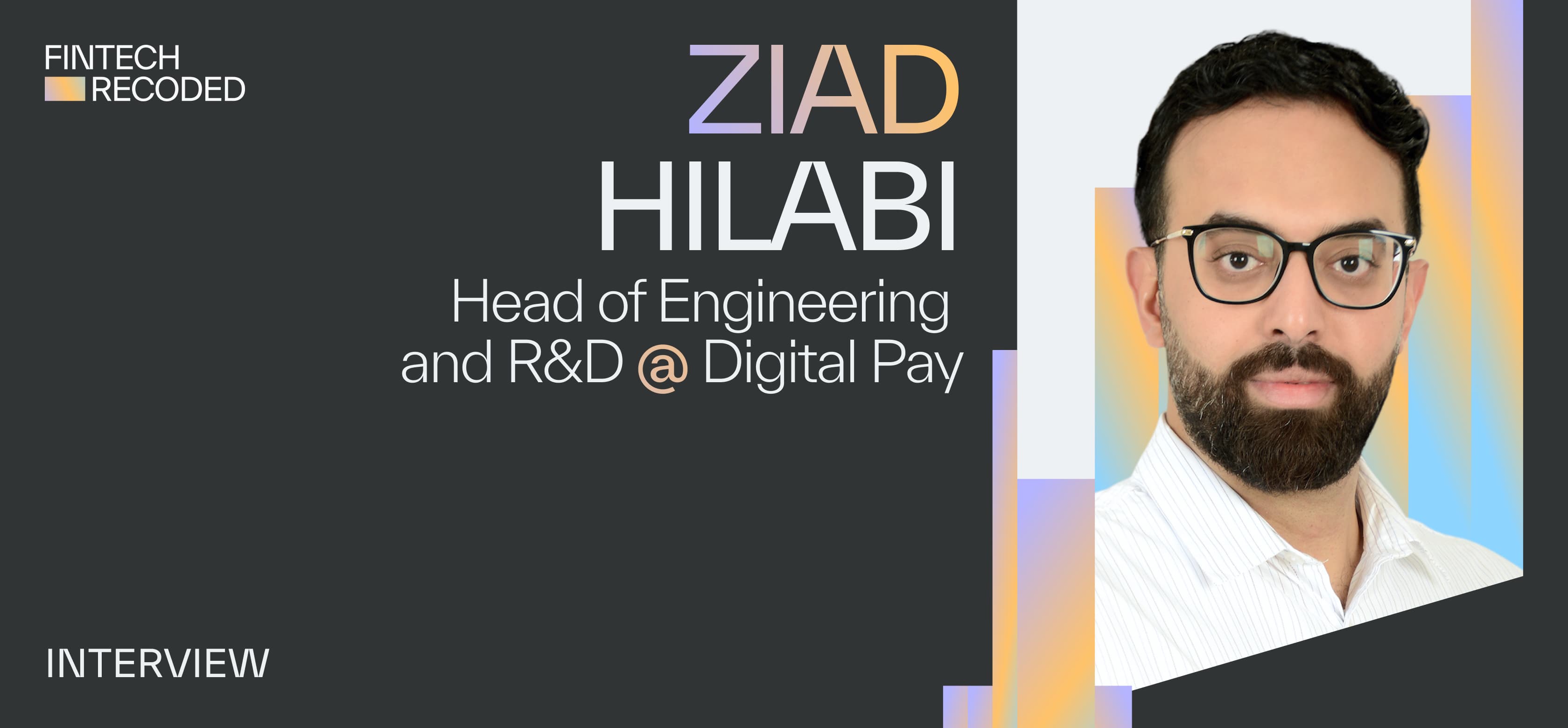

Compliance is often seen as a burden in fintech, but Ziad Hilabi sees it as the key to scaling and innovating with confidence.
As Head of Engineering and R&D at Digital Pay, Ziad Hilabi shares how cross-functional training reduces single points of failure, why discipline creates real speed in engineering teams, and how Saudi fintech can position itself as a global leader in uptime, security, and trust under Vision 2030.
Fintech Recoded interviews demonstrate how experienced product and technology leaders make difficult decisions in an environment where resources are constantly constrained, market changes are sudden, and deadlines are non-negotiable.
Turning fintech challenges into Vision 2030 opportunities
Saudi Arabia’s fintech sector is moving faster than ever, with payments at the center of its digital economy goals. Ziad Hilabi, Head of Engineering and R&D at Digital Pay, shows how cross-functional training, a purpose-driven talent strategy, and breaking down silos help engineering teams scale while staying aligned with Vision 2030.
In this interview, Ziad:
Shares how his team rolled out a nationwide POS update in just 2.5 days after an urgent central bank mandate,
Reveals why embedding compliance into Agile practices enables speed without compromising reliability,
Explains how proofs of concept and creative R&D keep innovation aligned with Vision 2030.
About Ziad
You recently became the Head of Engineering and R&D at Digital Pay. Congratulations on your new position! Starting a new leadership role often brings opportunities and challenges. As you look ahead, what’s your vision for your new team?
Ziad Hilabi: I come from a software development background, where I started out as a team member building systems for different purposes. Over time, I realized that what I really enjoyed was not only writing code but also guiding people and helping them grow into the best versions of themselves.
That is why I gradually shifted from pure development to leadership. I love working with teams, and it motivates me every morning.
When I stepped into the Head of Engineering and R&D role at Digital Pay, I first focused on alignment. In fintech, where the pace is fast and the stakes are high, building clarity and unity within the team is essential. I wanted to make sure the team understood my vision and the company’s vision and that we were moving together in the same direction.
Engineering Talent in Fintech
With over a decade in fintech, you have seen the market’s expectations for engineering talent evolve. Does the Vision 2030 era influence finding and hiring developers in Saudi Arabia?
Ziad Hilabi: I often interact with the Saudi Central Bank as part of my role, and they highlight the scale of the transformation we are living through. Even with all the growth happening now, we are still far from the target, which means the sector will continue to expand rapidly.
The number of fintech companies and the broader ecosystem around them is set to grow. That creates opportunities for everyone: investors, companies, engineers, and anyone connected to the field.
In Saudi Arabia’s fintech market, especially in payments, competition for top engineering talent is intense. Global tech companies are entering the Kingdom, startups are pushing hard to establish themselves, and Vision 2030 initiatives continue to expand. All of this makes attracting and retaining people a real challenge.
For developers, this means a bright future in Saudi Arabia’s fintech domain as the Vision 2030 agenda continues to accelerate.
How have you managed collaboration between internal teams and external partners to meet the demands of critical payment systems?
Ziad Hilabi: In payments, onboarding new engineers is not just about technical setup; it is about aligning them with a multi-stakeholder environment from day one. Payments always involve engineering, product management, and compliance, and the biggest risk is when these groups work in silos.
At Digital Pay, we tackle this by bringing everyone together from the start of any project. Engineers, product managers, and compliance officers participate in the initial discussions. This ensures that requirements are clear to everyone and that potential constraints are flagged early.
For example, compliance may highlight an issue the engineering team did not anticipate. Catching this at the start makes it far cheaper and easier to fix than discovering it in production. Misalignment here can be very costly, so by encouraging open communication and giving people the freedom to raise concerns, we avoid expensive rework and keep projects on track.
How do you onboard new engineers (in-house or external) to ensure they're practical and compliant from day one?
Ziad Hilabi: At Digital Pay, we built our talent strategy around three pillars: purpose, growth, and culture.
Purpose means showing engineers that their work directly impacts millions of people. Once engineers understand that, their motivation goes beyond salary. They see the meaning and commit deeply.
Engineers need a clear and structured career path. People are more likely to stay and contribute more over time when they grow and develop. I push it because structured growth makes a real difference.
Culture built on ownership, trust, and accountability, while respecting work-life balance. Fintech demands long hours, so effort must be rewarded. When people are respected, their motivation grows.
This mix has helped us attract and retain highly skilled engineers in one of the most competitive markets in the region.
Scalability & Agility vs. Compliance
During your career, you’ve worked on operating digital systems at scale. How do you balance moving fast with the strict testing and documentation rules in regulated payments?
Ziad Hilabi:
Fintech operates in a paradox. On one hand, you need to move very fast to stay competitive. On the other hand, you cannot compromise on compliance or reliability. The key is not choosing between the two but integrating them.
Compliance and testing are embedded directly into Digital Pay's Agile lifecycle. QA and compliance checks are part of our sprints, not afterthoughts. Automated regression testing, penetration testing when needed, and continuous updates to technical documentation are all built into our definition of done. We also use CI/CD pipelines with strict quality gates, so nothing goes live unless it passes validation.
Compliance is not an obstacle to agility; it is a guardrail allowing us to innovate confidently.
I spoke with Dennis Overbeeke, CTO of the Dutch fintech Newton, who strongly argued that “compliance is an opportunity, not a burden.” Do you see it the same way in your work at Digital Pay, and how do you turn compliance into an enabler rather than a slowdown?
Ziad Hilabi: Absolutely, 100%.
The more people understand that compliance is not an obstacle but part of the process, the smoother everything becomes.
When teams adopt this mindset, there are fewer surprises, fewer last-minute blockers, and everyone knows what to expect. Once compliance is seen as built into the process rather than added on top, the ride becomes much smoother.
Can you share an example of a sudden change – like a new regulation, market shift, or tech disruption – that your engineering team had to navigate? What did it teach you about leading in high-stakes environments?
Ziad Hilabi: Yes, let me give you a very recent example. Just last week, the Central Bank of Saudi Arabia issued an urgent mandate on Wednesday that required a change to be deployed across all POS terminals by Monday. We had no prior notice and essentially only two and a half days to deliver.
In payments, agility is not optional. Without an agile team, you cannot meet these kinds of deadlines. Beyond that, you need cross-training so that if someone is unavailable, another team member can step in immediately. That’s exactly what happened. We aligned quickly, shared responsibilities, and by Monday morning, the rollout was complete.
Sudden regulatory changes are part of the Saudi fintech environment, and failure is not an option. It puts pressure on engineering teams but teaches resilience and teamwork under high stakes.
Could you tell me more about your approach to cross-functional training to keep your team versatile and ensure maximum uptime during these changes?
Ziad Hilabi: Everyone should have deep expertise in their core area, but also a working knowledge of other domains. This makes the team more resilient and better prepared for unexpected demands.
For example, one of our POS developers is highly skilled in building systems, but when needed, he can also step into the certification phase and support testing and compliance activities. It is not his primary responsibility, but he is equipped and willing to contribute when the team requires it.
This type of cross-training reduces single points of failure. Knowledge is shared, responsibilities can shift, and the team always has a backup. It keeps us agile and ensures no sudden change or resource gap slows us down.
In my interview with Ehab Hakawati, Director of Engineering at Gathern, he said domain-driven development was key to scaling his teams. Given your focus on cross-training and versatility, what’s your take on domain-driven development?
Ziad Hilabi: I am a fan of domain-driven development. When people really understand a domain, beyond just their specific job, they perform better.
For example, I have account managers who work closely with banks, presenting our offerings and managing relationships. I appreciate that they are also technically prepared to handle specific questions. They understand not just what our product does, but also how it is built.
We run regular sessions across the whole company where we explain how our products are developed and gather feedback. This creates an environment where everyone, regardless of role, has domain knowledge and can contribute more effectively.
What’s a common scaling mistake you’ve seen in fintech development teams, and how would you advise avoiding it?
Ziad Hilabi: One of the most common mistakes I see in scaling fintech teams is working in silos.
Large, isolated departments slow everything down. Decisions get stuck in layers of approvals, and execution suffers.
The better approach is to organize around cross-functional squads with clear ownership. When teams own their domain end-to-end, decisions are faster, accountability is stronger, and delivery becomes smoother.
Another mistake is underestimating the role of discipline. In my view, discipline creates speed. If your team follows strong coding standards, invests in automated testing, and takes sprints seriously, you actually move faster because you reduce the risk of downtime, rollbacks, and firefighting.
So my advice is simple: break down silos, build cross-functional squads, and instill discipline in daily practices.
At some stage in a company’s growth, the product and the customer base start being too big, and departments start forming. When do you think that point comes, and how should leaders handle it?
Ziad Hilabi: I think the red flag is starting to see repeated misalignment.
I have seen cases where two departments worked on the same project without realizing it. That is a clear sign that something is wrong.
Or you might be about to launch a project and suddenly realize that some checkboxes are still missing because the people responsible were not aligned with you. That delay is a direct result of silos.
Misalignment is like a hidden disease. Once you spot it, you have to act immediately.
Sometimes, it means bringing everyone back to the table, and other times, it requires higher management support because, as companies grow, things can get too big to fix at the team level.
Research & Innovation
Digital Pay operates in a fast-evolving payments landscape, so there are always more ideas than time to implement them. How do you decide which R&D ideas to prioritize, especially when balancing customer needs with longer-term technical research?
Ziad Hilabi: In R&D, we always try to stay future-facing while solving today’s problems. On one hand, we explore emerging trends like AI for fraud detection, tokenization, or even blockchain use cases. On the other hand, we address current pain points in payments.
To balance these, we often start with quick proofs of concept. A POC helps us validate whether an idea makes sense and lets engineers be creative while contributing directly to the product. That mix of exploration and problem-solving keeps us ahead.
How do you take Vision 2030 goals into consideration when selecting your priorities?
Ziad Hilabi: Vision 2030 is always part of the picture. We watch announcements and updates very closely, because they open new opportunities.
When the Saudi Central Bank recently announced the adoption of Alipay Plus, we immediately looked at how Digital Pay could support it. Could we expand into merchant account services or become a QR provider? We acted quickly and started forming partnerships to explore those directions.
A similar case was when the Riyadh Metro was announced. We quickly evaluated how we could support it with payment solutions, such as ticket devices or kiosk systems. Today, some of our products are deployed in metro stations.
What metrics do you use to measure the success of R&D, both short- and long-term?
Ziad Hilabi: It really depends on the purpose of the R&D initiative.
One of the challenges we faced in the past was operational backlog. Our technicians could not always reach merchants quickly, especially in remote areas. Through R&D, we developed remote access capabilities for our POS terminals, allowing our team to replicate many of the technicians’ tasks directly from the office. The result? Support tickets were resolved without a physical visit, merchant coverage increased, and operational costs went down.
In this case, the success metrics were very tangible: fewer on-site visits, faster ticket closure, higher merchant satisfaction, and reduced costs.
That is how we measure R&D: by looking at both the business outcomes and the value created for users.
Future-Proofing for Vision 2030
Saudi Arabia’s fintech sector powers much of Vision 2030’s digital economy. 79% of retail transactions are now electronic, exceeding Vision 2030 targets. Probably in no small part thanks to Digital Pay efforts. What changes in digital solutions do you see as essential to take this vision even further?
Ziad Hilabi: Vision 2030 is all about digitalization, and payments are at the heart of it. Companies like Digital Pay are responsible for pushing the numbers even higher by making digital payments simpler and more accessible for everyone.
That means allowing merchants to accept payments through cards, digital wallets, gateways, or QR codes.
On the consumer side, the rapid rise of digital wallets shows how fast the market is evolving. A few years ago, people had one wallet. Now, most people carry several in their phones.
We also work closely with banks to modernize their backend systems, from reconciliation to transaction management. Every improvement, whether by regulators, banks, or fintechs, brings us closer to a fully digital economy.
The space for innovation is still massive. At Money 2020, I saw new ideas that reminded me how quickly this field moves. Large or small, every contribution from any stakeholder helps move the Kingdom closer to Vision 2030’s goals.
With Digital Pay’s role in building POS and payment infrastructure, how do you think Saudi fintech can lead globally in uptime, security, and trust?
Ziad Hilabi: Saudi fintech is on the verge of global leadership in uptime, security, and trust.
A few years ago, we didn’t have much choice with cloud providers. Today, AWS, Microsoft, Google, and Oracle are opening data centers here. That investment shows how Saudi Arabia is becoming a hub for digital infrastructure.
With this foundation in place, the opportunity is massive. The government has also made it easier for local and international companies to operate here. Setting up a business can now be done in minutes.
When you combine world-class infrastructure with this openness to investment, Saudi fintech can lead on a global scale.
General advice
Given your history of building critical payment systems over the past 12+ years, what advice would you give to engineering leaders aiming to thrive in high-stakes environments like Saudi fintech under Vision 2030?
Ziad Hilabi: Leadership style makes all the difference. Teams need psychological safety to raise issues early, experiment, and explore new ideas. When people feel safe learning and contributing, they perform far beyond expectations.
For me, transparency and accountability are key. A leader who builds trust and provides clarity creates an environment where teams can innovate confidently.
At the same time, I am constantly improving my own style and seeking advice from people who have been in the market longer than I have. Their experiences and lessons are invaluable.
If I had one piece of advice, it would be this: never stop learning from others, and never underestimate the impact of psychological safety on team performance.
It is the foundation for thriving in high-stakes environments like Saudi fintech.
Resources
Can you also recommend some learning resources for managers who want to explore the topic further?
Ziad Hilabi: I’ll be honest. Earlier in my career, I struggled when conversations got heated. I am very passionate about my work, and sometimes, that energy made discussions harder than necessary.
Taking a two-day Crucial Conversations training completely changed my perspective. It opened my eyes to techniques I had never considered, and the results were immediate. It helped me handle difficult conversations calmly, focusing more on outcomes and less on emotion.
This is more of a soft skill than a technical one, but for me, it was transformative. If a manager feels they sometimes get defensive, frustrated, or struggle to stay composed in tense discussions.
What’s next? 3 ways Saudi leaders can scale fintech with Vision 2030 in mind
With payments at the center of Saudi Arabia’s digital economy, Ziad Hilabi shares how engineering leaders can build resilient teams, integrate compliance with speed, and align innovation with the Kingdom’s long-term goals.
1. Build cross-functional squads, not silos
Scaling fails when departments isolate themselves. Organize teams around outcomes. Clear ownership and shared accountability reduce misalignment and speed up delivery.
2. Treat compliance as a guardrail, not a blocker
In fintech, agility and regulation must coexist. Compliance is not an obstacle but a framework that enables confident innovation.
3. Balance today’s pain points with tomorrow’s opportunities
R&D should solve current challenges while exploring future-facing ideas. Quick POCs validate ideas quickly, while close attention to Vision 2030 initiatives ensures innovation.
Authors

Aleksandra Dąbrowska
A copywriter who believes that with a little bit of creativity and humour IT doesn't have to be boring. Addicted to Spotify, music festivals and discovering new bands. She likes low-cost travels, but her favourite destination is the armchair where she reads books and binge-watches shows with clever storytelling.

Arkadiusz Kowalski
When it comes to business, he strongly favors building long-lasting partnerships and value. Always enjoys meeting new people and coming up with creative ideas. In his free time, he is happy to chat about computer gaming, politics, and social sciences.