
A Netherlands-based company set out to bring AI-driven development to their engineering teams in a way that matched the internal tools and workflows.
Lynx’s developer and DevOps teams began using and extending the system on their own, with support from internal champions trained to carry the work forward.
Partnership goal:
→ to help Lynx implement Agentic Engineering from the ground up and monitor its development, resulting in a personalized AI SDLC toolkit.
About the client
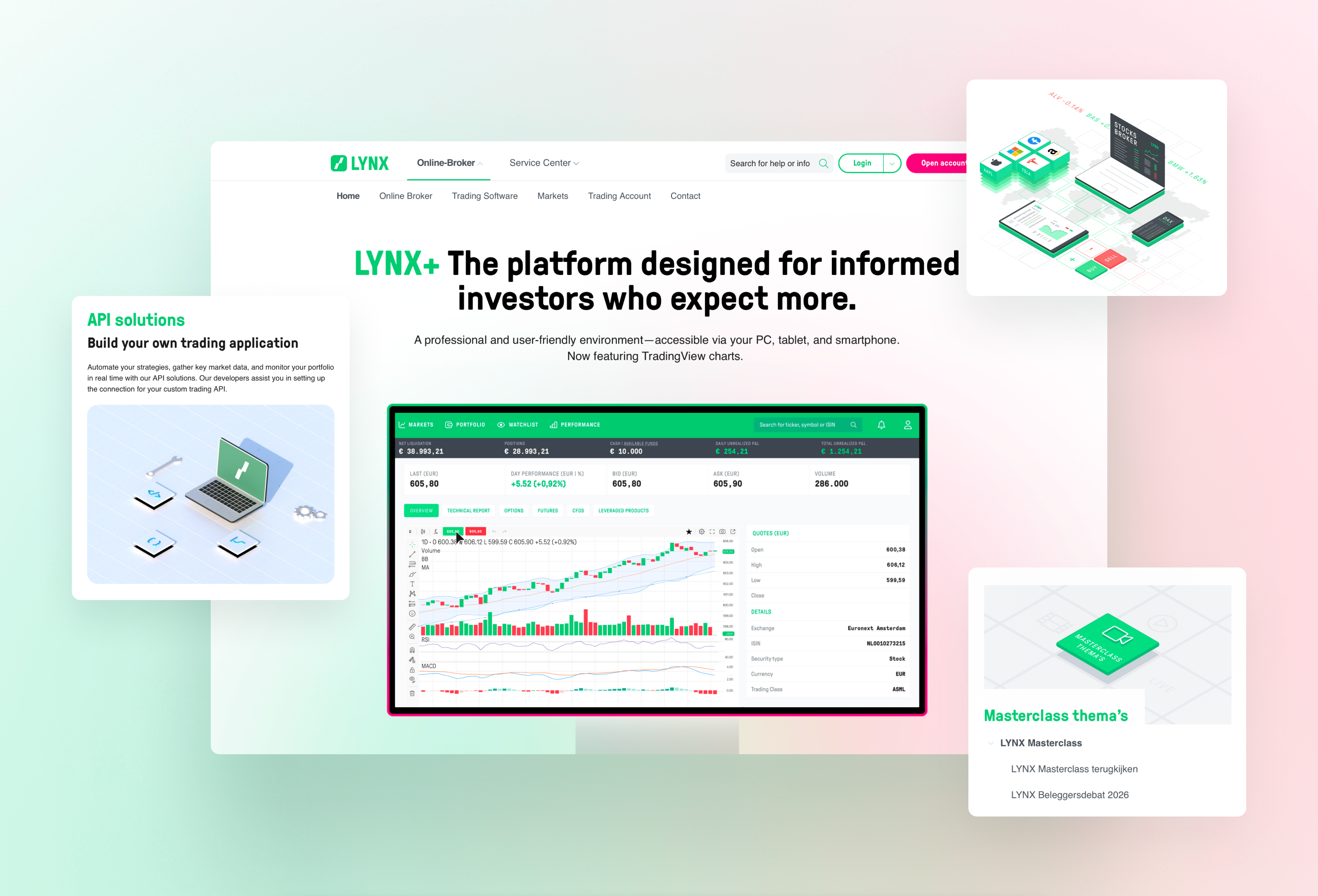
Lynx is an online broker founded in 2006 and headquartered in Amsterdam, the Netherlands.
The company gives investors access to more than 100 exchanges in over 30 countries through a single investment account, covering stocks, options, futures, forex, ETFs, and CFDs.
Lynx serves 70,000 clients through its LYNX+ platform and the professional-grade Trader Workstation, the same platform institutional traders use.

INDUSTRY
Fintech

COUNTRY
The Netherlands

SERVICE
AI Enablement
Business context
The company's developers ranged from experienced AI users to complete beginners.
Lynx wanted every developer across its engineering organization to reach a shared, confident baseline for working with AI and take full ownership of the AI system.
Challenges:
Bringing developers at every skill level to one shared standard,
Adapting a proven AI framework to Lynx's own tools and workflows,
Meeting strict security requirements as a regulated fintech company,
Managing AI costs during an industry-wide pricing change,
Building a system Lynx's teams could grow long after launch.
Enabling team
An enabling team exists to make itself unnecessary.
Lynx wanted their engineers trained on AI, not more hands added to the project.
Our AI engineering managers were paired with Lynx's developer and DevOps teams throughout the engagement, running daily standups, workshops, and hands-on task reviews together.
By the time we stepped back, Lynx's internal champions were running the system's development on their own.
Process
1. AI fundamentals workshops
We ran a set of educational workshops covering how AI works, how to build agents, and how to maintain quality while using AI.
These sessions gave every developer a shared starting point, regardless of prior AI experiece.
Lynx's developer teams reached a common baseline of AI knowledge across all skill levels.
2. Hands-on team workshops
We followed with individual and group workshops built around real tasks pulled from Shortcut.
Our engineering managers worked alongside Lynx's developers, observed how they used the toolkit, and refined the process based on daily feedback.
Lynx's teams applied AI to their daily work, without breaking processes that have already worked for them.
3. Security and cost workshops
We covered how to secure prompts and Model Context Protocol integrations, reflecting Lynx's position in a regulated fintech market.
The sessions also included cost-management practices, timed to prepare Lynx for a GitHub Copilot pricing change.
Lynx built AI security and cost practices fit for a regulated financial environment.
4. Champion enablement program
Together, we identified and trained internal champions at Lynx to take ownership of the AI system's ongoing development.
Now, these champions build new agents, add new skills, and extend the toolkit over time.
Lynx secured a dream team ready to keep developing their AI system without any outside support.
5. Customized agentic toolkit
Finally, adapting our AI Delivery framework, created base building blocks to align with Lynx's software delivery process and tools.
The team replaced generic workflows with ones built around Lynx's existing engineering roles.
This customized toolkit became the foundation for every session that followed.
Lynx gained an AI toolkit built for their own way of working, not a generic copy of someone else's.
Lesson learned
The real test begins when the enabling team leaves.
At Lynx, we learned to measure success by how confidently they now build, adapt, and extend the system without us.
Building up internal champions and making the AI toolkit easy to modify ensured that Lynx could adjust its AI workflows independently as their needs evolve over time.
That insight changed how we approach all future AI enablement projects.
Outcomes
Lynx's engineers build and extend their own AI system. Full ownership, no outside help required.
→ Self-sufficiency in AI development.
Lynx's developer and DevOps teams began using and extending the system on their own, without needing us in the room.
→ Secured long-term ownership.
Internal champions took full ownership of the system's ongoing development, so Lynx's momentum never depends on outside support.
→ An AI foundation beyond one toolkit.
The AI SDLC toolkit's fundamentals carried over to Claude, Codex, or any future platform, keeping Lynx free to evolve their stack over time.