
This client vibe-coded a frontend prototype of a promising app. Using our AI framework, Copilot Collections, our developer single-handedly transformed it into a market-ready MVP.
Find out how we managed to migrate the code for data security and integrate with the client’s APIs under a strict deadline and budget, generating all the code with our AI framework.
Partnership goal:
To rewrite a vibe-coded prototype into a proper MVP using 100% AI-generated code, with a small team and without compromising quality or scope.
The client
Their AI platform analyzes over 100 billion data points, including those from electronic health records, patient reports, clinical trials, and specialized literature.
The goal is to help companies find drugs with the greatest promise before committing significant funds, time, and effort to developing them.

INDUSTRY
Healthtech, Life Sciences

COUNTRY
USA

SERVICE PROVIDED
AI-driven development
Challenge
The client’s team created a prototype of their new app in Lovable, an AI app builder.
It’s a frontend for a selection of features from its main application.
The prototype, designed with feedback from their target user group in mind, validated the general concept.
It proved promising enough business-wise to convince stakeholders to develop an MVP ready for actual users who could inform further development.
To achieve this without exposing sensitive data to a third party, we were tasked with moving the app away from Lovable and connecting it to the client’s existing APIs.
A 100% AI-driven project
When we looked into it, we saw a perfect opportunity to use our AI framework, Copilot Collections, in a new way. This time, we’d generate all the code with AI.
Using this approach, we could boost productivity and deliver the project with a smaller team in the same timeframe.
Why this project specifically?
It was greenfield
While the Lovable prototype existed, it only provided the frontend code. The backend would be developed by our AI agents with little context to confuse them.
Its size was suitable for it
Not a small project by any means, but not a huge one that could overwhelm the agent with too much complexity.
The client expressed a strong interest in this idea and was eager to see proof that a high-quality solution could be developed with 100% AI-driven development.
The client agreed as long as the quality wouldn’t suffer.
Solution
Copilot Collections is not just a bunch of prompts.
Its basic 4-step workflow involves researching, planning, implementing, and reviewing, which reflects how our IT teams work.
The framework is designed to produce code as good as what our engineers would write by hand, but faster, provided you use it well.
“Using it well” is a subject that warrants its own article.
It calls for a very senior engineer with a T-shaped skill set, with broad experience across development, including architecture and DevOps.
Vibe-coding vs AI-driven development
Such experience is necessary to conduct true AI-driven development that contrasts with vibe-coding used to develop the original MVP.
WYSIWYG builders like Lovable focus on how things look and work, but they may not offer the highest degree of control over the codebase.
It’s still a valid, even recommended, approach to building a prototype, as it can be done quickly to validate the business idea behind a new product, as our client did.
AI-driven development gives all the benefits of custom engineering, like a maintainable codebase and scalable architecture, but aims to do it more efficiently with AI.
Unlike vibe-coding, it requires vast technical experience and involves some manual coding.
:quality(75))
AI-driven development is how experienced engineers develop with AI
Team formation
In AI-driven development, one engineer commanding AI agents goes a long way, so we kept the team small:
1 developer,
1 QA specialist,
1 Business Analyst.
Just one engineer, equipped with our AI framework, Copilot Collections, was tasked with doing the work of a traditional 3-developer team. If successful, the project would be delivered cost-effectively and quickly, reducing time-to-market, a key aspect for a company like this.
Technology stack
React,
Copilot Collections (TSH AI-driven development framework),
SonarQube,
shadcn (pre-built design system).
Process
Initial success
The project started exactly as we expected.
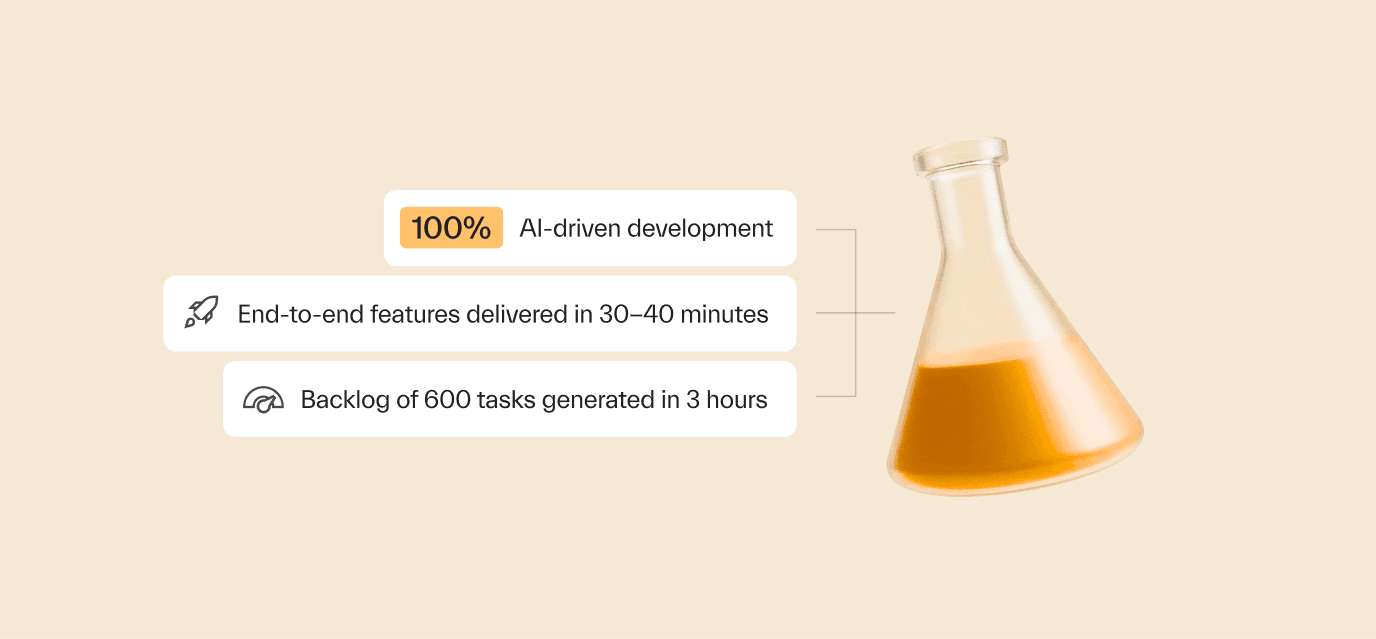
One developer did the work of three regular developers, delivering full features in as little as 30–40 minutes.
SonarQube, our static code analysis tool, ran with a strict quality configuration, as agreed with the client beforehand, to ensure code quality meets healthcare industry standards.
Each day brought several new pull requests.
We were on track to finish ahead of schedule.
Oh no, bottlenecks!
Familiar issues from previous AI projects began showing up at a higher frequency:
Empty backlog
The developer completed new tasks faster than the Business Analyst could create them.
Slow reviews
Full-feature PRs took so long that review work piled up.
Coding speed outpacing everything else was not new to us, but in a project with 100% AI-generated code, the problem became critical.
Life cycle rebalanced
We realized we had to do what we had planned for the next phase of our AI framework right now: extend it to cover all stages of the SDLC, not just coding.
In particular, we had to speed up the stages at the edges of the process, which were handled by the BA and the reviewer.
Here’s what we did:
Backlog generation
We added a new BA agent who generated a backlog of 600 tasks from the Business Analyst’s material.
Rather than replacing the Business Analyst, it frees him up to focus on gathering material rather than writing tasks.
We also decided that next time we would give the Business Analyst a more substantial head start in preparing for development.
Code quality
In addition to the regular Code Review agent, we added an AI job that performs a weekly code quality review.
Auto-fixes
We’ve set up a dedicated agent that automatically resolves all flagged issues.
Following these changes, backlog generation and review sped up enough to resolve most of the bottlenecks.
Big lesson we’ve learned
If you want to get the most out of AI-driven development, you need to apply the “AI-drives, human-verifies” approach to the whole cycle, including product, testing, and design, not to coding alone.
:quality(75))
Your delivery speed is only as good as that of the slowest stage in your process
Outcome
The app is now ready to undergo more tests from the client’s team before it’s deployed to the first real-world users:
→ The client received a product on time, from a smaller and less expensive team, with all the sensitive data securely connected
→ Despite this, all the features shown in the original Lovable frontend were included.
→ The app’s code adheres to the highest standards of quality.