
Saudi Arabia’s public and private sectors are accelerating digital transformation per Vision 2030, and the Unified Design System is at the heart of that progress.
This national framework and the DXMI score lay the essential groundwork for consistency and accessibility.
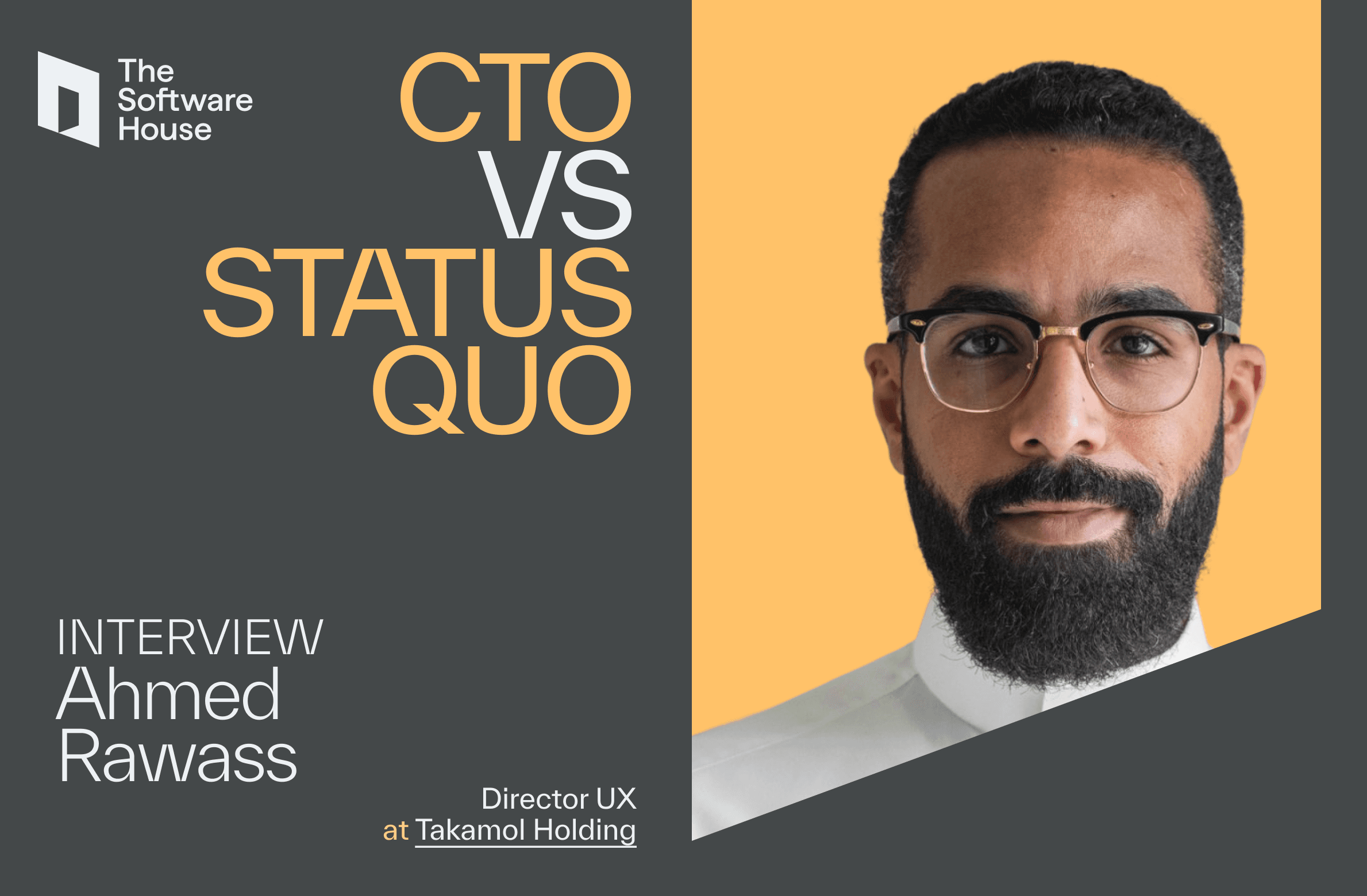
Ahmed Rawass, UX Director at Takamol Holding, explains how to use both the framework and the score to boost digital excellence.
The CTO vs Status Quo series studies how CTOs challenge the current state of affairs at their company to push it toward a new height … or to save it from doom.
Start with the Unified Design System. Then go further.
To build world-class digital services, Saudi teams need more than visual polish; they need a foundation of consistency and a culture of listening. In this conversation, Ahmed Rawass, UX Director at Takamol Holding, explains how the Unified Design System lays that foundation and how research, accessibility, and collaboration turn it into real user impact.
In this interview, Ahmed:
shares what UX capabilities will matter most in Saudi Arabia’s future,
explains how the Unified Design Systemsaves up to 20% in time and cost,
shows how combining vendors and local teams speeds upknowledge transfer.
About Ahmed
Currently the Director of UX at Takamol Holding, Ahmed is a seasoned digital leader focusing on service design, accessibility, and user-centered digital transformation.
With over a decade of experience in User Experience and Product Strategy, Ahmed has led design and research initiatives across industries, including government, telecommunications, and banking. He brings a unique blend of creative and analytical thinking to building digital platforms that align with Saudi Arabia’s Vision 2030 and deliver measurable public impact.
Ahmed & Takamol
Hello Ahmed. First of all, congratulations on your recent promotion in April. What’s it like to be a UX Director at Takamol Holding?
Ahmed Rawass: Thank you so much. I’m honestly grateful for the opportunity and the responsibility. I look forward to stepping into this role and seeing how we can shape the User Experience, especially in light of Saudi Arabia’s Vision 2030 and the broader digital transformation. Hopefully, we’ll be taking on major projects and turning all of that into real results that serve the millions of people here in Saudi Arabia.
UX trends in Saudi Arabia: personalization & unification
Given your experience designing for diverse user groups, what UX trends do you see as most transformative for public sector services today?
Ahmed Rawass: Well, even though UX has been around globally for a while, it's only been in the past few years that we've seen it take off in Saudi Arabia, both in the private and government sectors.
One of the biggest trends I’m seeing now is personalization. Take something like issuing or renewing any type of government identification. This time-consuming and frustrating process involved in-person visits, paperwork, and long wait times. Today, we’re witnessing a shift toward more tailored digital experiences that simplify the process and reduce friction, making public services more intuitive and user-centric.
Personalization is transforming the User Experience, making life easier for millions of Saudis and expats living here.
I couldn't agree more. Compared to a process-centric approach, a user-centric approach helps users navigate digital platforms more easily. It just makes sense.
Ahmed Rawass: Absolutely.
Another key change critical to UX is the unification of services across ministries. This is one of the significant milestones in Saudi Arabia’s digital transformation journey under Vision 2030.
A great example is Nafath and Absher. These platforms transformed how people handle everyday tasks, from renewing passports and IDs to managing driver’s licenses. Opening a bank account is now just a snap of a finger – no forms, no papers. You don’t need to be tech-savvy or have much digital platform experience. With just a click, everything’s taken care of.
I recently issued my newborn's birth certificate online. It took seconds, and there was no paperwork or appointment. The same goes for my ID. What used to take half a day now takes minutes, and it’s mailed directly to you. That’s a massive shift.
Any service that requires identity verification can now be accessed through this unified system. Even simple employment contracts, for example, can be reviewed and approved directly via the Qiwa platform using our national SSO. These streamlined experiences have significantly enhanced the user journey, replacing what used to be long, fragmented, and frustrating processes.
Are there any UX innovations you’ve seen that you believe could be relevant to Saudi Arabia’s digital government despite the country already being seen as a leader in this space?
Ahmed Rawass: That’s a good question. If you’d asked me this 10 years ago, I’d say yes—there were a lot of global digital trends we should have adopted. But in my humble opinion, Saudi Arabia is ahead of the curve today.
I’d say we’re on par—if not ahead—of many countries when it comes to UX and digital transformation. While we’re in a strong position, there’s still room for quality-of-life enhancements that could further improve how we serve both citizens and residents.
Overall, I believe Saudi Arabia sets an example regarding digital experience. We're in a strong position, but one area I think we can grow in is service design labs. Outside of Saudi Arabia, there is more investment in dedicated labs that focus specifically on User Experience and service design.
We’re also starting to see that in the private and public sectors, but it’s still in the early stages. I’d like to see more of those labs become standard for developing services..
How do you see AI and context-aware design enhancing interactions with government platforms in Saudi Arabia? I'm especially curious about the experiences of users who rely on them daily.
Ahmed Rawass: We’re still early in the AI journey, but significant investments have already been made. For example, the launch of Humain, Saudi Arabia’s first AI company, shows how seriously we're taking it.
AI has a significant impact on User Experience. Paired with the country’s digital transformation and systems like single sign-on, it’s reshaping how services are delivered. Tasks that once required paperwork, like filling out forms, are now automated. Users get proactive reminders when documents, such as IDs or licenses, are about to expire.
Context-aware features are already visible. Many platforms offer chatbot support, not just in government services but across the private sector, too. These bots help users solve issues quickly without waiting for human support or dealing with lengthy back-office delays. It’s all about speed, ease, and making the experience seamless.
You’ve built user journeys across various audiences. How can UX trends like accessibility and deep user research help bridge the gap between citizen expectations and current Saudi government services? Could you share examples of rethinking the user journey that led to measurable improvements?
Ahmed Rawass: I think investing in user research is fundamental. To truly bridge the gap between services and user expectations, we need people who understand the culture, environment, and day-to-day realities of citizens and residents here. You can’t apply UX assumptions from the US or UK and expect them to work in Saudi Arabia. You need local insight to translate user needs into meaningful, usable solutions.
Without proper research, platforms often miss the mark. You spend time and resources building something that doesn’t resonate with users. But when you understand your audience, you're halfway there – just translating real needs into practical, accessible solutions. That’s the core of effective UX and the foundation of digital transformation.
What’s important is that this isn’t just for citizens. Residents also benefit from the same experience. Once registered in the system, everything becomes accessible, fast, simple, and efficient.
The Saudi government really values the quality of service and people’s time. It’s not just about digital transformation. It’s about removing friction from everyday life.
DGA, DXMI, The Unified Design System
The Digital Experience Maturity Index is an essential tool for assessing the quality of digital experiences. From your perspective, how does DXMI scoring help governmental organizations align User Experience with broader digital transformation goals?
Ahmed Rawass: I think DXMI scoring is a great initiative. Before the Unified Design System framework and the Digital Government Authority (DGA) efforts, there was a lot of inconsistency in how services were delivered across different government entities. The User Experience varied widely from one ministry to another, which created confusion and friction for users.
The Unified Design System plays a key role in unifying those experiences. When users encounter the same design patterns and flows across different services, it boosts adoption, reduces support costs, and simplifies operations. People feel more confident using digital services because they know what to expect.
Adhering to the Unified Design System also gives a competitive edge. We'll start seeing the private sector follow suit once the public sector fully embraces a unified digital experience. Many businesses have already adopted similar standards; they don’t want to reinvent the wheel.
Ultimately, it’s about building trust. When users trust the platforms, they engage more easily. That trust benefits both the organization and the people it serves.
Beyond improving digital experience, do you think maximizing a DXMI score can give an organization a competitive edge in the Saudi market?
Ahmed Rawass: Absolutely. Competition is healthy; it ultimately benefits the end user, which both government and private entities care about. A higher DXMI score means better User Experience, more trust, and greater user retention. So yes, aiming for a top score can give organizations a real edge.
And what about those platforms that consistently score low? Are there any consequences?
Ahmed Rawass: There’s no formal penalty right now, but publishing the scores creates pressure. No organization wants to fall behind. Low scores push teams to improve, to climb the rankings, and to invest more in User Experience.
That visibility creates a culture of accountability. I wouldn’t be surprised if, in the future, we see awards or recognition tied to DXMI performance, especially for private entities providing public-facing services. It's a well-thought-out approach that encourages real improvement without needing to enforce it.
How has introducing the requirement for the Unified Design System impacted how Saudi teams design and deliver digital services, especially in the context of Vision 2030?
Ahmed Rawass: It’s made things significantly easier.
The Unified Design System is a strong set of guidelines, not rigid rules, but a solid foundation teams can build on. It helps reduce the time and cost of designing digital services, easily cutting effort by 15–20%, if not more.
Teams follow the system, and that increases their chances of success.
The Unified Design System supports consistency across government platforms because it’s based on research and best practices developed by the DGA. That consistency improves accessibility for everyone by making services more intuitive.
The Digital Government Authority introduced the Unified Design System last November, but they haven’t set a compliance deadline. Would it remain a flexible guideline, or could it become a formal requirement?
Ahmed Rawass: DGA strongly encourages adoption, especially within government and semi-government entities like Takamol. While it’s not mandatory, DGA pushes teams to follow it by highlighting the practical benefits, like reduced costs and faster delivery.
The system is constantly evolving. It’s not static and will keep adapting to new UX and service design trends globally, making it even more valuable as a long-term framework.
I’m not sure if anything like this has been done at this scale globally, but it’s a smart move. It sets a standard that makes it much easier for teams building digital platforms to stay aligned with national digital transformation goals.
Even though non-governmental companies aren’t required to follow DGA guidelines, do you think doing so could help them compete more effectively?
Ahmed Rawass: Absolutely. Every company wants to stand out, and today, great service gets noticed – whether through social media, news, or word of mouth. When people have a smooth, easy experience, they talk about it, which becomes a competitive advantage.
Adopting standards like the Unified Design System and aligning with DXMI principles helps companies deliver seamless experiences. It’s not just about compliance but about building trust and reducing friction.
Let’s be honest: No one likes waiting in lines or dealing with clunky processes. As more companies adopt these practices, we’re moving closer to a future where all digital services in Saudi Arabia, government and private, offer a consistent, user-friendly experience. I’m confident we’ll see that fully realized by 2030.
Future-ready UX leads to user research
Looking ahead, which UX capabilities should Saudi Arabia invest in next to accelerate digital transformation while keeping user needs at the center?
Ahmed Rawass: One of the most critical areas is accessibility. When I studied UX in the UK over a decade ago, accessibility was a priority. Back then, it wasn’t something we focused on in Saudi Arabia, especially not on large platforms.
But that’s changing. The DGA is integrating accessibility into the Unified Design System, addressing things like font size, color contrast for dyslexia and color blindness, and standards for users with disabilities. It’s still evolving, but the direction is clear and necessary.
We’re also seeing this shift in physical environments. Mowaamah, a program affiliated with the Ministry of Human Resources and Social Development, was launched as part of the Kingdom’s strategy to uphold the rights of people with disabilities. The program aims to empower individuals with disabilities by enabling access to suitable job opportunities, providing the necessary tools and support for their success, and encouraging organizations across all sectors to create inclusive work environments. This is done in line with defined standards and requirements that help entities ensure accessibility and support within their workplaces.
That mindset is slowly translating into the digital space as well.
That’s great to hear. How can product teams in Saudi Arabia continue building UX expertise beyond just following design system guidelines?
Ahmed Rawass: Guidelines are essential, but they’re not enough. You need to listen to users truly. Without that, you’re just guessing.
The next big step is investing in user research, actively engaging with users, identifying pain points, and building services around real needs. That makes the difference between a functional platform and a great User Experience.
How can product teams in Saudi Arabia attain new UX expertise in the future? What more can they do beyond just following guidelines?
Ahmed Rawass: UX isn't rocket science—it’s mostly common sense. It starts with listening. You can understand real pain points and build better experiences if you're a good listener. That’s the core of User Experience.
But often, teams skip this step because it seems “simple.” They fall into assumptions instead of talking to users. Businesses can get too focused on deadlines or profitability and forget to involve the people they’re building for.
It’s about balance – meeting business goals while genuinely addressing user needs. When you listen, the solutions often seem obvious in hindsight. But to get there, you have to make user input a priority.
Beyond formal training and following guidelines, what are some practical ways product teams in Saudi Arabia can build stronger UX capabilities? Could working with experienced external partners help?
Ahmed Rawass: Absolutely. Partnering with experienced vendors, especially those with a strong user research or market analysis background, can be incredibly valuable. Even if they're not UX specialists, their methods for understanding markets and audiences can translate well into service design.
That said, one of the most important lessons I share with new UX practitioners is: just listen. Too often, beginners insert their assumptions or personal experiences into research sessions. However, real insights come from keeping the spotlight on the user and truly listening without interrupting or projecting.
Partnership advice
Have you personally worked with external vendors? What were your experiences?
Ahmed Rawass: Yes, in every industry I’ve worked in, telecom, banking, and now government, we’ve collaborated with vendors. I’ve also been on the vendor side myself. The knowledge exchange is significant. You learn new ways to approach problems, design services, and understand users.
But local talent must always be part of the equation. Vendors may bring technical expertise, but only locals can truly understand why users behave as they do. Culture, habits, and expectations vary. What makes sense in one country may not work here.
That reminds me of when I spoke with Fadi Muzannar from Maven Insights, where we discussed connecting external European companies with Saudi teams. One key takeaway was that understanding the “why” behind user behavior always requires local talent.
Exactly – bring in external partners, but make sure the local team is deeply involved. That’s where fundamental transformation and sustainable learning happen.
Resources
You struck me as someone who values personal growth. Please recommend learning resources for managers who want to explore User Experience more deeply.
Ahmed Rawass: The first place I always recommend is the Nielsen Norman Group; they’re the go-to authority for anything UX-related. Their resources and courses are handy, especially for beginners or managers looking to dive deeper.
The second piece of advice is simple: read. There’s a wealth of content online about UX, service design, and user journeys. Spend even an hour a day catching up on trends, case studies, and how the field has evolved over the years – you’ll gain a lot.
I also recommend checking out the DGA’s Unified Design System for those in Saudi Arabia. It provides excellent guidance on how to approach digital service design, and in many ways, it lays the groundwork for you.
Overall, use trusted sources, stay curious, and just keep reading. You’ll eventually find the content that meets your needs and goals.
What’s next? 4 ways to raise UX standards in the Kingdom of Saudi Arabia
Ahmed Rawass shares practical advice for teams building digital services in line with Saudi Arabia’s Vision 2030:
Listen before you design
UX starts with listening. Saudi teams should prioritize user research early. “Users already have 50% of the answers,” Ahmed says. It’s about translating those into action
Apply standards like the Unified Design System
The DGA’s system cuts design time and cost by up to 20% while improving consistency. “It’s not just about compliance; it’s about trust and reducing friction.”
Invest in accessibility now
From screen contrast to inclusive flows, accessibility is no longer just optional. “It’s built into the Unified Design System,” Ahmed says, “and the mindset is shifting physically and digitally.”
Involve local talent in every project
External experts help, but culture can’t be outsourced. “Only local teams truly understand why users behave like they do,” Ahmed emphasizes.
Authors

Prem Markowski
Experienced IT Business Leader helping Saudi businesses grow through the right technology approach. Passionate about building win-win partnerships and driving growth with scalable software solutions and expert engineering teams. Golf enthusiast who likes the sport’s strategy and discipline - golden values both on the course and in business.