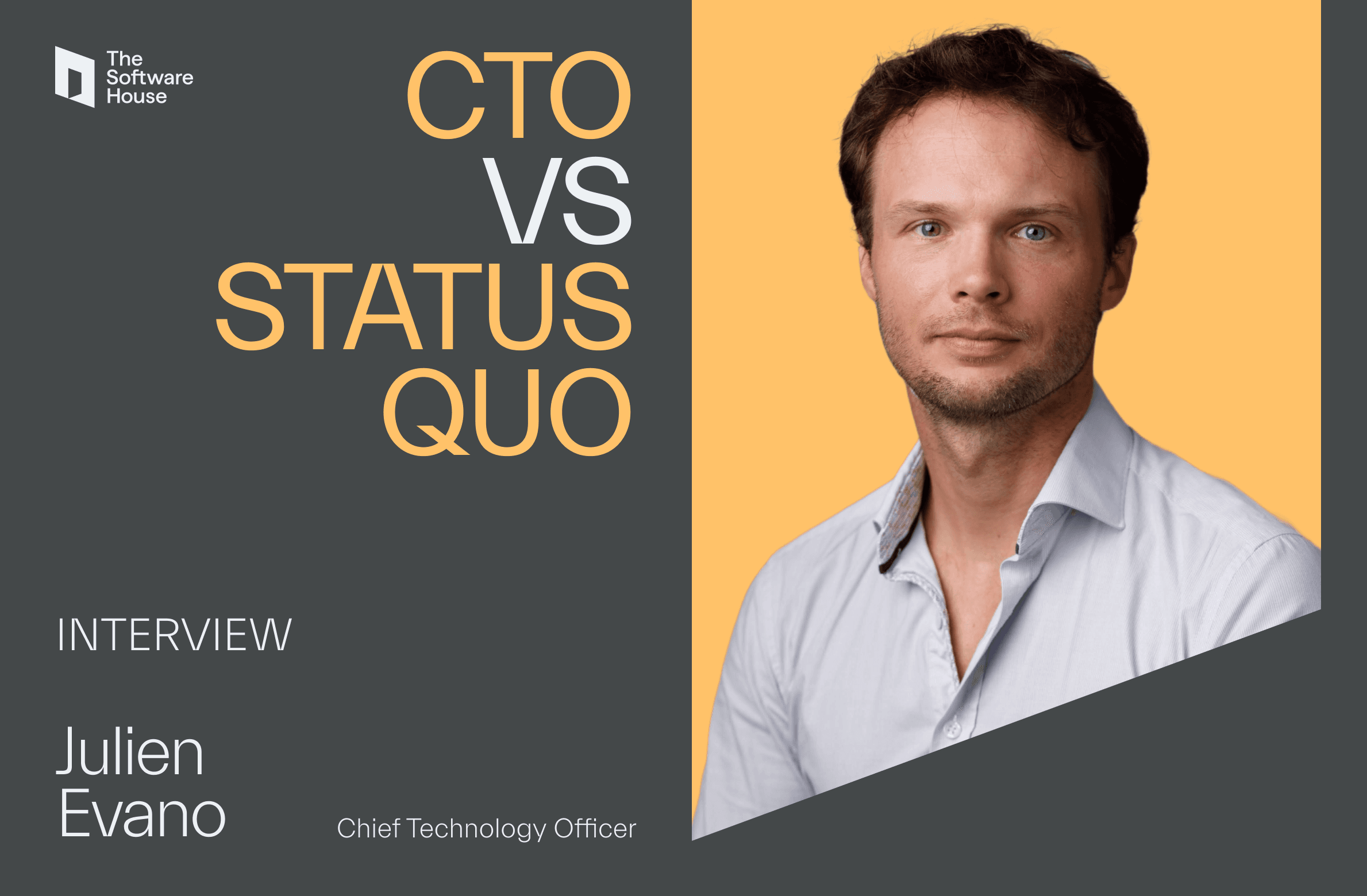

How to meet the demands of the ever-expanding role of a CTO? If you’re looking for guidance on how to enter other areas of your business without stepping on anyone else’s toes, Julien Evano is the perfect expert to learn from.
His approach is based on open communication but with clearly defined responsibilities. He also explains how to resolve inevitable cross-team conflicts.
The CTO vs Status Quo series studies how CTOs challenge the current state of affairs at their company to push it toward a new height … or to save it from doom.
“Today's CTO needs to participate in the product roadmap beyond just tech feasibility”
Today’s guest believes that neither perfect technology nor ideal product roadmap alone will grant your company success. Everything has to converge into one shared vision based on customer-centricity.
Read on to see how Julien Evano goes in-depth on how to ensure fruitful collaboration of the engineering team with the product team, as well as other departments in the business. You’ll learn:
what the role of the modern CTO of a product company looks like,
exactly how to boost your career and grow your value as a CTO,
the practices and strategies for aligning engineering with product and business,
why clearly defined responsibilities are essential.
About Julien
Engineering leader who leads, scales and motivates high-performing product and engineering teams to deliver innovative solutions and significant business outcomes. With two decades of experience ranging from start-ups to enterprises across various industries, Julien has vast knowledge about designing, building, and operating complex Web, Mobile, and Cloud solutions. User Experience design is the core of every solution he has delivered, ensuring that users receive the value they deserve.
Meet Julien
Piotr Urbas: Hi, Julien. I know that you recently reached a major funding milestone for Series B. This is great news but it probably means a lot of challenges, such as rapid scaling. How is the year for you so far? Am I right to assume that it’s quite busy?
Julien Evano: Hello, Piotr. It's been busy for the last two years to reach Series B. Now we have scaled, it’s all about the execution of our strategy.
I see. Assisting individuals with estate planning operates within the FinTech sector and the emerging field of DeathTech. What's it like to work in such an industry?
At first, the idea of joining the DeathTech industry was a bit unconventional, but after consideration, it is more than just writing wills. Estate planning and administration is mainly about FinTech and LegalTech to provide products and services that enable people to transfer their wealth as intended while protecting their legacy, family, and loved ones - covering all aspects from legal, administration, emotional, and financial.
This also extends outside just end-consumers, through partnerships. Not-for-profit organisations receive donations as part of bequests. Large enterprise-level organisations - such as retirement funds, large law firms, and more - help provide a fully comprehensive solution to our customers and extend our partners’ offering.
From silos to collaboration
The issue of scaling is quite relevant for today's topic, because the larger an organization is, the harder it may be to keep the technological and product departments aligned.
What do you think are the reasons why CTOs are increasingly interested in the product domain?
CTOs now act as strategic visionaries of the business. Our expertise is vital in designing robust, scalable, secure, and efficient product architectures, proactively addressing potential technical challenges, and implementing solutions to ensure the product's long-term viability. But we not only understand current technology trends, we also anticipate future developments by balancing innovation, managing risks and ensuring a strong return on investment. Our understanding of the Total Cost of Ownership (TCO) enables us to make informed business decisions that consider the long-term financial implications of product development and maintenance.
For instance, with the increasing importance of data protection, a CTO may implement a Zero Trust Architecture with a Security-by-Design and Privacy-by-Design first approach to protect consumers’ data, build trust with investors and partners, and create a competitive advantage.
Furthermore, the increasing importance of data in formulating business strategies elevates the CTO's role in leveraging our technical expertise to extract valuable insights from data infrastructure and analytics, leading to stronger collaborations with other C-suite executives and all department leaders.
Beyond technical expertise, CTOs play a crucial role in facilitating communication and collaboration across different departments. We act as a bridge between technical and business teams, translating complex technical concepts into understandable business terms, and ensuring that product development aligns with market demands and overall business strategies.
In the daily operations, CTOs integrate the product management and development to eliminate silos between departments, accelerate the time to market and ensure that innovation is consistently focused on customer needs and driven by data insights.
As business leaders, CTOs handle the commercial responsibility of ensuring that the company's products are not only technologically sound but also profitable and deliver substantial business value. This necessitates our active involvement in shaping the product strategy, which serves as a crucial link between the company's overarching vision and its day-to-day operations.
This increasing convergence of product and technology functions has even led to the emergence of the Chief Product and Technology Officer (CPTO), especially in highly technical products. However, when serving general consumer markets, it is essential for the organisation to have a strong dynamic between the CTO and CPO to balance expertise across both technical and product domains and set the tone for a culture of cross-collaboration and innovation across the organisation.
You said that a CTO can help break silos, but sometimes it may be easier said than done. What would be the first step for a CTO to initiate meaningful collaboration between siloed departments?
First, the most important step for CTOs is to align the product with the overall business vision to make it its core, not just a supporting tool. For that, CTOs support the teams to move away from a focus on project-specific timelines and estimates towards a more pragmatic and adaptive methodology that prioritises overarching business needs, strategic targets, and tangible outcomes.
To integrate the product and engineering functions, CTOs need to advocate for small, autonomous, cross-functional teams that take full responsibility for specific work streams, fostering collaboration and accelerating the delivery of high-quality products. Team Topologies can help to implement the concept of stream-aligned teams.
Forming cross-functional teams can sound easy, however, it’s much harder to ensure constant alignment. Adopting the Product Triad approach promotes close collaboration between the product manager, designers and engineers, all working together to deeply understand user research findings and the underlying problems that the product aims to solve. Within this framework, the entire team dedicates its efforts to achieving the product vision and delivering the maximum possible value to the end-users.
Using a shift-left approach to engage the product trio in the delivery lifecycle is also essential to foster a strong alignment between business objectives and execution, ensuring initiatives directly contribute to the company’s strategic goals. Now, product managers and designers participate in strategy in addition to scoping, design, and prioritisation - instead of business stakeholders defining the scope of work. And, product engineers participate in scoping, design and prioritisation in addition to managing project tickets and ensuring effective implementation and deployment.
Finally, implementing Agile and DevOps methodologies to adapt to market dynamics through rapid and iterative development is also crucial. For example, keeping a short cycle time with an effective continuous integration and deployment (CI/CD), a delivery cadence of four sprints of one week per milestone, and a definition of done being deployed into production, allows teams to learn, iterate and adapt quickly based on a continuous feedback loop.
As a summary, this approach creates better alignment between business objectives and technical execution. It enables cross-functional collaboration and effort focused on delivering real customer value with the end-user’s needs and experience in mind within deep domain expertise teams. Its iterative development allows for accelerating high-quality product delivery and adapting to market dynamics.
Lastly, its team empowerment also leads to increased motivation, ownership, and development.
This takes us to the idea of product-oriented development. In this series, we’ve talked at length about this. In your opinion, how does this change the role of the CTO?
CTOs need to act as servant leaders to empower and collaborate with their teams with a product-oriented mindset. Throughout my career as an engineer, lead, architect, and now CTO, my journey with product strategy has evolved from a technical focus to understanding its critical role in business success.
I was always involved in the product to some degree. However, as I took on more leadership responsibilities, I better understood the importance of the "why" behind what we were building and the necessity of involving technical leadership in the early stages of product definition. The most elegant and efficient technical solutions can fall short if they don’t align with the needs and desires of the users, markets, and company objectives.
CTOs need to make a conscious effort to gain a deeper understanding of needs and challenges beyond pure technology by learning about business strategy, management and execution. This leads to a broader perspective involving understanding product management practices and enabling the idea of product-oriented development.
The Product-Oriented Development (POD) concept prioritises delivering continuous value to end-users and business to achieve user satisfaction and business outcomes – beyond the traditional approach of a defined scope, timeline and specifications. It requires persistent stream-aligned teams owning the product for the long term, instead of temporary teams rotating through projects. Those customer-centric and value-driven teams continuously iterate based on user and stakeholder feedback, not just at the end of the project.
And these teams are goal-oriented, right?
Yes, the teams are goal-oriented and metrics-driven. They align their objectives and key results with the overall business vision, mission, and strategic goals.
And, they guide their daily decisions and actions not only by staying connected to the “why” defined by these goals but also by focusing on “what” delivers real value to users through product metrics, and “how” efficiently they bring that value to life through engineering metrics and leading indicators.
CTO as an everyday Product Partner
What’s the role of the CTO in developing the product roadmap today, especially beyond the technical advisory that used to be the focus?
Today’s CTOs play a fundamental role in shaping the product roadmap, expanding beyond just technical feasibility. We serve as a key strategic partner for the product leader by participating in the entire process, contributing to the strategic vision, identifying opportunities for innovation, and ensuring the long-term technical health of the product.
Our involvement starts with aligning the technology strategy with the overarching business goals, ensuring that technology investments directly support the strategic direction of the company. We bring a unique perspective on how emerging technologies can unlock new product features, enable innovative business models, or provide a significant competitive advantage. We are responsible for staying aware of technology advancements and proactively exploring their potential impact on the product and the market.
A key contribution of CTOs lies in designing a robust and scalable product architecture that can adapt to future growth and innovation. Our deep technical expertise allows us to foresee potential technical challenges early in the roadmap process and to propose solutions that mitigate risks and ensure the product's long-term viability.
So, you collaborate on the roadmap. However, the role of CTO is to make the final decisions, right? Take all the data, align the product with final tech feasibility and set realistic expectations?
CTOs ensure the team or the product triad makes decisions focused on customer needs and driven by data insights, not guesswork. We foster a continuous improvement culture within teams that encourages accountability and autonomy to experiment, learn, and explore new ideas that can be incorporated and quickly iterated into the product roadmap - always with a data-driven decision-making approach.
When you're discussing specific features with the product team, how do you facilitate collaborative decision-making regarding prioritization and implementation?
This comes back to the Product Triad. CTOs play a crucial role in facilitating communication and collaboration between the team and other stakeholders involved in the product roadmap, ensuring that technical considerations are effectively communicated and integrated into the overall plan.
And now this feedback loop is always bringing you back to the value, the business goals. And if it fits, you go further and gather more data, right?
Yes, CTOs' role in the product roadmap is not static. It requires continuous adaptation to market shifts, prioritizing agility and innovation, leveraging live data analysis to forecast trends, and actively engaging with customers to understand their evolving needs.
I really like this approach. Deliver fast but don’t go in blind, gather data and verify what works. It's very interesting – especially on such a short timescale. With one-week sprints, you can quickly change direction. I believe that it usually takes much longer than one week for teams to realize something doesn’t work and pivot, doesn’t it?
That’s correct, time is one aspect, but volume and dependencies are also important factors to enable learning and iteration from experimentation. For this reason, cross-collaboration across the business is crucial to coordinate initiatives.
For example, to get volume through experimentation, the team could coordinate their initiatives with the growth team to increase volume through paid marketing campaigns or affiliate programs with partners.
Maximizing impact – strategic collaboration in action
My next question is about maximizing impact. How can a CTO be involved in high-level product strategy without stepping on the toes of product leaders?
A critical aspect of CTOs’ increasing involvement in product strategy is the ability to collaborate effectively with product leaders without creating conflict. This requires a clear understanding of roles and responsibilities, a focus on shared goals, and the cultivation of a strong relationship. The foundation of a successful collaboration lies in building trust, fostering open and effective communication, and developing a shared understanding of the customers and the overall product vision.
Active listening to the perspectives of product leaders and other stakeholders is very important to create an environment where all ideas are heard and valued. In situations where disagreements arise, a proactive approach to conflict resolution is essential. This involves identifying the root cause of the conflict, requiring self-awareness and emotional intelligence to navigate disagreements constructively.
When participating in product strategy, CTOs should complement the expertise of product leaders. While product leaders focus on the "what" and "why" of the product, CTOs contribute to the "how". We focus on the overarching vision and how technology can enable it, leveraging our technical knowledge to inform strategic decisions and ensure their feasibility.
By prioritizing the shared goal of creating a successful product and maintaining open communication, CTOs can effectively contribute to product strategy without stepping on the toes of product leaders.
Can you share some stories with us of how your involvement as a CTO in the product strategy led to some really positive outcomes?
I have two stories: first, at a B2B technical product business, and second, at a B2C end-consumer business.
At a privacy-preserving technology company, I was tasked with leading the integration of an acquired business and its data collaboration platform, which served major US customers with B2B data-driven innovation. This was a critical moment requiring seamless business continuity, strategic clarity, and technical leadership.
I reformed and integrated the engineering, product, and customer success teams, ensuring cross-functional collaboration. I developed a 2-year product and technology vision and roadmap, aligned it with business priorities, and influenced senior executives to streamline strategy around customer retention and platform evolution. I made deliberate decisions on tech stack simplification, decommissioning underperforming products, and focusing resources on platform re-architecture and system enhancements.
This led to stronger business continuity, improved delivery velocity, retention of key US customers, and operational efficiencies. I optimized P&L by increasing margins, reducing infrastructure costs, lowering support effort, and focusing the business on scalable and profitable offerings.
The key learning was that successful integration and transformation require unifying teams under a clear vision, aligning technology decisions with business outcomes, and focusing ruthlessly on what drives customer value and scalable growth.
At an estate planning and administration company, the business was scaling rapidly and needed a clear technology strategy to align with ambitious business goals and support fundraising efforts. I defined a 5-year technology strategy that articulated our challenges, guiding principles, and coordinated actions to realize the company’s vision. I established a scalable platform architecture with a clear market fit and competitive differentiation.
Additionally, I structured adaptable teams inspired by Team Topologies, balancing continuous discovery and delivery, and embedded Agile and DevOps practices to create fast feedback loops and an efficient operating model. The strategy played a key role in securing successful Series A and B fundraising rounds, while enabling scalable growth, strong product-market fit, and a competitive edge.
Internally, we built a high-performing, adaptable model capable of sustaining growth and continuous improvement. The key learning was that aligning technology strategy tightly with business vision, while building adaptable teams and modern operating models, is critical to scaling a company successfully and creating a sustainable competitive advantage.
Sounds impressive, but there had to be some tough challenges along the way. What are the most common obstacles you've encountered in fostering collaboration between tech and product, and how did you overcome them?
One of the common mistakes is misunderstanding the distinct roles and interactions of CTO, CPO, and product managers. While the three roles are crucial for product success, they focus on different aspects of the product lifecycle and have distinct responsibilities.
The CTO is the technological visionary of the company, responsible for formulating the technology strategy and overseeing the product development resources and processes. They focus on the technical aspects of the product - the “how” - ensuring its feasibility, scalability, performance, and security. This involves making decisions about the technology stack, architecture, infrastructure, and development processes.
The CPO is the voice of the customer within the company, responsible for the product vision, strategy, and user needs - the “what” and “why”. They focus on conducting market research, analysing customer feedback, defining the product roadmap, and ensuring the overall success of the product in the market. They work closely with marketing, design, and engineering teams to bring the product vision to life.
The Product Managers are the bridge between the product vision and the development team. They participate in the definition and focus on the execution of the product strategy to deliver specific features and improvements outlined in the product roadmap. They work closely with the engineering teams to translate initiatives into actionable requirements and ensure that the product meets user needs and business goals.
Effective collaboration between the CTO, CPO, and product managers is crucial for merging product vision with technical feasibility and delivering innovative, user-centric solutions. While the roles are distinct, their close partnership, built on mutual respect and a shared understanding of goals, is essential for driving product success.
General advice
Given all you've said, what advice would you give to tech leaders who aren't satisfied with the state of tech-product cooperation in their organizations? What can they do to change that?
Success involves a mix of technical expertise, business acumen, product development processes, and a passion for solving customer problems.
To become more product-oriented and involved in product strategy, CTOs should focus on a deep understanding of the business context and how the product contributes to the company's overall goals. This enables us to make technology decisions that are strategically aligned and demonstrate value beyond purely technical considerations.
It’s also critical for CTOs to stay up-to-date on emerging technologies to create new product opportunities or improve existing ones. This forward-thinking approach to technology positions us as a valuable source of innovation for the product strategy.
Another important aspect is cultivating strong communication and collaboration skills for effectively working with product managers, designers, and other stakeholders. The ability to clearly articulate technical concepts and build consensus across different teams is crucial for influencing product strategy.
Learning the fundamentals of product management, including concepts like product roadmaps, user stories, and agile methodologies, provides a common language and framework for collaborating effectively with the product team. It’s also important to proactively seek opportunities to understand customer needs and pain points, whether directly or through the product team.
It provides a customer-centric perspective that ensures technology decisions are driven by real user needs and contribute to a better product experience. Building products with the customer in mind, rather than solely focusing on technical innovation, is a key principle for startup CTOs aiming for product-market fit.
Finally, fostering this culture of customer empathy within the engineering team ensures that developers understand the impact of their work on users, outside the technical domain.
Resources
Can you share some learning resources that you find valuable or use on a daily basis? Podcasts, books, social media, whatever you enjoy.
Andy Grove’s “High Output Management” was extremely valuable for me. It teaches you the foundation of scalable management methodologies and frameworks to drive execution efficiently. As a complement, John Doerr’s "Measure What Matters" provides an OKRs framework to connect initiatives to measurable business goals and drive accountability.
Richard Rumelt’s “Good Strategy, Bad Strategy” is great to help you distinguish real strategy from fluff, and define and communicate a strategy that solves actual problems for the business.
Ben Horowitz’s “The Hard Thing About Hard Things” offers guidance, based on real examples, on leading through difficult situations and building resilient product and engineering organisations.
About culture and collaboration, Reed Hastings’s “No Rules Rules” challenges the traditional controls and inspires businesses to build a high-trust and high-performance culture.
Kim Scott’s “Radical Candor” is open-minded and helps you foster a culture of direct, caring feedback that improves collaboration.
Thomas Erikson’s “Surrounded by Idiots”, while the title may be confusing, is also an excellent book that gives you simple models, based on your own personality, to adapt your communication style for better influence and alignment across diverse personalities.
In terms of product, Marty Cagan is probably #1 with "Transformed", "Empowered", "Inspired", and "Loved." Those books guide you to build empowered product teams that deliver real customer and business value, not just features.
Mellissa Perri’s "Escaping the Build Trap" is also really useful to show you how to shift your organisation from shipping outputs to delivering outcomes, aligning technology with product strategy.
Finally, for product newsletters, Lenny's newsletter is a good one to keep you updated with tactical, real-world product and growth practices. The Beautiful Mess offers nuanced insights on navigating the complex realities of scaling product development in tech organizations. Else’s Productpourri is extremely useful and curates actionable, no-nonsense product tips that help you foster better product thinking in your teams. Lastly, The Product Compass provides structured product frameworks and checklists that help you and your teams stay aligned and focused on impactful delivery.
What’s next? 5 strategies to foster healthy and successful collaboration between technology and product
Julien recommends these strategies to break down the silos and work together towards a common goal:
Become a strategic partner for the product leader, and facilitate cross-functional communication and collaboration using active listening and resolving conflicts using emotional intelligence.
Strive to converge technology and product into one, shared vision, don’t let technology or product get carried away with their own ideas.
Adopt a value-driven, customer-centric approach, and open yourself up to areas outside of technology, including the needs of the business and other departments within it.
Prioritize alignment of the tech strategy to business goals, and then design a scalable and adaptable architecture with capabilities that will unlock the development of new product features.
Build persistent, cross-functional teams that work long-term on specific business outcomes.
As you can see, aligning technology and product is as much about engineering excellence as it is about emotional intelligence!
Author Disclaimer
The views expressed in this article are solely those of the author in a personal capacity and do not reflect the views, policies, or positions of their current or past employers. The content does not disclose or reference any confidential or proprietary information.
Authors
Piotr Urbas
Software business developer with 5 years of experience working with startups and scale-ups, in particular those from the U.S. A product development enthusiast with a keen interest in product delivery. Passionate about sports.