
What is the secret to establishing efficient cooperation between teams from Saudi Arabia and Europe?
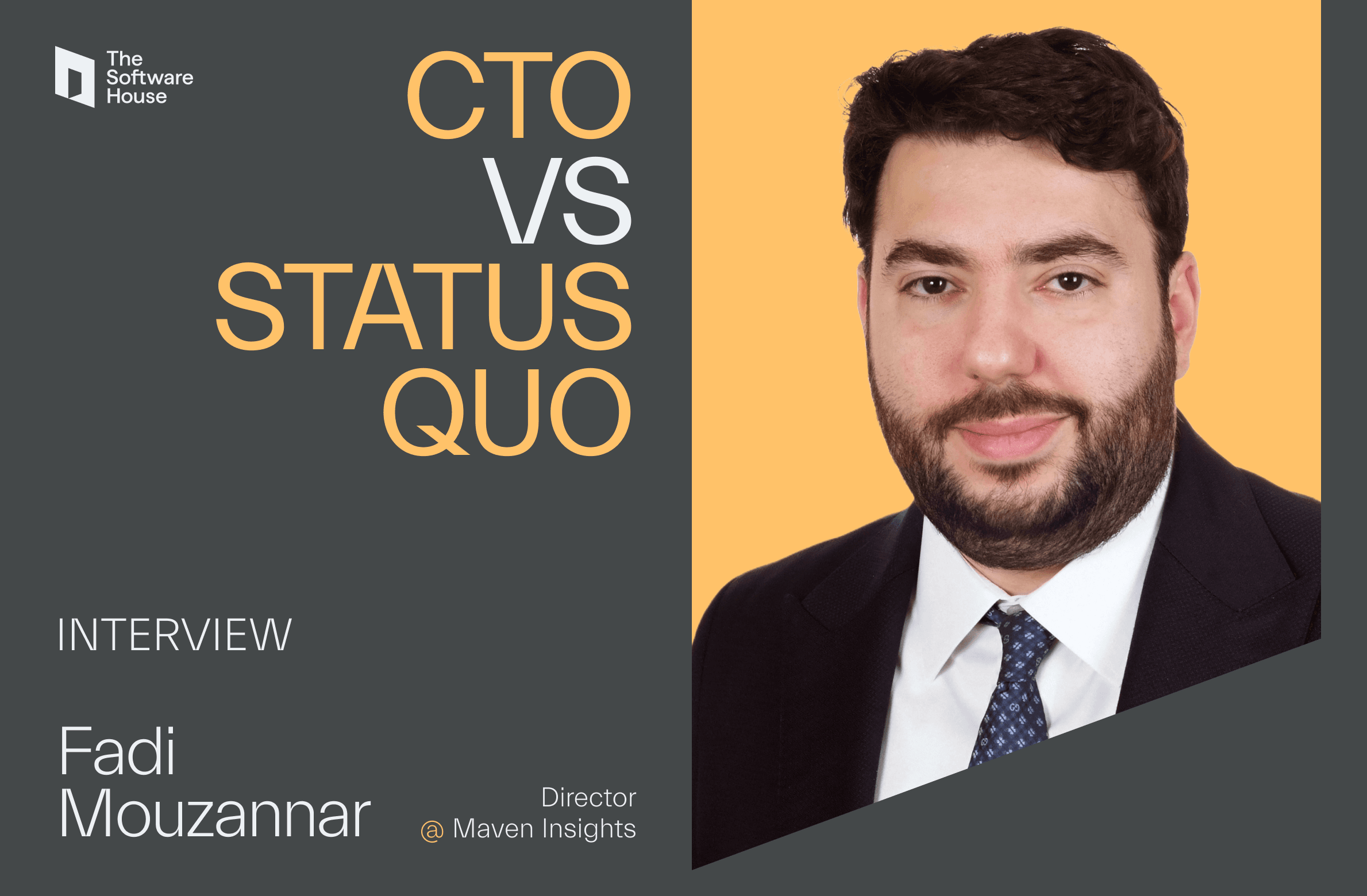
Fadi Mouzannar, Director at Maven Insights, has developed a suite of strategies to ensure success during his collaboration with The Software House.
He believes that it’s not enough to choose the right company. You also need to adapt an approach based on open dialogue and view cultural differences as advantages, not obstacles.
The CTO vs Status Quo series studies how tech leaders challenge the current state of affairs at their company to push it toward a new height … or to save it from doom.
“It’s good to have an open dialogue”
Service providers in KSA constantly compete to outrank each other in the Digital Experience Maturity Index (DXMI). This has created a powerful incentive to offer an increasingly better customer experience, and working with a European development partner can be an effective way to do just that. In this interview, based on Maven Insight’s collaboration with The Software House and his own experiences, Fadi Mouzannar:
explains the challenges that Saudi Arabian service providers are facing and how to solve them,
clarifies the benefits of working with European development partners,
outlines the critical steps required to maximize value and knowledge transfer from such collaborations.
About Fadi
Currently Director at Maven Insights, Fadi is a seasoned leader with a particular interest in Customer and Destination Experience. With a background in product development, he excels in aligning business and technology strategies to effectively plan and execute projects across the entire product lifecycle. His experience spans both the private and public sectors, where he has consistently delivered successful outcomes.
Say hello to Fadi
Prem Markowski: Hello Fadi. How are you doing? I saw that your Riyadh team has recently gathered together for an Iftar dinner. Given how family-centric the Saudi Arabian culture is, am I right to assume that it’s not the first time?
Fadi Mouzannar: Hi Prem, I’m doing well, thank you! You’re absolutely right! We make it a priority to organize monthly activities to maintain a work-life balance. Whether it's iftars, marathons, or something fun like laser tag, we strive to offer a variety of experiences. Our goal is always to ensure that our consultants have the best possible employee experience. Even though we’ve grown to over 100 employees, we continue to prioritize that close-knit, family-oriented approach.
That’s great, I think all companies should do this. On the professional front, I know that you have a deep interest in Customer Experience. A Product Management Consultant from Riyadh recently told us that success in the Saudi market is impossible without a focus on UX. Do you think the same applies to Customer Experience?
Absolutely, it’s critical, especially with the significant changes happening in Saudi Arabia right now. At Maven Insights, we place a strong emphasis on place experience, which is essentially the customer experience at tourist destinations. As Saudi Arabia positions itself as a global tourism leader, one of its key goals is to deliver a unique and memorable experience. This journey begins the moment people arrive, continues through the places they explore, and encompasses every sensation they encounter along the way.
Foundation
Our main topic is cooperation between Saudi organizations and European IT companies. In your opinion, what are the key benefits that Saudi businesses can expect from partnering with European software development companies?
Saudi Arabia is becoming more multicultural, and working with European companies exposes us to different perspectives and ways of working. Even if European companies don't always operate the way we do, they challenge us to learn new ways of approaching problems and structuring work so that we can collaborate successfully.
I know what you mean. When we were merging our team with one in Saudi Arabia, we talked a lot about how to transfer knowledge, know-how and cultural backgrounds effectively – both us learning from the KSA team and vice versa. When is the right time for Saudi business owners to partner with a European software development company?
Partnering with a European software development company can be valuable at any stage, whether you're launching a new project or looking to scale an existing one. What truly matters is finding a partner with the specific expertise your business needs.
In the early stages, Saudi teams can benefit from the highly structured approach of European companies. These partners bring tried-and-tested best practices, tools, and processes for building and organizing teams. This support is especially valuable at the beginning and helps lay a solid foundation for future success.
Then, as your company matures or if you hit a dead end, European companies can help you start a new chapter – we often see that in customer experience. When your metrics are strong and your customers are satisfied, it’s easy to think you can relax.
However, customers quickly adapt to the current level of experience you offer, so rather than relaxing, it's essential to keep innovating and introducing fresh ideas. This is something that European companies excel at.
Partner Selection
What are the main factors to consider when evaluating European partners?
Partnering with a development company is a long-term collaboration – it’s not just about a one-off project. Restarting with a new partner can be costly and disruptive, so it’s crucial to choose the right one from the beginning. At Maven Insights, we focus on five key criteria when evaluating potential partners:
Number one is familiarity with the Saudi market. While international experience is valuable, a deep understanding of the Saudi market and experience working with local companies are more important.
Number two is alignment on the technology stack. This is an obvious factor that cannot be overlooked.
Number three is documented expertise in User Experience.
Many European companies offer solid development and price-to-value ratios, but UX experts are harder to find. In Saudi Arabia, providing a unique User Experience is critical – with many competing service providers and platforms that rank performance. It’s important to find a partner that can elevate your UX.
Number four is the leadership team. Are the leaders creative? Are they capable of driving projects within your problem domain to success?
Finally, number five is financial sustainability. This is essential for a long-standing relationship. Challenges are inevitable, and you need a partner with the financial stability to weather tough times and remain committed throughout.
You’ve been working with The Software House so I can’t help but ask – how did our company do on your key evaluation metrics?
I wasn’t there for the entire process, but you [The Software House] met all five of our key metrics. Our representatives visited your offices and were really impressed with your team and capabilities.
Also, you keep growing, especially in terms of User Experience. We’ve worked a lot on that together from the beginning, and I’ve noticed a clear improvement recently. It's been great to see all the innovative ideas you're bringing forward.
The Digital Experience Maturity Index (DXMI) is a big thing in Saudi Arabia at the moment. How important is the European partner’s ability to improve the DXMI score as a factor for digital government platforms and their services?
With numerous service providers in Saudi Arabia, all are competing in terms of digitalization and delivering unique, seamless experiences. The government’s DXMI initiative is great because it helps uplift those capabilities. It rewards those who excel in this area and pushes the laggards to improve.
For many of our clients, improving their DXMI rank is a top priority. It’s a universal ranking across the country – everyone knows your score and is working to surpass it. That’s why you have to continuously keep improving, even if you believe you’re already leading. Partnering with European companies that have UX expertise can make a significant difference in this area.
When it comes to public institutions in Saudi Arabia that need to be DGA-compliant, how can they verify a European partner’s ability to boost their score?
The partner needs to understand the DXMI standards and the specific criteria that must be improved to increase the score.
Ultimately, it all comes down to the type of projects the partner has delivered. You want a team with relevant experience – one that already has a framework to evaluate your DXMI level and a clear understanding of the roadmap needed to take you further.
Cooperation
Once you’ve chosen a European development partner, how do you define a clear product vision and ensure alignment with them?
The discovery phase is crucial. It often gets rushed in an effort to start the project as soon as possible, but it's important to allocate sufficient time to it.
Hold workshops with your European partners and, if possible, visit each other’s headquarters. In-person collaboration is always beneficial, so it's important to find a partner who's willing to invest their time in meeting your team, co-creating the product vision, and working side by side to bring it to life.
One aspect I appreciated when working with The Software House was how often we repeated these brainstorm sessions. Every three months, we would revamp and reshape our direction and vision. It’s a great way to ensure we're continuously moving towards the right targets.
But not everything is always perfect – what are the common pitfalls to avoid when communicating technical specifications to the European partner?
One common challenge we used to encounter was companies saying, “We’re not sure yet.” Their technical specifications would often lack details, and they wouldn’t be able to clearly define their needs or scope. This can lead to miscommunication in terms of scope, priorities, and the type of expertise the European partner needs to successfully meet project goals.
It’s important to maintain an open dialogue. Even when you can’t answer all of the partner’s questions, give them acceptable ranges or high-level goals to make sure you’re setting the right direction.
Speaking of dialogue, how can a Saudi Arabian team effectively communicate requirements to a European software development partner on a day-to-day basis?
It starts with choosing a partner that knows exactly how to set things up early on. They'll help you organize the right tools to improve communication and transparency, as well as keep track of the tasks you're working on.
For example, while people rely on emails and WhatsApp, Slack provides a more effective communication channel. Features like channels, mentions, and information storage make a significant difference. Then there’s Jira, the bedrock of any development project. It’s a must-have.
When it comes to brainstorming – especially when the partner isn’t on-site – Miro can be very helpful in creating a whiteboard for coming up with ideas. In my view, these are the most critical tools. European companies rely heavily on them and can teach you all the features and best practices to maximize their value.
Cultural differences
What are the common challenges encountered in cross-cultural software development partnerships, and how should you address them?
The difference in weekends is one of the most common challenges we face. Your weekend is Saturday and Sunday, while ours is Friday and Saturday. This creates a gap, which some might see as losing a day each week – but we came to relish those days.
I liked having Sundays when no developers were there to ask questions or follow up. I could dedicate them to all the non-development work and really focus. Likewise, your team had Fridays to concentrate on development without interruptions. It’s a win-win.
I agree, using Fridays for deep work and to prepare everything for the next week, set meetings with the Saudi team, it helps me perform better. So, it's all about the right perspective, right? It can either be a benefit or a challenge, depending on how you’re able to adapt to this four-day overlap.
I completely agree. While it’s a bit challenging at first, it eventually becomes something you look forward to. "It’s Sunday, the European team isn’t available, so I can focus solely on my other responsibilities." Similarly, for them, "It’s Friday, I can put on my headphones and dive into deep work all day."
What else can Saudi and European teams do to synergize and create a collaborative environment?
The tools I mentioned are critical, as they help bridge the gap between both regions. The time zone difference isn’t significant, so it doesn't create major challenges.
From time to time, put in the effort to actually visit each other or have one-on-ones in person. This helps maintain alignment and ensures everyone stays on the same page. Spending time together on-site is essential for fostering a strong collaborative environment.
Knowledge transfer & sustainability
How can Saudi businesses effectively use the know-how gained from these partnerships to expand their own internal capabilities?
After working with a European partner for a while, the collaboration becomes second nature. You begin to regularly exchange ideas and approaches to work, which is incredibly valuable for the Saudi company. Over time, this naturally influences how you tackle challenges and manage your day-to-day operations.
Try to spread the knowledge you’ve gained. Our approach is based on a “train the trainer” model – we learn from you, then pass that knowledge on to our local team.
Resources
What resources would you recommend to those who want to learn more about Saudi-European IT partnerships, customer experience, or product development in general?
It might sound a bit cliché, but I would recommend starting with "The Design of Everyday Things" by Don Norman. It’s a great book to go over, as Don is a pioneer in User Experience and Customer Experience.
When it comes to events, the E3 Customer Experience event in Riyadh is excellent; we attended it in 2024. It brings together many companies offering cutting-edge technologies focused on innovative Customer Experience. In addition, major events like LEAP and GITEX attract large crowds and global attention, but smaller, more targeted events can be just as valuable for meaningful conversations and networking.
Ultimately, meeting new people and exchanging ideas and experiences are some of the most powerful ways to learn.
What’s next? 5 strategies to ensure a successful Saudi-European collaboration
Fadi recommends these strategies to get the most value from partnering with European software development companies:
Evaluate European partners thoroughly
– Fadi recommends five metrics: familiarity with the Saudi Arabian market, tech stack alignment, documented expertise in User Experience, leadership track record, and financial sustainability.
Prepare detailed technical specifications
– even if you’re not sure of all the details, have an open dialogue and provide acceptable ranges and high-level scope to ensure alignment and avoid miscommunication.
Don’t rush the discovery phase
– give it time to properly kick-off the project, do workshops with your European partner, visit each other’s headquarters to collaborate in-person and build a strong product vision together.
Use cultural differences to your benefit
– for example, the difference in weekends can be an advantage, because both teams get one day to focus 100% on their work without interruptions.
Apply the “train the trainer” approach
– ensure effective and lasting knowledge transfer by learning best practices from European partners, and then passing them on to local teams.
Working with the right European IT partner can benefit you in many ways, just make sure that you choose the right company and give them all they need to succeed.
Authors

Prem Markowski
Experienced IT Business Leader helping Saudi businesses grow through the right technology approach. Passionate about building win-win partnerships and driving growth with scalable software solutions and expert engineering teams. Golf enthusiast who likes the sport’s strategy and discipline - golden values both on the course and in business.