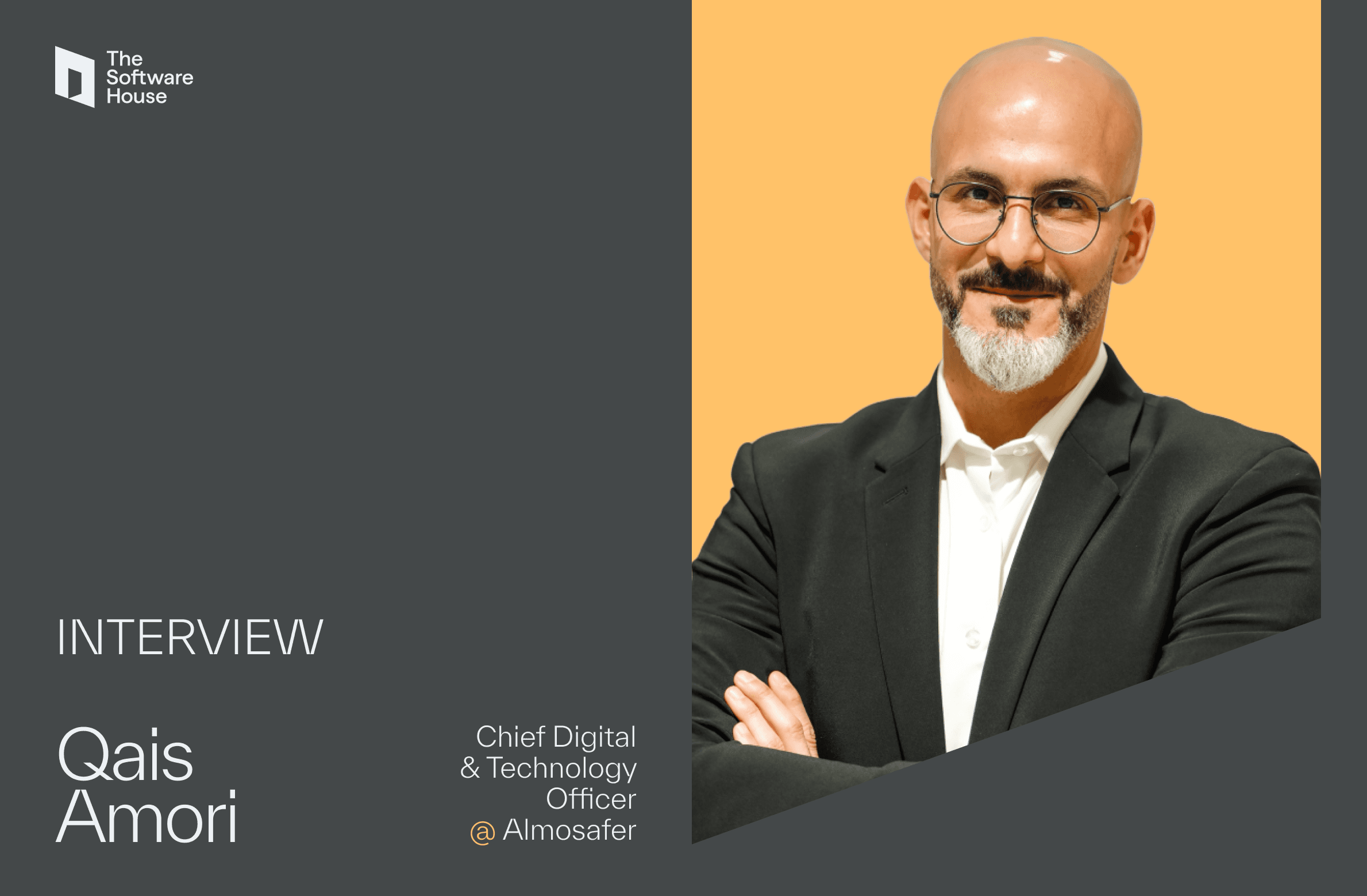

With AI powering everything from customer service to code, and mobile-first design driving over 70% of bookings, Almosafer (part of Seera Group) is redefining travel tech in Saudi Arabia.
At the heart of it is an Arabic-first platform, built around local culture and user needs. Qais Amori, Chief Digital & Technology Officer, shares how the company puts the traveler first while supporting the Kingdom’s bold Vision 2030 push to become a global tourism powerhouse.
The Voices of Vision 2030 series highlights how Saudi tech leaders break away from the status quo to drive innovation, unlock growth, and help realize the Kingdom’s vision for a thriving digital future.
Navigating technological transformation in the Saudi Arabian travel Industry with AI at the core
At Almosafer, AI isn’t an add-on; it drives personalized hotel picks to automated customer service, from faster code delivery to smarter decision-making. AI is built into every platform layer. Qais Amori, Chief Digital & Technology Officer at Almosafer, explains how deep AI adoption powers Saudi Arabia’s next-gen travel infrastructure under Vision 2030.
In this interview, Qais:
breaks down how AI boosts engineering, marketing, and customer support,
explains why local-first platforms have higher-converting travel experiences and outperform global templates,
reflects on what it takes to lead digital transformation under Vision 2030 without chasing trends or losing focus.
About Qais
Qais & Almosafer
In the past year, your official position at Almosafer changed from CTO to Chief Digital & Technology Officer. What impact did it have on your responsibilities?
Qais Amori: I wouldn’t call it a change as much as an evolution. Even as CTO, I was deeply involved in product and worked hand-in-hand with our Chief Product Officer to build the digital department. When he moved on about a year and a half ago, I stepped into that space, so my scope naturally expanded.
It meant going beyond architecture and engineering. I started working more closely with business and commercial teams, aligning our digital strategy with business objectives. I also became even more focused on understanding customer needs because, at Almosafer, we’re a customer-obsessed, product-led organization.
I always start with the problem: What issue is our customer or business team facing, and how can we solve it digitally?
So, in short, becoming Chief Digital & Technology Officer didn’t flip everything overnight. It just deepened and broadened my involvement across the board.
Almosafer’s vision and… Vision 2030
Saudi Arabia’s Vision 2030 goal is to generate 1.6 million tourism-related jobs by that year. How do you see Saudi Arabia’s ambitions for digital tourism impacting the future of travel platforms like Almosafer?
Qais Amori: Vision 2030 is one of the most ambitious national transformations ever. As someone living in the region, I feel incredibly proud and humbled to play even a small role in supporting it alongside other leaders and companies in the Kingdom.
Tourism is positioned as a key economic pillar of the country, and technology is at the center of that shift.
At Almosafer, we have a unique advantage: a technology company specializing in travel. Being based in the region gives us a deep understanding of national objectives, and we’re building digital platforms that align directly with those goals.
We work closely with the Saudi government to support inbound tourism and promote the Kingdom’s cultural experiences. Real-time traveler insights and data-informed decision-making drive this, which helps us scale quickly, stay relevant, and contribute meaningfully to Vision 2030 and our business growth.
Almosafer is doing splendidly right now. With its momentum and growing role in the Middle East’s digital ecosystem, how do you ensure the company continues leading in a highly competitive market?
Qais Amori: “Continues” is the key word here. At Almosafer, we consider it a continuous journey.
No company grows in a perfect straight line. There are always ups and downs. What matters is keeping the overall trajectory moving upward. Hit one milestone and immediately start aiming for the next.
A big part of staying competitive is culture. In a fast-moving market like Saudi Arabia, you need real agility. Not just the ceremonies of agile, but true adaptability. That means quickly understanding customer needs and responding with smart, practical solutions. COVID made that lesson very clear.
Localization is another critical factor. Every digital touchpoint, language, UX, payment method, and content is tailored for our markets.
We constantly invest in emerging technologies like AI, machine learning, and automation to stay ahead. In this space, if you fall behind for even six months, you risk becoming irrelevant.
Finally, our strategic partnerships across aviation, hospitality, local or global tourism boards and global tech providers give us a unique edge.
Together, these elements help us maintain our position and lead with purpose.
Trends reshaping the Middle East travel experience
What are some of the most significant technological changes you’ve seen in the regional travel tech space over the past few years?
Qais Amori: The elephant in the room (and the most significant shift by far) is AI.
AI has impacted travel tech in two ways:
Reshaping customer behavior. Travelers no longer go to search engines and click around for hours. They expect personalized, fast, intelligent responses, whether they’re booking a hotel or looking for travel inspiration. That shift forces platforms like Almosafer to rethink how we deliver content and build digital experiences.
Transforming how we build and operate internally. I’ll give you some examples.
We’ve embedded coding AI tools across our engineering teams.
AI-assisted coding tools improved developer performance up to 15%. This gives our engineers more time to focus on what truly matters – delivering value to the customers.
Beyond that, we’ve introduced AI co-pilot tools to support employees across the company. Need an answer to a common internal question? You don’t have to wait for someone, just ask our internal AI assistant. Our content and marketing teams use AI to move faster and deliver more targeted campaigns.
Another case is our agent co-pilot. It helps the customer support department give smarter, faster answers to travelers, dramatically impacting customer satisfaction and retention.
In short, AI isn’t just a trend. It’s driving a fundamental change in how we work and what travelers expect. And you should build for both.
Considering those AI additions, how does Almosafer use the data to meet the expectations of today’s Saudi travelers, who increasingly expect seamless and hyper-personalized experiences?
Qais Amori: As mentioned earlier, Almosafer is a customer-first organization, meaning we think about the customer across every touchpoint. That’s where AI and data help us deliver the personalized experience that today’s Saudi travelers expect while making our platform more intelligent with every interaction.
Take our hotel booking experience: A Saudi traveler is booking a hotel in Warsaw. They don’t want to scroll through hundreds of global reviews. They want to see what other Saudis are saying. So, we’ve trained our AI models to automatically categorize and summarize reviews, making it easy for travelers to find what’s relevant and relatable.
We also use AI to personalize recommendations based on user behavior, preferences, and intent.
It’s not about offering what’s popular but what’s right for each traveler.
In a region where mobile usage leads the way, how does that shape your roadmap?
Qais Amori: Mobile-first isn’t just a trend for us; it’s a reality. More than 60–70% of our traffic and bookings come through our mobile platforms. That tells you how deeply mobile has penetrated daily life here in the Kingdom, and I only see that continuing to grow.
That matches what I’ve seen, too. Two things are essential when building digital products for the Saudi market: localization and mobile-first design. You simply can’t win here without getting both right.
Qais Amori: Small comment on localization. It is a term used when you want to have a product, for example, in English, and localize it to a given market.
At Almosafer, we don’t just localize after the fact. We’re Arabic-first. That’s a big difference.
Many global platforms are built in English and then translated later. For us, Arabic isn’t an add-on but where we start. That impacts everything, from interface design to the user journey.
That approach matters when introducing technologies like voice recognition or predictive interfaces. These tools only create value if they feel natural and intuitive to the user. Cultural relevance and accessibility are non-negotiables.
So yes, those technologies are on our roadmap, but we don’t rush to deploy them just because they’re trendy. We want to make sure they enhance the experience for our users. If it doesn’t meaningfully improve personalization or convenience, it doesn’t belong in the product yet.
Given the fast pace of tech development and government-backed innovation, how do you specifically assess which technologies to invest in for the Middle East market?
Qais Amori: The key is to avoid building technology for the sake of technology. It’s easy to get caught up in hype cycles and adopt AI or other emerging solutions just because they’re trending. But it won’t create lasting value unless that technology solves a real customer or business problem.
At Almosafer, we always start by identifying and prioritizing the problems we need to solve. We rely on data, a deep market understanding, and close customer relationships to guide those decisions. Once we’re clear on the problem, we look for the right technology to address it effectively.
This approach helps us stay focused and grounded. We’re not just chasing innovation. We’re using it to impact our users and the business meaningfully. That’s how we assess what to invest in, and it’s especially important in a fast-moving, government-supported tech environment like the one we’re operating in across the Middle East.
Building and scaling tech for travel
What are the biggest technical or operational hurdles when building an innovative travel platform tailored for local and regional customers?
Qais Amori: The travel industry is fundamentally operational, creating unique challenges. At Almosafer, we provide the platform that enables travelers to book flights, hotels, and experiences, but we don’t own the delivery of those services.
From a technical standpoint, one of our biggest challenges is integration. Almosafer connects to over 35 global suppliers through our proprietary hotel connectivity platform, Enigma. It aggregates inventory from various partners, introducing a major hurdle: mapping. Suppose we receive different data about the same hotel from multiple suppliers. In that case, we must consistently display the hotel and its rooms to the user. We’ve significantly invested in solving this through advanced hotel and room mapping technology.
On the airline side, we face another challenge: legacy systems. Global distribution systems still power much of the airline industry, and while they’re evolving, they often limit what we can do in terms of innovation. You can’t fully inject cutting-edge features like AI personalization if the systems you’re integrating with don’t support it.
Travelers’ needs evolve rapidly, and we’re expected to respond just as fast. We’ve seen this during events like COVID and other regional disruptions. Our ability to adapt quickly as a tech organization is essential for resilience and continuity.
Finally, talent. Travel tech is still a developing space in the region, and it’s not easy to find engineers and product professionals with domain expertise. Building and retaining top talent (especially those who understand technology and the complexities of the travel industry) is a critical and ongoing challenge.
Speaking of talent, how do you approach attracting, developing, and retaining tech experts as the Saudi tech ecosystem matures?
Qais Amori: If you want to make a team of missionaries, not mercenaries, you need full ownership and deep commitment from the people building your platform.
It all starts with culture. Not just warm greetings and team-building activities, but a system-wide environment where people can grow, contribute meaningfully, and understand how their work connects to the larger purpose. It should be embedded across the entire organization. I credit my former colleague, Ronnie, our Chief Product Officer when I was CTO. We worked closely to set shared values that shaped how our teams operate.
Culture doesn’t come from policies; it starts with leadership and how you show up daily.
Hiring is also critical. You need a strong, deliberate process to search for the right people, identify potential, and invest in coaching and development. Building a high-performing team in this region, especially in travel tech, means growing that talent internally over time.
And what helps us retain them? Alignment. Each product team at Almosafer (like our flight or hotel teams) includes product managers, designers, and engineers working side by side. Everyone in that team moves in the same direction and feels ownership of the product they’re building, not just their individual role. That eliminates the all-too-common friction between product and engineering.
Innovation the Saudi way
What does tech innovation and experimentation look like in a large organization with so many responsibilities and much at stake at any given moment?
Qais Amori: Honestly, I can’t count how many experiments our teams run daily. It’s how we make decisions, evolve our products, and improve customer experience. However, there are a few non-negotiables to make experimentation work at scale, especially in a business as complex and fast-moving as travel.
You need the right people. You can’t empower teams that aren’t competent, so you have to start by hiring strong product managers, designers, and engineers with a curious, problem-solving mindset. We’re not looking for project managers to execute fixed plans but product thinkers who explore, test, and learn.
Give your team problems, not solutions. Let them define the best way to solve what matters most.
Equip them with the right tools and architecture to experiment effectively.
That said, I want to be clear: this isn’t idealism. In theory, every team would work this way 100% of the time. But in reality, we operate in a dynamic business. Urgent requests come in. Top-down decisions need to be executed. That’s normal.
The goal is to build a culture, not a system, in which teams are focused on customer interviews, testing, and solving real problems at least 70% of the time. When that’s your baseline, you still move fast, but you do it in a way grounded in customer insight and long-term value.
Is convincing other stakeholders to try new things difficult, especially when everything seems to be going well?
Qais Amori: We don’t think of them as “stakeholders” in the traditional sense, but “partners”. Take our VP of Consumer Travel, for example. Yes, he leads the business side, but he’s also a key digital team member. We’re not operating in silos. He’s deeply involved in shaping what we do, and we move forward together.
One of the biggest mistakes product-led organizations make is creating artificial divides: here’s the product team, here’s the business team, and they talk through formal handoffs or protocols. That approach slows things down and builds barriers.
To experiment and drive innovation, you must bring the business side in from the very start and make them feel ownership. Yes, they’ll challenge ideas sometimes. Yes, they might step in and shift priorities when the business requires it. But when there’s mutual trust and alignment, those conversations become productive.
What practical steps do you take to ensure your teams stay ahead of global and regional travel tech trends while staying grounded in local user needs?
Qais Amori: Never adopt blindly, but stay closely attuned to global travel tech trends, from how customers search and book to how emerging technologies shape expectations. The key is to assess what truly fits our business and our market and adapt accordingly. “Think global, act local” mindset guides everything we do.
Acting locally doesn’t mean reducing the experience. You’re not compromising; you’re attuning the experience to meet your users’ real needs.
Take something as fundamental as the calendar. In Saudi Arabia, the Islamic Hijri calendar is widely used, not just for religious events but also for everyday planning. Most global travel platforms default to the Gregorian calendar. At Almosafer, Hijri is the default for Saudi users. If they prefer to switch to Gregorian, they can. However, most global players don’t offer a starting point for cultural alignment. It’s a small feature with a big impact because it reflects deep local understanding.
This approach also applies to how we handle domestic versus international travel. We recognize that a Saudi traveler booking within the Kingdom behaves differently than when booking a trip abroad: the priorities shift with family preferences, convenience, cost, or cultural familiarity.
As Saudi Arabia transforms into a major tourism hub, both inbound and domestic travel behaviors are evolving fast. As that shift continues, we ensure we’re not just reacting—we’re anticipating, experimenting, and adapting. That’s how we stay ahead while staying relevant.
As a technology leader in a Saudi company, what values or leadership principles guide your approach to digital transformation?
Qais Amori: One of the biggest misconceptions about digital transformation is treating it like a project with a clear start and finish.
Digital transformation is a journey, not something you check off in nine months and move on from. I’ve learned that means shifting how the entire company thinks about solving problems and achieving business goals.
It’s not just about tech or moving from a feature factory to a product-led organization, though that’s part of it. It’s about reshaping culture, mindset, and decision-making across the board.
That’s why alignment at the leadership level is critical. Everyone on the board must be brought in. You can’t drive sustainable change without that shared commitment anchored in strategic objectives that matter to the business.
We’ve gone through this evolution ourselves. We come from a traditional brick-and-mortar business under the Seera Group umbrella. Over time, we’ve rebuilt ourselves into a digital-first travel platform. But even now, we don’t say, “we’re done.” The way we operated in 2016 is different from 2020, and 2025 looks nothing like that either. By 2030, it’ll evolve again. That’s the nature of this journey.
If I had to summarize the leadership values that guide me:
Build a strong, empowered culture
Set clear, meaningful strategic objectives
Think long-term and accept the ups and downs
Treat transformation as a continuous evolution, not a milestone
You’re on the right path as long as your overall trajectory is moving forward.
General advice
Given everything we’ve discussed, what advice would you give to Saudi leaders who want to use the latest technological trends to outperform their competitors?
Qais Amori: First and foremost, stay close to your customers. Don’t build products in isolation or based on assumptions. Whether you’re creating for travelers in Saudi Arabia, the UAE, or Bahrain, you must constantly talk with them. Don’t limit those conversations to leadership or product teams; bring your engineers into the process. When they hear customer needs firsthand, they often come up with the most creative and technically sound ideas.
Second, you can’t build agile teams without agile architecture. It’s tempting to delay thinking about scalability until later, but that can come back to haunt you. You don’t have to start with a fully-fledged microservices setup, but you need to build with flexibility in mind, brick by brick, with a clear direction. A fragile foundation will limit your ability to respond quickly, no matter how talented your team is.
And finally, as a leader, you must have a cross-functional mindset. Today’s travel tech leaders can’t afford to operate in a silo. You must understand engineering, business, HR, product, and design. That drives transformation across the organization, not just within your own vertical.
Don’t chase trends for the sake of it. Ground innovation in real customer needs, build a foundation that can adapt and lead with a broad, collaborative vision.
Resources
Can you recommend learning resources for executives who want to know more?
Qais Amori: Absolutely. There are three books I always recommend to anyone serious about product leadership and digital transformation. They’re all written by Marty Cagan, one of the most influential voices in the product world. If these resonate with your leadership style, you’ll see your own beliefs reflected in them:
“Inspired”
– A must-read for product managers. It teaches you how to think in a truly product-led way, talk to customers, and build the kind of products people love.
“Empowered”
– Geared more toward product leaders and executives. It focuses on how to structure, lead, and empower high-performing product teams.
“Transformed”
– Relevant for organizations going through digital transformation. It lays out how to drive deep, structural change, not just in technology but in how the company operates. In fact, Almosafer is featured as a case study in “Transformed”, so we’ve gone through this journey ourselves.
On the tech side, I’ll say this: no single book will keep you updated. Technology is evolving faster than ever. You must commit to continuous learning, reading, following updates, and staying close to what’s happening in the global tech ecosystem every week, not once a quarter. It can sometimes be overwhelming, but it’s part of the job now.
Overall, the more you stay curious, the more prepared you’ll be.
What’s next? 4 ways to build world-class travel tech under Vision 2030
From aligning with Vision 2030 to embedding AI across teams, Qais Amori explains how Almosafer builds for change, not just scale.
Make AI everyone’s advantage
AI at Almosafer isn’t siloed. Whether writing code, crafting campaigns, or answering travelers, AI is embedded across daily workflows to drive efficiency, insight, and better customer experiences.
Design Arabic-first, not just localized
Global platforms translate after the fact. Almosafer starts in Arabic, design, language, and UX, creating experiences that feel intuitive, local, and more relevant to Saudi travelers.
Turn teams into problem-solvers
Teams at Almosafer own problems and test solutions daily, using real customer insight to guide what gets built and improved. That’s how experimentation creates real business value.
Lead with Vision, evolve with purpose
For Qais, Vision 2030 is more than a national plan; it’s a leadership mindset. Transformation isn’t a project to complete but a shift in how teams think, solve problems, and stay aligned.
Authors

Prem Markowski
Experienced IT Business Leader helping Saudi businesses grow through the right technology approach. Passionate about building win-win partnerships and driving growth with scalable software solutions and expert engineering teams. Golf enthusiast who likes the sport’s strategy and discipline - golden values both on the course and in business.

Aleksandra Dąbrowska
A copywriter who believes that with a little bit of creativity and humour IT doesn't have to be boring. Addicted to Spotify, music festivals and discovering new bands. She likes low-cost travels, but her favourite destination is the armchair where she reads books and binge-watches shows with clever storytelling.