
With Saudi Arabian restaurants facing growing demand from local customers and millions of new visitors, the digitalization of services has never mattered more.
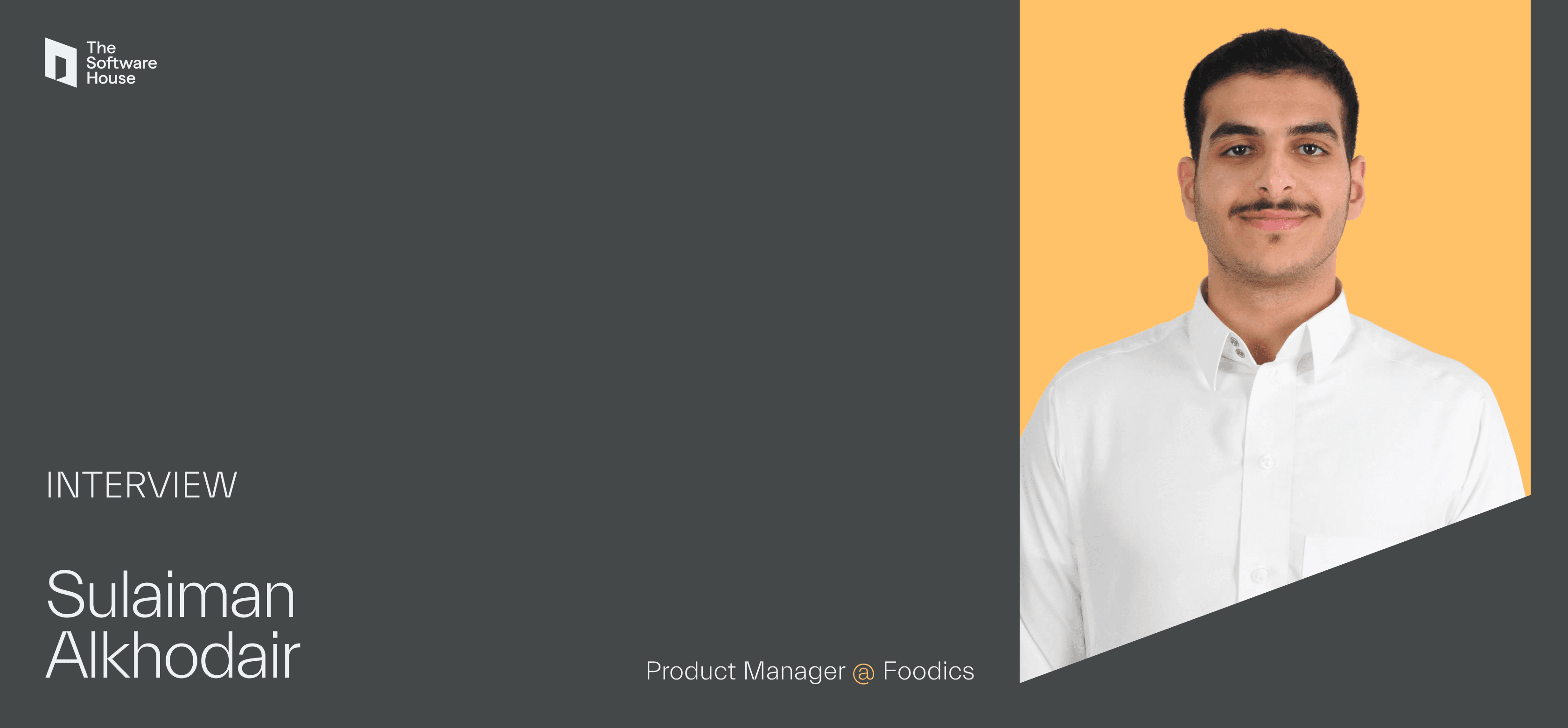
“Empathy is our most powerful technology”, says Product Manager Sulaiman Alkhodair. In this interview, he shares how continuous feedback loops, real-world user insight, designing with empathy and data, and investing in AI-driven personalization help merchants boost revenue while delivering seamless experiences to both local guests and international visitors.
The Voices of Vision 2030 series highlights how Saudi tech leaders break away from the status quo to drive innovation, unlock growth, and help realize the Kingdom’s vision for a thriving digital future.
Designing restaurant tech around people
Saudi Arabia’s food and beverages sector (F&B) is transforming rapidly under Vision 2030, and Foodics plays a central role in that shift. Sulaiman Alkhodair, Product Manager at Foodics, shares how unifying restaurant operations into one platform, designing with empathy and data, and focusing on accessibility help merchants grow while serving both local guests and a rising wave of international visitors.
In this interview, Sulaiman:
Shows how Foodics replaced multiple disconnected tools with one ecosystem for operations, payments, loyalty, and ordering,
Explains how continuous feedback, data, and AI drive smarter loyalty, upsell, and product decisions,
Reveals how balancing reliability with innovation enables SMEs and global brands to scale in line with Vision 2030, including welcoming 150 million visitors a year.
About Sulaiman
Foodics operates deeply within Vision 2030. What excites you most about the Vision and its impact on your work?
Sulaiman Alkhodair: Vision 2030 has changed so much in Saudi Arabia, not only at a national level but also in my daily life. The events, the infrastructure, the economic growth, and the diversity of opportunities across every pillar of the Vision – it is something we all feel.
From a work perspective, the transformation is even more exciting. The technical landscape has grown incredibly fast. We are witnessing the emergence of new startups, innovative developments, and a strong push for digital excellence across the Kingdom.
If we look specifically at the restaurant and F&B sector, the shift has been massive. When Foodics started, restaurants often relied on five or six different tools to run basic operations. Each system handled a separate task, and that created complexity.
Today, all of that is unified. Restaurants can manage operations, payments, staff, inventory, analytics, loyalty, ordering, and customer engagement from one platform.
This level of consolidation didn’t exist before. Seeing how the entire ecosystem has evolved and how rapidly it continues to evolve makes this industry one of the most exciting places to be right now.
Empathy-driven product design
Foodics is recognized for developing technology that’s intuitive and human. How do you make sure empathy stays at the center of your product and engineering decisions?
Sulaiman Alkhodair: This is a big topic, and honestly, it is one of the main reasons why some products succeed, and others don’t.
Many great products start when a founder personally feels a problem. Foodics began in the same way. Ahmad Al-Zaini saw an authentic operational challenge that restaurants faced and built something that genuinely solved it.
We still follow that approach today. Every feature we build starts with one question: what does the user need? Customers are involved from discovery to design to post-launch feedback. It’s a continuous loop of listening, building, and improving.
And “customer” depends on the product. Cashiers, waiters, owners, and guests all have different pressures and journeys. Whether it’s a cashier in a rush or a guest using a kiosk, empathy drives every decision.
What processes help your teams stay connected to real restaurant owners, employees, and customers when designing new features?
Sulaiman Alkhodair:One of the advantages of working in F&B tech is that we experience the industry every day ourselves. Every time you walk into a restaurant, you naturally see things from a user’s point of view. But we always remind ourselves that we are not the only users. The cashier, the waiter, the restaurant owner, and the end customer all experience the product in very different ways.
We meet regularly with restaurant teams to understand their pain points and hear feedback directly or through their customers. Insights also come from people ordering, using kiosks, or interacting with any part of our ecosystem.
Most importantly, this connection never stops. Continuous conversations, not one-off research, ensure we build features rooted in real needs, not assumptions.
Foodics applies data from that user research and feedback loops to guide product design. Can you share a story where user feedback directly changed the direction of a product or feature?
Sulaiman Alkhodair: Yes, absolutely. A clear example is the redesign of our combo ordering flow. When we first launched it, merchants reported that customers were confused and making mistakes while attempting to order a combo meal.
After speaking with both the merchant and their end users, we realized the flow wasn’t intuitive. We redesigned it, and the complaints disappeared completely. The fix reduced errors, improved operations, and strengthened the restaurant’s relationship with its customers.
For us, it was a reminder that keeping both the merchant and the end user at the center always leads to better products and stronger partnerships
Data, Insights & Decision-Making
Foodics generates large amounts of data for restaurants. How do you turn that data into actionable insights that help business owners make smarter decisions?
Sulaiman Alkhodair: You often hear companies talk about being data-driven, but in reality, very few truly are. At Foodics, data plays a major role in every product decision we make, from validating a feature to guiding our bigger strategic direction.
Data tells us where to focus. It shows whether we should explore a new product line, improve a specific flow, or fix something that is creating friction for merchants or end users.
Foodics started as a POS and has grown into a whole ecosystem: kiosks, apps, waiter tools, payments, Capital, and even banking integrations. None of that expansion would have happened without clear signals from data showing where real value exists.
So for us, data is a filter. If an idea is not backed by real usage patterns or clear demand, we do not pursue it. And if the data reveals an opportunity or a pain point, that becomes our priority. It is one of the main reasons Foodics has reached this stage. Data keeps us aligned with what actually helps restaurants grow.
How do you see data and AI impacting decision-making in the F&B sector?
Sulaiman Alkhodair: AI is already transforming how restaurants operate. With the large amount of data we have across menus, orders, and customer behavior, we’re building tools that make decisions more predictive rather than reactive.
For loyalty, AI can help avoid generic discounts by understanding how often someone orders, what they like, and when they churn so that we can trigger the right offer at the right time.
In ordering flows, AI can help suggest smart upsells based on the menu and what’s in the basket, for example, recommending a cold drink with a spicy burger.
These insights feel personal to the user and drive higher revenue and retention for merchants. None of this works without a strong data foundation, but with it, AI becomes a real growth engine.
Engineering & Product Culture
How does Foodics ensure that your engineering culture balances innovation with reliability, especially in a sector where downtime directly impacts business?
Sulaiman Alkhodair:Balancing reliability and innovation is never optional in F&B tech.
Downtime hurts merchants instantly, but a lack of innovation stalls their growth. Focus only on stability, and the product stops evolving; focus only on new features, and you lose trust the moment something breaks.
Our culture is built around finding that middle ground: protecting uptime while continually improving the experience and unlocking new value. It’s the only way to create a platform merchants can trust today and depend on as they grow.
In practice, how do you manage that balance day to day? And how do you help your team avoid going too far in either direction, too much innovation or too much focus on reliability?
Sulaiman Alkhodair: Balancing stability and innovation is one of the most challenging aspects of product management. Every day, you choose between fixing issues, reducing technical debt, or pushing new features forward. The only way to make the right call is to zoom out and focus on where the real value is. Sometimes that means improving performance; other times, it means unlocking new opportunities through innovation.
Alignment comes from clarity and data. You need data to prove when stability is the priority and data to show when innovation will move key metrics.
My role is to bring the technical and business sides around the same picture. Once the value is clear, the entire team moves in the same direction.
Since you use data to judge where the value is, I’m curious what other elements you consider. Are there additional signals or criteria you rely on when deciding which improvements should move forward?
Sulaiman Alkhodair: When evaluating new features, we look at expected ROI and revenue impact, that’s one clear type of value. But value isn’t only financial. Some improvements strengthen long-term relationships with merchants, even if the impact isn’t immediate.
Balancing short-term performance gains with long-term foundations and trust is crucial in determining what moves forward on the roadmap.
You operate an ecosystem of products, including POS, payments, lending, logistics, and more. How does Foodics structure in-house teams and external partners to deliver consistently across so many domains?
Sulaiman Alkhodair: When every team knows the company’s direction and how their product fits into it, the whole ecosystem moves as one. Each team understands its role, whether it’s resolving settlement issues or ensuring reliability and quality across the platform.
From order placement to user feedback, multiple departments shape the experience, and it works because everyone is aligned around a single mission: helping merchants run better businesses through a seamless, integrated ecosystem. Even with a large product suite, clarity and alignment keep everything moving forward together.
Accessibility & Human Impact
How does Foodics simplify UX and digital adoption for business owners to boost their profitability?
Sulaiman Alkhodair:At Foodics, we focus on making every feature simple and intuitive so merchants can run their business, not their software.
Whether it’s a cashier taking orders, a manager checking inventory, or a customer using a kiosk, the experience should feel plug-and-play.
Clear UI and predictable flows have a direct impact on revenue: smoother kiosks increase basket size, smart upsells boost order value, and simple loyalty actions improve retention.
On the merchant side, we remove operational friction by making setup effortless, like creating an online ordering website in just a few clicks. The easier the system, the faster merchants go live, take orders, and grow.
And when everything is consolidated into one platform, how do you ensure each part of the system stays simple enough for both merchants and their customers?
Sulaiman Alkhodair: We look at “users” in two layers. First, the business owner or staff member uses Foodics every day. Second, there are their customers who interact with kiosks, apps, or online ordering. Foodics has to make life easier for both groups.
Ultimately, our goal is to help merchants increase their revenue. If the platform is complicated or unreliable, merchants lose revenue and customers. When it’s seamless and consistent, merchants grow faster, cut overhead, and deliver better experiences.
That’s why we focus on consolidation and simplicity. Instead of juggling multiple tools, merchants get one platform for all their data, operations, and insights.
Whether the goal is to increase sales or reduce operational effort, a simple user experience helps everyone succeed.
Accessibility is becoming a central theme in the global tech industry. How do you ensure Foodics’ digital platforms are inclusive and usable for everyone, regardless of their technical skill or disabilities?
Sulaiman Alkhodair: As I mentioned earlier, many of our users are business owners, not tech experts. They should not have to understand how to build a website or configure complex systems to run their restaurants.
But accessibility for us is not only about design. We also have dedicated teams focused on merchant success and customer success. These teams conduct frequent training sessions, provide step-by-step support to merchants during onboarding, and guide them through more advanced features or configurations as needed. Whether the need is operational, technical, or business-related, we make sure someone is there to help.
So it is a combination of two things: building simple, intuitive experiences and providing human support whenever the merchant needs it. Both are essential parts of making Foodics accessible and usable for everyone.
Saudi Arabia’s Vision 2030
Foodics plays a major role in Saudi Arabia’s digital transformation for the F&B sector. How do you see Foodics’ mission aligning with Vision 2030 goals of enabling entrepreneurs and digital innovation?
Sulaiman Alkhodair: Saudi Arabia’s digital infrastructure is evolving quickly, and Vision 2030’s focus on fintech aligns directly with Foodics’ direction. We’ve grown from a POS provider into a full fintech-enabled ecosystem that covers payments, online ordering, lending, and more.
Supporting SMEs is central to Vision 2030, and that’s where Foodics delivers the most value, providing businesses with affordable, scalable, and ready-to-use tools instead of forcing them to manage separate systems. When SMEs grow, we grow with them by lowering barriers to launching, operating, and scaling their restaurants.
The F&B market in Saudi Arabia is massive, up to 200 billion SAR, and still growing. Foodics is becoming one of the core pillars that enable this growth, supporting businesses as they transition into a fully digital future.
Considering the Vision 2030 target of attracting 150 million visitors a year, how do you balance the needs of local restaurant guests with those of international tourists when designing your solutions?
Sulaiman Alkhodair: When visitors come to a new country, food is a core part of their experience. Because Foodics supports merchants across many countries, we’re already used to diverse user expectations and menu styles.
The approach remains the same: keep both the merchant and the end-user at the center. Whether it’s a local family or a tourist using a kiosk for the first time, we design for clarity, universal usability, and scalable features that work across markets. This helps international brands operate smoothly in Saudi Arabia and supports Vision 2030’s push to deliver seamless experiences for every guest.
That's exactly why we've invested $ 10 million with AWS (Amazon Web Services), so we can build solutions prepared for scale and ready to process an enormous volume of data while remaining reliable and providing a seamless experience.
Advice
What’s your advice to other product managers on how to implement Vision 2030 into their daily operations?
Sulaiman Alkhodair: Whenever you make product decisions, you always look ahead. It’s not easy to plan several years into the future, but Vision 2030 gives us a clear direction. For example, one of the pillars in the financial track of the Vision is the shift toward seamless, contactless payments. That’s why we’ve invested heavily in our payment solutions, including devices that enable fully contactless experiences for merchants.
When you build anything, ask: Will this still matter in the years to come? Will it support the direction the market and Vision 2030 are heading?
Whether it’s new payment options or features like pay-at-table, these decisions directly align with Saudi Arabia’s push toward a more digital, cashless economy. Vision 2030 isn’t something we “add on” to our work. It naturally guides how we prioritize, where we innovate, and what we build for the future.
Resources
Can you also recommend some learning resources for managers who want to explore the topic of empathy-driven product design further?
Sulaiman Alkhodair: Empathy-driven product design is a skill you keep sharpening over time, and some great resources have shaped my own thinking.
Don’t Make Me Think (Revisited) by Steve Krug. For understanding simplicity, usability, and how to design products that feel natural for the user.
Hooked: How to Build Habit-Forming Products by Nir Eyal. While it focuses on behavioral design, it offers strong insights into user psychology and motivation.
Emotional Design by Don Norman. For understanding why certain designs resonate with people and others don’t.
What’s next? 3 ways Saudi F&B leaders can scale with Vision 2030 in mind
With restaurants at the heart of Saudi Arabia’s tourism and lifestyle ambitions, Sulaiman Alkhodair shows how product leaders can turn empathy, data, and ecosystem thinking into real growth for merchants and better experiences for guests.
1. Make empathy development drive product decisions
Treat merchants, staff, and guests as distinct users with different needs. Involve them early and often through continuous feedback so features fix real pain points instead of adding complexity.
2. Let data and AI embedded solutions guide everyday decisions
Use real usage patterns to decide what to build next, where friction sits, and how to grow revenue. AI-powered loyalty and upsell flows transform behavior data into targeted offers, increasing basket size and retention.
3. Build one ecosystem, not many tools
When restaurants run everything from one place (operations, payments, ordering, loyalty), they launch faster, reduce friction, and deliver a better experience for both local guests and international visitors.
Authors

Arkadiusz Kowalski
When it comes to business, he strongly favors building long-lasting partnerships and value. Always enjoys meeting new people and coming up with creative ideas. In his free time, he is happy to chat about computer gaming, politics, and social sciences.

Aleksandra Dąbrowska
A copywriter who believes that with a little bit of creativity and humour IT doesn't have to be boring. Addicted to Spotify, music festivals and discovering new bands. She likes low-cost travels, but her favourite destination is the armchair where she reads books and binge-watches shows with clever storytelling.