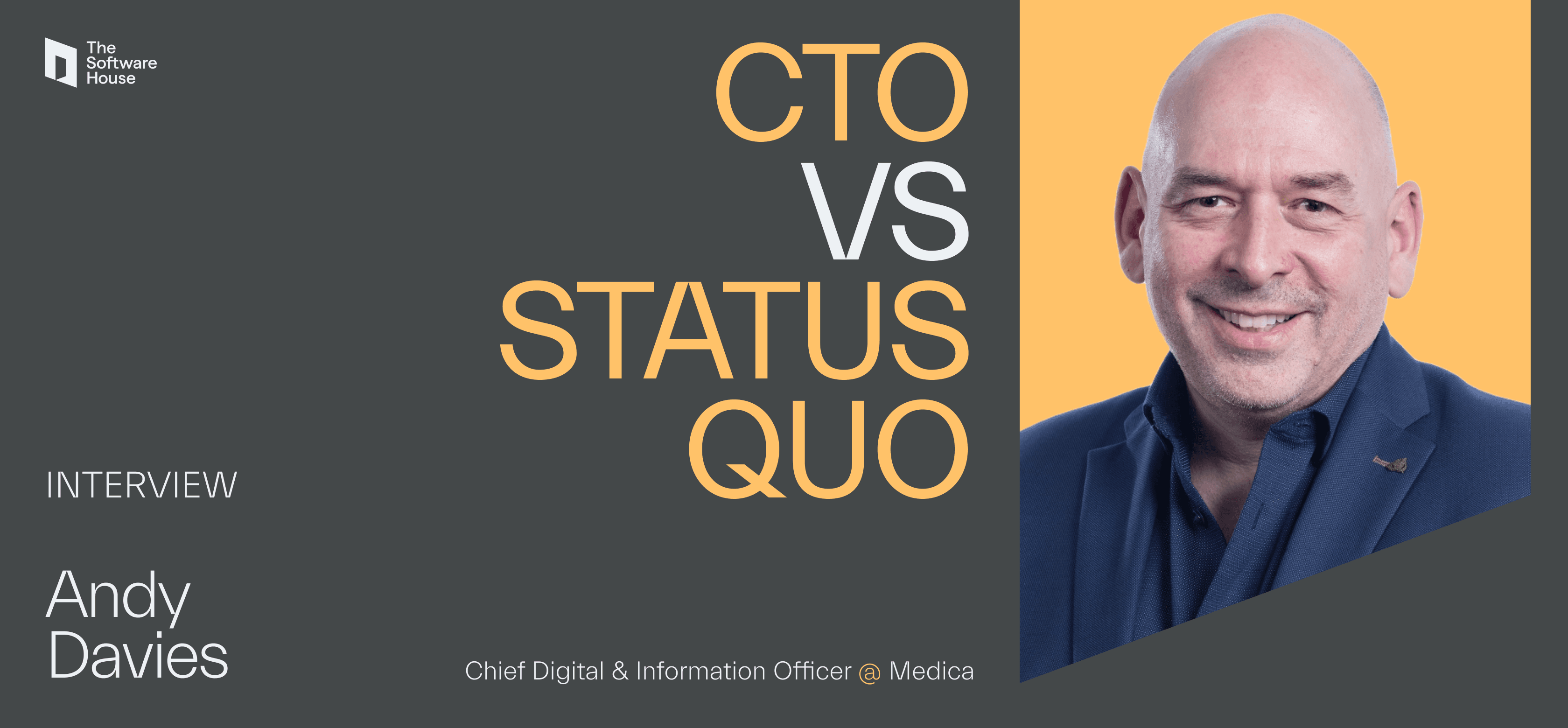

How do you drive digital transformation in healthcare both quickly and safely?
Overseeing technology for the UK’s largest teleradiology provider, Andy Davies knows the ins and outs of healthtech innovation.
Drawing from decades of experience in the technology industry, he explains in detail how to de-risk the product development process in healthcare.
The CTO vs Status Quo series studies how CTOs challenge the current state of affairs at their company to push it toward a new height … or to save it from doom.
“At the end of the day, it’s all about making sure we have good patient outcomes.”
Moving fast is rarely mentioned in the context of healthcare innovation because it seems impossible. Andy Davies shows that it’s doable.
When you adopt the right approach, implementing healthtech solutions is no longer a slog. Technological proficiency is a given, but it’s soft skills like communication and collaboration that make it work.
In this interview, Andy explains:
why siloed healthtech technology teams are doomed to fail,
how to make digital transformation projects easy to handle for clients,
when can cutting-edge technologies like AI be used in production,
why healthtech solutions require clinical safety by design.
But first, find out more about Andy.
About Andy
Having held leadership positions in tech since 1997, Andy is now the Chief Digital & Information Officer (CDIO / CIO) at Medica Group. He’s an experienced technology executive, and an expert in digital transformation and change management. He’s praised for an outstanding ability to apply cutting-edge technology into business.
Meet Andy
Arkadiusz Kowalski: Hello Andy. I heard that Medica is doing really well, with lots of praise for its emergency teleradiology reporting service NightHawk and active team expansion. Can you tell us a bit more about this?
Andy Davies: Medica Group consists of three different companies.
The largest of our three companies is in the UK. We have a teleradiology and telepathology business, with Medica being the market leader in this space. We’ve been around for 20 years. It started with a couple of guys above a flower shop in a small seaside town, and now we have approximately 750 remote radiologists worldwide.
Medica Ireland provides teleradiology and manages imaging services in radiology and sonography for the HSE, the National Health Service of Ireland.
Our business in the US, RadMD, deals with reporting on clinical trial imaging.
You’ve got a broad range of responsibilities across the health space. What kind of challenges in clinical workflows or diagnostics do you see as the most urgent to address through Medica’s technology?
At the end of the day, it’s all about making sure we have good patient outcomes. Efficiency is a key element of it. That breaks down into a number of things.
One is speed – getting the result back to our client as soon as we can. Then there’s accuracy and clinical quality.
Lots of that is driven through streamlined workflows based on reliable, robust, secure computing from both a network and storage perspective. We also need to assign the right specialist to read or report on each image and do all that work within all the relevant regulations and guidelines.
Digital transformation in healthcare
This brings us to the main topic of today’s conversation, which is digital transformation. It’s a phrase that gets thrown around a lot, so my question is: what does “digital transformation” actually mean for a modern healthcare organisation?
If I look at Medica’s journey, it’s about improving speed, accuracy, clinical outcomes, turnarounds, and working closely with our partners to make sure that we’re delivering in a clinically safe manner.
Take our pathology business. People have worked off glass slides for years in a pathology lab. With digital pathology, you’re removing those slides going in the post from point A to B because we can transmit them.
Digitisation is obviously one element, but it’s ultimately about doing things more efficiently, which also creates the opportunity to introduce other technologies, such as AI, into workflows.
Within healthcare, there are masses of transformation. In my previous role, I was in DNA sequencing. The progress there is leading towards personalised medicine, because when you can understand a pathogen really well, you can prescribe precise drugs rather than broad-spectrum ones.
You also worked in many different areas than healthtech, including as a Consulting Director for Gartner. What makes digital transformation in healthcare uniquely difficult compared to other industries?
One thing is the safety of information. The data in healthcare is much more sensitive, it’s a big part of the risk of transformation and digitisation. That’s what makes it different from banking, telco, or others. The data is extremely sensitive and highly personal.
But clinical safety, excellence and governance are at the top of the list. Say there’s some information that needs to be transferred to a clinician; if the data gets either corrupted or delayed, that could impact a patient’s outcome.
If there’s an embolism or a bleed on the brain in the case of a stroke, that information is essential and needs to be delivered very quickly.
That’s why we have safeguards in place. If the main system is unavailable, we have backup systems and processes that provide an alternative route to return the report to the hospital. That secondary provision to report, along with resilient and robust backup systems, is crucial.
Since both efficiency and patient safety are on the line, how should healthcare leaders prioritise their digital investments?
One approach is around the way you construct teams. In some businesses, IT might believe they know what’s best, design a system, and then deliver it over a fairly lengthy timeline. In healthcare, the digital teams cannot operate in isolation.
You must be closely aligned with your clinical governance, compliance, and operational teams to remain compliant with regulations and adhere to a clinical safety framework.
You have to keep making sure that the designs you’re putting forward and the processes you’re re-engineering are clinically safe. You need multiple experts around the team, you cannot afford to operate IT in a silo.
The other approach, which I truly believe in, is to take small steps and get systems and products into customers’ hands rapidly so that you can learn from their usage. That way you can iterate, and if something’s not right, you can backtrack easily. You’re not delivering something in nine months, but rather little functionalities, piece by piece, and knitting them together.
This helps you make sure that each one is tested. You learn a lot by having part of a system in the user’s hands. You can monitor it, look at the data you get back from it and see outliers or errors. That’s how you can innovate quickly, whereas a three-year waterfall programme will probably never meet the user’s needs.
Technology enablers in healthtech
Let’s dive a bit deeper into technology enablers in healthtech. Speaking about specific technological trends, we have to start with the obvious one – AI. Recently, we helped a fintech company anonymise their user data so that they can use AI to improve efficiency while staying compliant. Do you face similar challenges with AI in clinical settings?do you help your teams get the skills to deliver fast?
What you find with AI in healthcare is that it’s not allowed to make a decision, but it’s definitely going to be assisting with patient outcomes. The human, or the clinician, is the final step. AI assists in that decision or afterwards, helping to audit that decision.
For example, AI might highlight an area of concern for the radiologist to look at very carefully. But it’s up to the clinician to agree or disagree, and come to their own conclusion. Or, AI can look at a radiologist’s report, along with the image and associated data, and raise a flag saying, “Are we sure this is right?”
At the end of 2024, I went to one of the large radiology conferences in the US – the Radiological Society of North America (RSNA) event. There were so many AI vendors that it looked more like a technology event.
Looking at the market, lots of small startups are coming up with AI algorithms, and there’s going to be mass consolidation around this over time. I think it’s definitely maturing and coming along.
But, with the hype around AI, lots of people are dressing up general business logic, or standard computing algorithms as AI when there’s no learning in them at all. We need to be careful of that type of thing, thinking AI is something it’s not.
How do you evaluate whether a new technology – like an AI tool or automation platform – is truly fit for clinical use?
We’re investing heavily in testing lots of AI algorithms. We’re building a library of exams, all anonymised – golden records, if you like, of the truth of each image. We’re running that through various tools to see what the automated outcome of that is, and whether it matches our data.
Then we have experienced, qualified radiologists look at the results during a proof of concept, and verify the accuracy. It’s a key thing before we would ever get near putting it out to production.
Another thing we look at is performance, because a good clinical outcome is about speed as much as anything else. Does an AI component slow a workflow down? If it takes an extra 10-20 seconds, that’s probably acceptable. If it takes an extra five minutes, and we have an SLA of less than an hour, that could have a significant impact. Then you’ve got to think about the cost of the compute environment to actually run that AI tool efficiently.
One tool we recently tested boasted 90-95% accuracy. We ran it through our test systems and proof of concept, and we found that the accuracy was significantly lower, below the level where it would be a useful tool.
But we’re continuing to work with that supplier, because we think it’s a good tool with great potential for us.
One tool that we do use in production for detecting head injuries is Qure.ai. It’s in a small part of the exams we get, but the clinicians who use it love it.
You already mentioned the safety of information. As an innovative healthcare company, you need to balance using data to support better diagnosis and care with the need to protect and respect sensitive patient information. How do you juggle that?
One requirement is a very active Data Protection and Information Security Officer, but we’ve got multiple other elements to this. No one’s hack-proof, but you need to make sure you have the best defenses you can possibly put in place.
You also need to understand anonymisation of patient data, as well as regulations, and the requirements laid out in client contracts. For example, some clients allow us to use qualified radiologists, who are resident overseas. Other clients stipulate that they must be in the same country as the client.
Take the data we use for testing tools – there’s no way of tracing it back to an actual patient. Some of it is also synthetic data. It’s absolutely essential for our business that we maintain our clients and patients’ data confidentiality, because if we didn’t appreciate those guidelines and treat them with respect, it would be detrimental to the business and the reputation of the organisation.
Scaling innovation
Like you said, any innovation needs to meet all the business requirements to work at scale. If it doesn’t, then it’s not practical. In the context of healthtech, how can healthcare companies move fast and innovate without compromising on strict clinical standards?
Your requirements have to be well-defined, as well as the goals – what are you actually trying to achieve? And then, how do you test each part of your system?
You’re probably familiar with security by design. Here, it’s clinical safety by design. If you have a requirement to do X, you have to think, “How does that fit within clinical safety? How does that work within data security, protecting patient data?” That’s right up front when you’re designing the product, gathering the requirements, understanding what the outcome should be from that piece of work.
Clinical safety is not something to think about once you’ve got the snazzy new application you’ve designed. “Oh yeah, so how are we going to think about the clinical safety side of this?” It needs to be part of your first principle thinking.
I really like the term “clinical safety by design.” What are some other non-negotiables when it comes to patient safety in the context of digital innovations?
You’re looking at the hazard logs and all the various standards you’ve got to meet. Things like ISO 27001 as well as other standards and regulations, such as DCB0129 (“Clinical Risk Management: its Application in the Manufacture of Health IT Systems”).
Basically, you’re looking at the clinical hazard of anything you’re designing. It’s a very specific risk log. If you’re a new supplier that we want to employ, we would either need to do that check, or you would do that, and we’d only take you on as a supplier if you met that standard.
A lot of AI companies don’t have the approvals yet. So we need to go through that step before we can use their tools in production.
So you always have to start with security and safety first in mind.
Yes. One other big thing you have to think about – some third-party software elements within our environment are defined as a medical device, and those are a whole different ball game.
For example, a PACS system, which is basically an archive of images, is classified as a medical device. When it’s implemented, or upgraded, or a change goes in, our supplier has to recertify the environment, which runs on our computers, before the change can actually go to production.
So you have to look out for additional regulations around certain elements of what you do in healthcare solutions.
Security and safety standards are one thing. On the other hand, with all innovations, you need to deal with adoption.
How do you build trust and adoption among clinicians when introducing new technologies into patient care pathways?
I think it comes back to the team and colleagues you work with. It’s about having the type of people who can move quickly, but they’re still actively listening to the clinical team, the compliance team, and our customers. The clinical governance team within Medica is very strict about what we can do, how we prove things to them, and things like that.
Adoption is also about having a strong and positive relationship with your clients. You need to have a good track record of safety and reliability. If you can’t demonstrate that to your clients, they’re not going to give you their business.
Lastly, there’s good IT practice – scalability, security, robustness, failover ability, all those elements. Some aspects of our workflow aren’t regulated as such, but they still need to be developed in such a way that they’re highly reliable and never interrupt the clinical pathways.
Digital transformation vs cultural transformation
Looking from the perspective of clinical, IT, or trust stakeholders, what are the biggest cultural or organisational challenges during digital transformation?
Our clients are extremely busy, so the first challenge is to minimise the impact on the client. For an NHS Trust’s IT department to make a change, that could take quite a long time. They’re sometimes under-resourced, and they’re always busy.
Something might be a good change that the trust wants, they might be waiting on their IT department to make those changes, and it could take a while. We need to figure out how to minimise the effort on the client’s end.
For example, we’re currently doing a large migration of all our systems from colocation data centres into Microsoft Azure – hundreds of systems. How do we minimise any disruption to clients? How do we minimise any changes required?
Even something simple – like a VPN pointing into a different IP address range – how can we simplify that for our clients? In the end, the solution is good communication and good relationships with those clients.
How do you keep the team engaged and aligned during what looks like long and complex transformation journeys?
In a word: phasing, making sure that you can say, “That’s successful, we’ve achieved a business outcome here, we’ve achieved an improved patient outcome.” So we can do it in stages, and it doesn’t seem like a long slog.
Other than that, it’s about selling a vision, and it comes back to change management in general. You’re telling people why you’re doing this. It’s not just because you want to make this technology change – you want to improve the turnaround time for this hospital, there’s an actual patient outcome objective.
Keep people informed, and let people join in the success and feel proud of what you’ve done. People can become really jaded, or frustrated, or just fed up with constant change, especially if they don’t see the end picture painted.
So – divide it into phases, and keep tracking the progress and showing it to the team, right?
Yes, and it’s not just about my team – it’s about the whole business. Every time we want to make a major change, there might be an outage with a client. We might need 40 minutes of downtime on a client system. In a healthcare setting, it’s never ideal, but sometimes you can’t avoid a planned outage when migrating a core service.
Some transformation programmes are never-ending. No one’s clear what the goal is, or the reason you’re doing it, so you hear “digital transformation” or “business transformation process”, and you just think, “I don’t know what’s going on, I just know that every Friday I have problems logging on.”
So you need to keep clients informed as well. They need to know in advance. And then it’s about excellent execution from my team, and with the client relations team, to make sure something happens as planned.
Even when something doesn’t go to plan, as long as you’ve got good recovery processes and you can show progress, I think you’re okay.
Right, the “digital transformation” term gets thrown around a lot, and people can have a very different understanding of it.
I remember back when big data was the big buzz. Where’s that now? It’s never really materialised, in my view. We just collect more data because we have more devices capturing data.
And when I hear things about AI, like AI-enabled business, I feel that it’s going to be the same. In a couple years’ time, it’ll be like saying, “oh, do you know what? We use the internet in our business!” It’s going to be just computing. That’s what we do.
I think digital transformation is similar. A good business is always innovating, adapting, changing – digital transformation is just a part of that. It just means that we’re using IT computing to make businesses more efficient.
General advice
Given all we’ve discussed, what advice would you give to healthtech leaders who want to use the latest technologies and ensure their mission-critical software remains reliable and compliant throughout the transformation journey?
Start with first principles: what are you trying to achieve and why?
You need people who know the industry well. I’ve come into Medica with very little clinical knowledge, but I have people who really understand radiology in my team, and really good people in architecture and security, just a great team all around.
Also, don’t get hung up on technology. Much more time should go into thinking about data, because the way you actually architect data is key. Sometimes, when you iterate quickly, you end up with little data silos, or islands of data that are difficult to bring together and extract value out of the wider data sets.
And then it’s just not being siloed. I think that’s the biggest danger for me. Your IT department, just trying to deliver it by themselves… I think you’d fail.
If you want to deliver digital transformation in healthcare, you need a significant degree of collaboration between all parties. So don’t keep it as just a technology project. You need to have clinicians involved, clinical governance people, compliance people, a data protection officer, your business people as well. Collaboration is key.
It makes me think of the difference between going fast and going far. When you invite a lot of people to the process, it might take longer, but you’ll go farther in the long run.
Absolutely. I also think that there’s an element of bravery here from the technology team – the ability to say, “Actually, that’s a really bad idea if we did that.” A clinician or a business person might have an idea that seems great to them, but you need to let them know that from a good IT practice viewpoint, it’s a really bad idea.
So it’s getting your colleagues to state their requirements and not state the solution. I think you need that happy medium of collaboration which has a degree of pushback on both sides.
Resources
Can you also recommend some learning resources for tech leaders who want to learn more about digital transformation initiatives in healthtech?
The best thing to do is go to one of the healthcare technology conferences. Meet and talk with people, talk with vendors, and talk with users of their technology. In my area, there are great conferences around sequencing, biotech, healthcare, radiology, pathology and things like that. It’s eye-opening to attend them and talk to people.
There’s a lot of passion in healthcare, it’s one of the great things about this industry. Sometimes, in other fields, people are a bit more jaded. But here, people want to share, they want to improve, they want to discuss.
What’s next? 5 healthcare digital transformation practices to follow
According to Andy, the success of digital transformation projects in healthcare requires:
starting with first principles, always keeping in mind the goal of improving patient outcomes,
clinical safety by design, which means verifying from the get-go whether the planned functionalities don’t carry any risks for the patients and their data,
constant collaboration with subject-matter experts, meaning that technology can’t be created in isolation from the real-world environment,
transparent communication between stakeholders, always keeping everyone updated on goals and progress,
working in small steps, implementing small functionalities piece by piece, continuously testing them, and knitting them together into the final solution.
Remember that digital transformation is just a means to an end. In the case of healthcare organisations, the ultimate goal is always to improve patient outcomes.
Authors

Arkadiusz Kowalski
When it comes to business, he strongly favors building long-lasting partnerships and value. Always enjoys meeting new people and coming up with creative ideas. In his free time, he is happy to chat about computer gaming, politics, and social sciences.