19 January 2026

The definitive app modernization toolset for CTOs: from discovery to development

Adrian Senecki

Marek Gajda

8 min read

With 79% of modernization projects failing due to poor planning, how do you beat the odds? Above all, don’t try to reinvent the wheel. Instead, use tried-and-true methods and solutions that modernization veterans employ to run a discovery phase that leads to a successful implementation pretty much every time.

TL;DR

  • Modernization veterans’ plan for each challenge includes the objectives of a project, methods of optimizing it for them, and technological solutions for the delivery

  • These three elements form the app modernization toolset

  • Find out how it works and use it in your modernization project

The Software House has helped 160+ commercial clients deliver complex software on time.


Working across fintech, healthcare, or SaaS, we’ve honed an approach that involves applying the same best development practices, but tailoring them to each case.

Our application modernization practice started in 2018.


Be honest, how many app modernization projects have you overseen before?

No need to be ashamed. Modernization is not something that many CTOs do every day.

If you are one of them, you know that supporting the ongoing business may take precedence over any attempts to overhaul the technology.

Besides, even if you believe that modernization could be beneficial in the long run, how can you convince other stakeholders and guarantee results?

The good news is that there are people who regularly undertake modernization work, and they have already developed an approach to addressing these problems.

Because the truth is that when it comes to app modernization, you really do need a sound plan. After all…

Most modernization projects are doomed at discovery


Many tech leaders are well aware that their legacy systems are hindering their businesses. They want to fix it.

However, they do too much, too quickly.

For example, they choose to rewrite an entire app or go for an ambitious new approach to architecture.

Non-technical stakeholders may not even understand what the tech team is aiming for and why there is no time for developing new features.

All the while, developers struggle with delivery. They create workarounds to meet deadlines. These compound complexities generate new legacy code.

The result? A big mess without any real company-wide buy-in for modernization.

The app modernization toolset


When you put the modernization challenge this way, it’s no wonder that 79% of such projects fail (vFunction Report 2022, which surveyed 250 IT professionals from companies with at least 5,000 employees).

That’s why modernization veterans at The Software House designed a structured approach to modernization that can be tailored to each project.

Drawing from their experience, they set it up as follows:

1. Modernization objectives

Specific goals that you want your modernization project to prioritize, such as compliance or time-to-market.

2. Modernization methods

When you know what to prioritize, you can tailor your discovery using various methods. These useful concepts help you determine what to keep, how to manage the transition between the old system and the new one, and more. If you apply them, you will obtain a modernization roadmap and internal buy-in.

3. Modernization solutions 

When you decide what you want to achieve, you can pick the best technological solutions to implement your roadmap.

Modernization objectives


Let’s take a quick look at the objectives modernization veterans optimize their plan for.

  • Scalability 

The new solution is easily extendable and handles high traffic easily.

  • Compliance 

It stays compliant with internal standards and external regulations.

  • Maintenance costs 

It’s designed to minimize costs during the transition from the old system to the new one and afterward.

  • Time-to-market 

All or some of the deliverables are released timely, in accordance with business requirements.

  • Features delivery 

The modernization project doesn’t have a negative impact on the development of new features.

  • Performance 

The new system offers performance and maintenance gains. The metrics are project-specific (e.g., code coverage or reduction in manual processes).

Typically, you want to achieve all of these objectives to a degree, but some of them will be more important to you.

When you determine which ones matter most, you can prioritize discovery methods that help with achieving them the most.
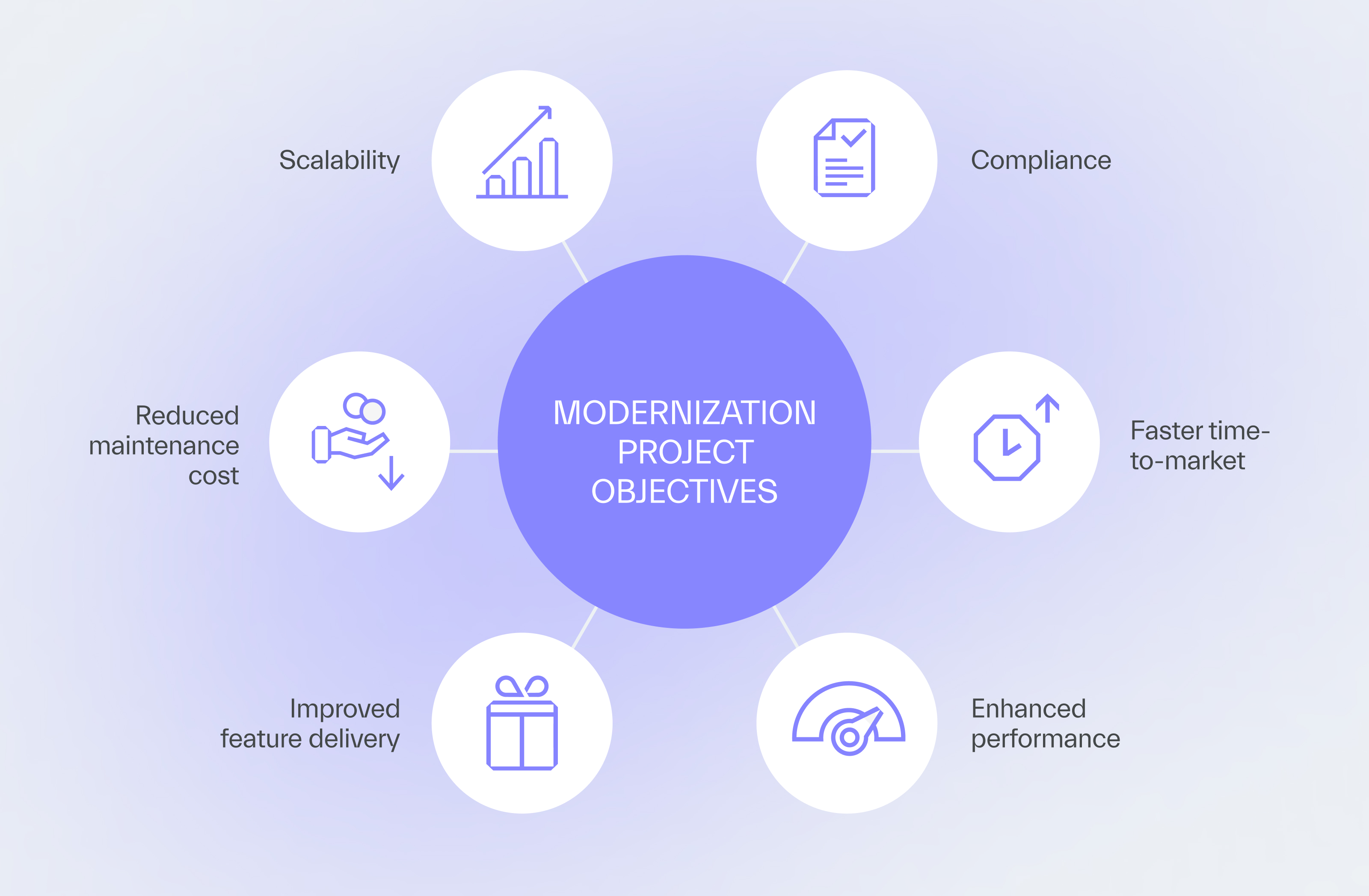
Diagram showing "Modernization Project Objectives" with icons for scalability, compliance, faster time-to-market, enhanced performance, improved feature delivery, and reduced maintenance cost.

Modernization methods


Modernization matrix

Affects: scalability, feature delivery, maintenance costs

Before you start planning, you need to know where to focus.

The modernization matrix helps you decide. You break your platform down into components and evaluate each one individually.

Use these assessment criteria:

  • Expected ROI

  • Business impact

  • Technical difficulty

  • Confidence level

  • Time to value

The 5R method

Affects: scalability, time-to-market, maintenance costs

The 5R method helps you determine the migration path for each individual piece in your backlog.

Here are your five options:

  • Rearchitecting involves architectural redesign

  • Rewriting is a ground-up rebuild

  • Refactoring means code optimization without changing external behavior

  • Retaining means keeping parts of the system unchanged

  • Retiring means phasing out specific parts or whole applications

You divide your software into parts and evaluate each one individually.

If you keep some parts, you may significantly lower costs. If you retire others, you reduce complexity. The key is making deliberate choices for each component.

Modernization Matrix and the 5R method work in tandem to help you figure out the best migration path for each individual piece of software

Incremental delivery

Affects: time-to-market, features delivery, compliance

Shipping a fully modernized application in one go is not always the right approach. It’ll take a lot of time for you to be ready to release something.

And if you don’t release anything in a long time, despite investing many hours in the modernization project, you may lose internal buy-in.

Incremental delivery breaks your modernization into small, manageable steps, each with its own release date that brings new business outcomes.

The newly released pieces of the modernized system run in parallel to the old system, which is phased out gradually.

The incremental delivery method makes it possible to run both the old and new systems together and transition between them in a methodical and risk-free manner

Third-party strategy

Affects: time-to-market, maintenance costs

A common modernization mistake is trying to build a custom solution for every single task.

The third-party strategy helps you decide when to build and when to buy.

The method focuses on the strategic impact and complexity of the task in question. The lower they are, the more it makes sense to obtain the solution for it from a third party.

Implementing such third-party solutions can save significant development time and reduce long-term maintenance costs.

This method divides your features into those worth building in-house and those that aren’t based on their strategic impact and complexity

Dedicated team

Affects: features delivery

A dedicated modernization team develops faster due to higher overall modernization expertise and the ability to focus entirely on this task, benefiting from reduced context switching.

If your dedicated team lacks specific skills, you can bring in external experts to join it.

In the meantime, your core team stays focused on product innovation, rather than getting pulled into modernization work.

Modernization roadmap sprint

Affects: all objectives

The best way to employ all of these modernization discovery methods above is to craft your game plan during a focused modernization roadmap sprint.

It involves stakeholders from across the whole company and produces the following deliverables:

  • functional and non-functional analysis of system components

  • identified initiatives

  •  high-level roadmap and backlog 

  •  architectural proposal

  •  cost & time estimates

  •  executive summary with estimated business outcomes

By involving non-technical stakeholders and showing them that every architectural or software decision was made with a business goal in mind, you go a long way to establishing internal buy-in.

Are you unsure if you have the right competencies to undertake such a sprint? The modernization veterans at The Software House can assist you with this.


Sign up for a Platform Modernization Roadmap Sprint™ and develop a modernization plan tailored to your objectives in just 2 weeks.

In subsequent iterations, you can refine the sprint deliverables into a more detailed modernization game plan that is ready for implementation.

Modernization solutions


Once your modernization game plan is ready, you’re going to know which specific technological solutions you’ll need to implement it.

Below, you can find some of the most relevant for modernization projects.

Review them to determine:

  • how much new expertise you’re going to need 

  • how you’re going to obtain it (e.g., training, hiring, or contracting)

Tech stack upgrade


Are you planning to alter your tech stack significantly?

  • Assess your current team's skills against the new tech stack requirements

  • Identify gaps that require new hires or reskilling

  • Build a training plan before development starts

  • Do not wait until mid-project to discover you lack critical expertise

Plan ahead so you are not surprised later.

Microservices


Service-based architecture is very likely to be high on your agenda for a number of reasons:

  • You can deploy one microservice at a time, supporting the incremental delivery approach

  • You can use different technologies for different services based on what fits best in terms of performance and access to talent

  • You isolate failures so that one broken component does not bring down everything

  • You make it easier for different teams to work independently, each on its own microservice

As you employ the 5R method to figure out your migration plan, each component you rearchitect can become its own service.

Cloud optimization


Cloud complements microservices by providing the necessary infrastructure for them to thrive.

It could help you:

  • Run parallel systems during your transition

  • Scale resources up and down based on demand

  • Reduce infrastructure costs

If you are using incremental delivery, the cloud makes it much easier to manage multiple versions running simultaneously.

Data migration


Data migration is one of the most challenging aspects of app modernization, as it involves handling incompatible data formats and addressing issues related to data quality and integrity, which are often exacerbated by legacy code.

Ensure that you develop a data migration plan during the discovery phase.

GOconnectIT needed to transfer terabytes of data from a legacy system where it was stored in a relational database. The data had to be transformed into a format that was digestible by GO FiberConnect, the new system all customers were transitioning to.


The Software House team built a fully automated data migration process that handled the transformation at scale. 

The results:

  • complete app refactoring while keeping the application live

  • $90,000 yearly savings on optimized cloud

  • increased market competitiveness.

Check the data migration case study


API integrations


If you are using the third-party strategy, APIs become critical.

Plan your integration strategy during discovery. Identify the necessary APIs before you begin building.

AI enablement


AI enablement can improve delivery by up to 30%, but only if you manage to increase the adoption rate of AI tools in your organization.

In his piece for the Effective Delivery newsletter, The Software House’s CTO, Adam Polak, talks about removing 7 AI for code adoption blockers that won’t allow you to improve productivity with AI tools.

The 3-step modernization process


The objectives-methods-solutions toolset fits into a larger three-step process developed by modernization veterans.

Step 1  – the roadmap sprint


That’s where you determine your objectives and employ various methods to create a modernization roadmap.

Step 2  – phase 0


It’s where you develop the initial plan into detailed initiative planning. This includes discovery workshops, architectural diagrams, tech stack composition, and a detailed backlog.

Step 3  – the implementation


It consists of repeated cycles of planning, development, and deployment. This is where you apply the solutions.

The three-step modernization process involves the initial sprint, an in-depth planning stage, and an iterative implementation

Make the first step towards modernization


Launching a modernization project is a significant challenge.

One wrong move, and you risk alienating stakeholders.

And if you end up implementing an incomplete modernization plan, it may turn out to be an even bigger problem for your business.

Instead, you can book the Platform Modernization Roadmap Sprint™ to:

  • Make a business case for modernization right from the start,

  • Produce a plan that minimizes technical and business risks,

  • Learn the expertise of modernization veterans

And if you decide to go it alone, may this app modernization toolset help guide you.

Good luck!

Authors

  • Adrian Senecki

    Copywriter and budding fiction writer, interested in (but not limited to) the business side of software development. Likes acquiring new skills and foretelling the future.

  • Marek Gajda

    A COO at The Software House who is building bridges between technology and business. A former full-stack developer and experienced Scrum master. He has a solid background in Node, PHP, Java, Ruby, and .NET, but now codes just for fun. Marek has been directly involved in nearly 100 successful software projects. He is currently immersed in solving complex problems regarding cloud, scalability, and software architecture.

Is modernization a part of your post-M&A journey?

Platform Modernization Roadmap Sprint™

Contact us to explore ways to achieve data and product synergy.

Work with modernization consultants who have helped cut time-to-market by 75%.

Book consultation

More app modernization
stories

M&A integration
success stories

See how we help customers drive post-M&A transformation and integration.

See how we help customers drive post-M&A transformation and integration.

Go to cases