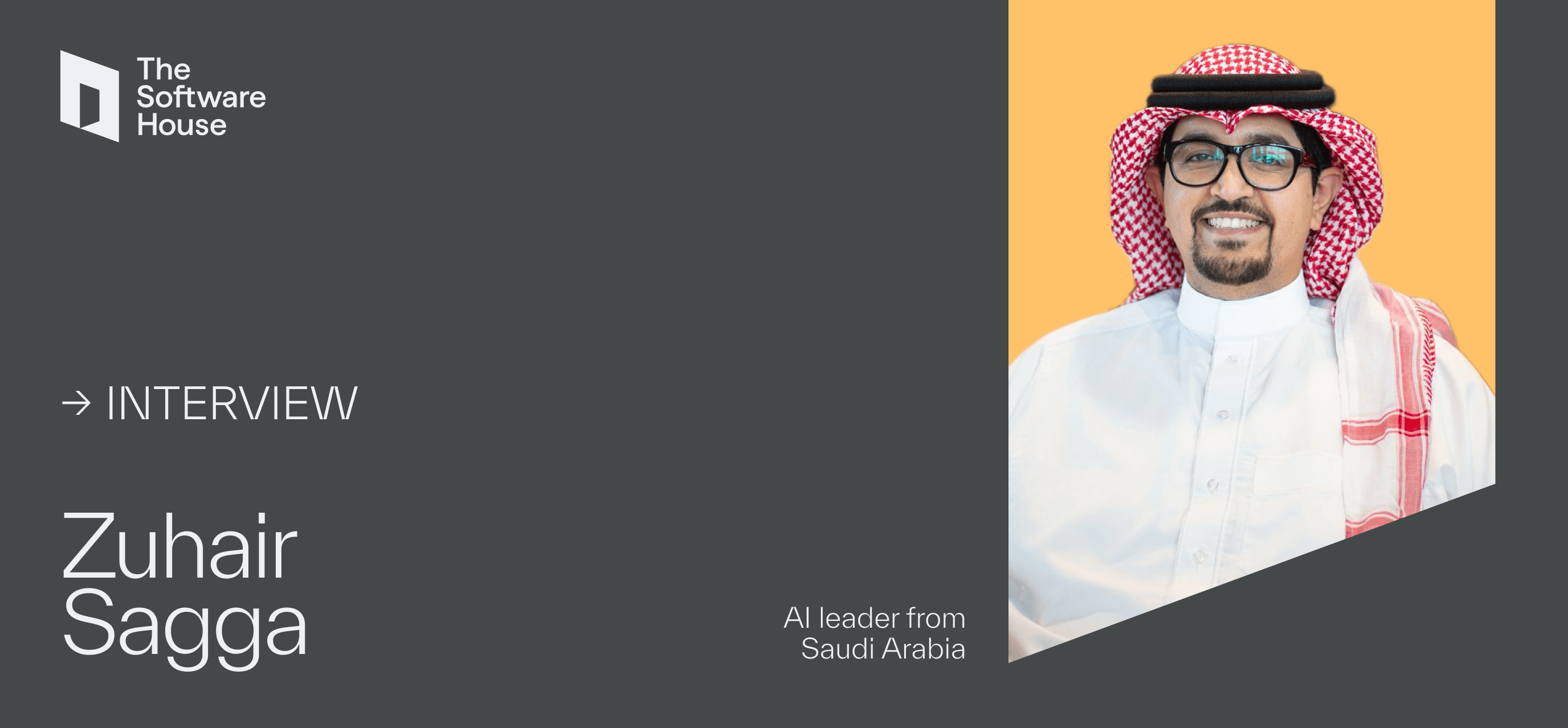

With AI Agents reshaping how products are built and Saudi Arabia investing heavily in digital leadership, a new kind of product mindset blends strategy, automation, and Arabic-first innovation.
Zuhair Sagga, a longtime leader in Saudi Arabia’s tech scene, shares how AI agents give rise to a new kind of Product Manager: less focused on documentation and more focused on discovery and strategic thinking.
This conversation explores how Saudi product leaders turn AI into a force for real impact under Vision 2030.
The Voices of Vision 2030 series highlights how Saudi tech leaders break away from the status quo to drive innovation, unlock growth, and help realize the Kingdom’s vision for a thriving digital future.
Meet the AI Agents powering a new era of product management
From handling repetitive tasks to adapting in real time, AI enables Product Managers to focus on strategy, user needs, and innovation. Zuhair Sagga, AI leader in Saudi Arabia, shares how this shift is creating a new kind of product leader in the Kingdom: one that’s better, faster, sharper, and deeply aware of the local context.
In this interview, Zuhair:
Highlights how local platforms and language-aware AI give Saudi teams a competitive edge in building more innovative digital products,
Makes the case for strategic product management empowered by AI, not replaced by it.
Explains why AI agents are ready for production if the rules are clear and the outcomes are measurable.
About Zuhair
You recently launched a blog, “Zuhair Writes”. Was there a moment that pushed you to start writing publicly about your personal experiences, or was it a slow build-up over time?
Zuhair Sagga: It was both. When you hit 40, something shifts. It is a golden age where you can finally share your experience with others. Before that, I always felt like it might be premature. But at 40, you’ve done the work, achieved things, and have a track record. Your opinions start to carry some weight.
I always admire people who share instead of keeping knowledge to themselves, so thank you for that. What topics can we expect to read about in the future?
Zuhair Sagga: I’ve been thinking about four categories.
1. Leadership & Management. Ideas like rethinking work hours. What if the day started at 4:30 a.m. and ended at noon? As Muslims, we already wake early for Fajr. Instead of going back to sleep, what if we used that time to work while our energy is highest? It’s one of the most productive windows, yet often wasted on commuting.
2. Product Management. How product management works in Saudi Arabia, and how to build strong digital products and experiences that fit the local context
3. Personal Reflections. Stories, thoughts, and experiences from my journey, what’s worked and hasn’t, and what I’ve learned along the way.
4. Zuhair’s Friends. A space for friends who have great ideas worth sharing but don’t want to run a blog. If someone says, “You should write about this,” I say, “You should write it.” I’ll publish it under a dedicated category on the blog.
Do you plan to write anything about AI?
Zuhair Sagga: Definitely. I’ve been into AI for a long time, since the early days of online courses, I was fascinated immediately. I even attempted to build a tool to predict real estate prices using machine learning. The idea was to help people decide when to buy or wait, but the data wasn’t there back then.
To me, AI is like the Internet when it started: a game-changer. It’s a multiplier for productivity and creativity. Steve Jobs once called computers “a bicycle for the mind.” AI takes that to the next level.
Yes, it has risks, but if used well, it can unlock tremendous value for individuals and organizations. I think we’re only just beginning to see what’s possible, especially with the rise of AI agent tools.
AI Agents
How would you explain AI agents to a product leader who still sees AI primarily as “just automation” or “just chatbots”?
Zuhair Sagga: Let’s start with the word “agent.” An agent is someone you authorize to act on your behalf. You still stay accountable, but they handle the task on your behalf.
An AI agent works similarly: a system that takes on a specific task instead of you. Unlike traditional automation, it can understand context, adapt, and learn.
A simple example: modern cars have sensors that automatically brake when another vehicle gets too close. You didn’t press the brake, but the system acted as your agent. That’s not AI yet, but it shows the principle.
AI vacuum cleaners that learn your space or smart pet feeders that adapt to your pet’s eating habits are basic AI agents. They handle tasks, adjust based on your routines, and free up your time.
"What’s new isn’t the agent; it’s that today’s AI agents learn. They adapt to your behavior, preferences, and tone of voice. The same AI agent will behave differently for me than for you, because it’s operating in individual contexts."
Zuhair Sagga
AI Leader
That’s far beyond automation. Decision-making, context awareness, and continuous learning are all done on your behalf.
Are AI agents already mature enough for production in high-stakes environments, or are we still in the experimentation phase?
Zuhair Sagga: It depends on the context.
"If you work in areas with well-defined processes (things where it’s easy to say what’s right or wrong), then yes, AI agents are already proving useful.
Take software engineering, for example. It’s relatively straightforward to validate: does the code run? Does it do what it’s supposed to? You have clear feedback loops and measurable outputs. These kinds of environments are where AI agents can thrive.
But moving into more subjective or ambiguous areas (like philosophy, art, or law) is a different story. Even humans don’t always agree on what’s right in those spaces. There’s too much nuance and variability from person to person, place to place.
"So, in high-stakes environments, I’d say AI agents are production-ready only when the task has clear logic or structure, and you can define success mathematically or process-driven. For the rest, we’re still in the learning and experimentation phase."
The tech will evolve, but right now? Utilize AI when the rules are well-defined.
The new Product Manager
How do you see AI changing the core tasks of a Product Manager, say writing a product requirements document, doing market research, or prioritizing new features?
Zuhair Sagga: Great question. There are tasks that product managers are doing today that they shouldn’t be spending time on, such as perfecting PRDs or manually analyzing scattered data.
AI can handle much repetitive, formatting-heavy, or data-crunching work. That means Product Managers can finally focus on what truly matters.
Product management spans four areas, and AI tools help PMs stay focused on the essential thinking across:
Business. Is the product feasible and valuable?
Design & UX. Is the product usable and functional, not just pretty?
Engineering. Can it be built and maintained?
Sales & growth. Can it drive and sustain revenue?
"With AI handling the repetitive stuff, PMs will have more time to lead strategically."
Imagine you’re working with engineers in different countries. Instead of manually rewriting PRDs for each team in other ways, an AI agent could tailor the message to each context and even translate it into their native language.
That’s powerful because if you want to speak to someone’s brain, use their language. But if you talk to their heart, use their mother tongue.
Human and AI collaboration
There’s a lot of fear that AI will replace PMs. But your writing suggests a different story. How do you see product teams’ “human & AI” relationship unfolding?
It depends on what kind of product team we’re talking about.
Some organizations treat Product Managers like glorified project managers or scrum masters. In those environments, the role is primarily about coordination and documentation. Yes, AI might replace that kind of work.
But that’s not real product management. That’s just a mislabeled job.
"True Product Managers are not going anywhere. Great PMs do far more than manage tasks; they identify unmet and even unrealized needs. AI excels at surfacing data, identifying patterns, and enabling us to work more efficiently. But humans shine when discovering opportunities that no one can yet articulate."
It’s like the old story: if you asked people back in the Middle Ages what they wanted, they would’ve said “faster horses.” Only a visionary human could imagine the car.
"Innovation happens at the edge of what’s possible. AI can support and even accelerate that, but it can’t originate it. At least not yet."
So for empowered, innovation-driven PMs? AI won’t replace them; it will make them sharper, faster, and even more essential.
What new skills or mindsets do you think PMs need to succeed in this new “hybrid” era?
Zuhair Sagga: First, PMs need to understand how to use AI tools, not just as chatbots or search engines, but as thinking partners.
Most people treat AI like Google; they ask questions and expect quick answers. But in reality, you can flip the script. Tell the AI what you’re working on and ask what questions you should ask.
"The mindset shift, from “answer seeker” to “thought partner”, makes a big difference."
Second, it’s not about the tool, it’s about knowing how and when to use it. A screwdriver in the right hands can fix anything. In the wrong hands, even with all the strength in the world, it’s useless. Same with AI.
Third, PMs must develop a mindset that fosters innovation and addresses unrealized needs. AI is great at optimizing what already exists, but the ability to imagine something new and spot what people don’t even know they want is still a profoundly human skill.
Finally, PMs must learn to wear different hats. They need to be comfortable shifting between business, design, engineering, and user empathy, often in the same day. That flexibility and smart use of AI will set the best apart.
AI in the Saudi Arabian market
In one of your posts, you said AI doesn’t replace Product Managers; it helps them do more. Do you think this is making product leadership more strategic in Saudi companies?
Zuhair Sagga: Yes, but it depends on how PMs and organizations approach it. In Saudi Arabia, AI is pushing product leadership to become more strategic. Here’s how:
Smarter task focus. AI takes over repetitive tasks like writing PRDs or formatting documents, allowing PMs to focus on strategy, user insights, and business impact.
Context awareness. PMs here understand local constraints, particularly in government or semi-government environments where data privacy is a key concern.
Arabic-first opportunities. There’s a significant gap in AI tools that handle Arabic effectively, which gives Saudi product teams a distinct advantage.
Building on national platforms. With platforms like ALLAM, HUMAIN future products, and SDAIA emerging, the next step is for PMs to build helpful AI agents and services on top.
So AI is helping, but the fundamental shift is in mindset. PMs who lean into this change will drive more meaningful innovation, not just faster output.
Then, there is the other side. Some teams chase AI just because it’s trendy. How can Saudi companies use AI not for the sake of trends but to drive business value?
Zuhair Sagga: I don’t think this problem needs fixing. In a free market like Saudi Arabia, trends play a crucial role in driving innovation. People are naturally drawn to shiny things, and that’s okay.
Many great products started as trend-driven experiments before evolving into something meaningful. If we try to stop that too early, we might kill ideas that need time to pivot.
The market will sort things out, successful ideas will survive, and the rest will either pivot or fade. That’s how innovation ecosystems grow. So, I’d say let it play out rather than trying to regulate it. Sometimes the best thing to do is simply let people experiment. And as leaders, we must remember that we shouldn’t fix everything; we need to recognize that when we fix one thing, we often break something else. Therefore, let us choose our battles carefully and focus on signals instead of noise.
Where to start with AI
Many Saudi organizations, from ministries to healthcare systems, want to be more AI-driven but don’t know where to start. What’s a realistic first step for them?
Zuhair Sagga: The first step is to ask: Do we want to build AI or be AI-powered?
There’s a big difference. Building AI means developing platforms, models, or foundational tech like LLMs, and being AI-powered means utilizing existing platforms, such as ALLAM, or leveraging commercial models to enhance your services or operations. That decision shapes everything that follows.
If you aim to be AI-powered, start by understanding what models are out there, not just LLMs, but also computer vision, predictive models, and more. Then, match the right technology to the problems you’re trying to solve. For example, if your product is Arabic-heavy, ALLAM might be the proper foundation. If accuracy is a priority, look at models like Perplexity.
From there, think strategically, like you would with any digital transformation effort. What data do you have? What are the recurring pain points? What repetitive tasks are burning out your teams? Reporting is a great example; nobody wants to spend hours creating the same weekly report.
Utilize AI where it effectively solves real-world problems. Start small. Learn fast. Build from there.
Are there any early-stage practical frameworks you’d recommend for Saudi teams looking to integrate AI into their day-to-day operations?
AI isn’t just a tool we plug into our systems. It’s a shift in mindset, operations, and how decisions are made and scaled. I’ve seen this firsthand, working alongside leadership teams trying to move beyond buzzwords into tangible strategies.
What separates success from noise isn’t the tech itself, but where and how that tech — in this case, AI — embeds itself in decision-making, workflows, and people.
The frameworks you choose say a lot about your direction: Are you building with AI? Or building an organization powered by it?
There’s no one-size-fits-all answer. But here are a few names that matter, depending on where you are in the journey:
- Hugging Face
- IBM Watson Studio
- Keras
- LangChain
- PyTorch
- Scikit-learn
- TensorFlow
The tools are only as powerful as the clarity of the problem you’re solving, and the conviction of the team solving it.
I recently spoke with Fadi Mouzannar, who mentioned that working with external European software companies brings fresh perspectives and high-quality execution. From your experience, how can collaborating with international partners help Saudi teams, especially when introducing AI?
Zuhair Sagga: I’ve worked with international teams, mainly from Poland, and I’ve seen the benefits firsthand.
Poland is renowned for producing some of the world’s top programmers. The time zone is 1 hour from Saudi Arabia, and communication is smooth. But beyond logistics, the real value is in mindset and quality.
Polish teams don’t just act as vendors but as trusted advisors.
"A typical consultant might give you three options and say, “You choose.” But a strong partner will say, “Here’s what I believe is the best way forward, and here’s why.” They’re not afraid to disagree, even push back. That kind of constructive tension leads to better outcomes."
You get absolute alignment when a partner has skin in the game and your success is theirs. They care about quality, because your product reflects on their reputation too. That’s what I’ve experienced with the best international software houses.
Yes, working with international teams raises the bar in terms of strategy, execution, and product thinking. That level of perspective and ownership is invaluable, especially when building with AI.
Saudi Arabia’s Vision 2030
Zooming out a bit, how do you see AI-powered product management aligning with the goals of Vision 2030?
As a proud Saudi — not speaking in any official capacity, but simply as someone deeply inspired by what’s happening around me — I see Vision 2030 as a blueprint for enablement and empowerment.
Digitalization isn’t just a buzzword here. It’s a strategic pillar that drives productivity, efficiency, and innovation. That’s why we’re seeing national efforts ramp up, companies like HUMAIN emerge, and entire ecosystems being built under a coherent and integrated framework.
I genuinely believe the level of alignment and governance we’re witnessing could become a global benchmark — if it isn’t already.
What excites me most is that we’re not watching from the sidelines. We’re building, leading, and contributing to the future of AI on a global stage.
In all of this, AI-powered product management is a game-changer. It enables us to deliver more innovative solutions faster and with greater impact, aligning perfectly with our national goal of building a competitive, knowledge-based economy.
We’re walking the talk. And honestly?
The impossible isn’t Saudi.
From your experience, what real possibilities excite you the most regarding AI agents in Saudi Arabian public and government services?
Zuhair Sagga: There are quite a few. One example that comes to mind is an Arabic-first LLM such as ALLAM. Another robust use case is in public healthcare. Think of something as simple as X-ray scans. Today, patients might wait a while to hear, “You’re fine, go home.” But if you had AI agents reading those scans instantly, you’d save time for both doctors and patients, speeding up what’s already routine.
Most importantly, we need to be smart about where we apply this tech. Not every problem requires an AI solution. We should focus on use cases that are impactful, low-risk, and truly improve people’s lives.
Do you think there’s a gap between what AI can do and what most Saudi teams aim for right now?
Zuhair Sagga: AI has enormous potential, but there are still limitations, especially regarding local context.
Examples in voice and visual tasks. Take the Arabic language and try asking AI current tools to generate an image with correct Arabic text. It still comes out garbled. Or ask it to speak in a Gulf dialect.
In programming, too, right-to-left support remains a struggle. Tools are improving, but often, you still have to step in and fix things yourself. That said, it’s still more efficient than starting from scratch, and some tools built by Arab founders, like Replit, might address these gaps.
But the most significant barrier isn’t tech; it’s content. Arabic content is severely underrepresented online. You can find a book in English on almost anything, but that’s not yet the case for Arabic. This imbalance holds back Arabic AI.
"AI can do more than we imagine, but only if we actively shape it. Especially in our region, we need to provide it with better data, guide it with the correct use cases, ethics, and continue to push for tools that reflect our languages, religion, and culture."
That’s one of the reasons I started my blog: to contribute to that missing content. More people need to document, write, and create in Arabic so that future AI systems have better material to learn from.
General advice
Given everything we’ve talked about, what advice would you give to Saudi leaders who want to start using AI?
Don’t shy away from asking the hard questions. AI is a fact. Whether you’re ready or not, it’s here.
My advice is simple: adopt it thoughtfully, not fearfully. Look for the beneficial use cases, understand the constraints, and build around them with the right governance in place.

Zuhair Sagga
AI Leader
Saudi Arabia has already made significant strides in this area. We have robust national governance in place for AI, and we’ve even been internationally recognized for it. So there’s a solid foundation.
What we need for leaders to embrace AI not just as users but as active players to help shape how it evolves in our region. This isn’t something to fear. It’s something to lean into and lead.
Resources
Can you also recommend some learning resources for managers exploring the topic further?
I’d recommend two books I’m currently reading:
Designing Agentive Technology by Christopher Noessel. It’s a great introduction to how we can create AI tools that work alongside people rather than just automate tasks. Coming from a design background, the author does a great job of bridging design with agentive AI.
AI 2041 by Kai-Fu Lee and Chen Qiufan. It’s a mix of storytelling and analysis, each chapter imagines what life might look like in 2041, then breaks down the AI concepts behind it. What I like most about them is how they teach complex ideas like objective functions or algorithmic bias without feeling technical. It’s not dystopian, not utopian, just realistic and thoughtful.
For courses, I recommend checking out IDEO’s Designing AI Strategy. It’s more strategic, which makes it useful for decision-makers.
Locally, there are some excellent Saudi-led initiatives, too. Maharat, from MCIT, offers an online and free course on building an AI strategy, which I found helpful.
SATR is another platform worth exploring. It’s more hands-on and focused on coding and AI technologies, and it’s also Saudi-based.
What’s next? 3 ways AI agents reshape product leadership in Saudi Arabia
With AI agents moving from experiment to execution, Zuhair Sagga shares how Saudi product teams can lead with purpose, not just speed.
1. Use AI to amplify human insight
AI agents don’t replace Product Managers, they free them to focus on what humans do best: uncovering unmet needs and driving strategic thinking.
2. Start with structure, then scale
AI agents thrive when the problem space is clear. By applying them to process-driven areas first, teams build momentum before expanding into more complex tasks.
3. Redefine what it means to be a PM
The role of the Product Manager shifts toward orchestration, storytelling, and vision-setting.
Authors

Prem Markowski
Experienced IT Business Leader helping Saudi businesses grow through the right technology approach. Passionate about building win-win partnerships and driving growth with scalable software solutions and expert engineering teams. Golf enthusiast who likes the sport’s strategy and discipline - golden values both on the course and in business.

Aleksandra Dąbrowska
A copywriter who believes that with a little bit of creativity and humour IT doesn't have to be boring. Addicted to Spotify, music festivals and discovering new bands. She likes low-cost travels, but her favourite destination is the armchair where she reads books and binge-watches shows with clever storytelling.