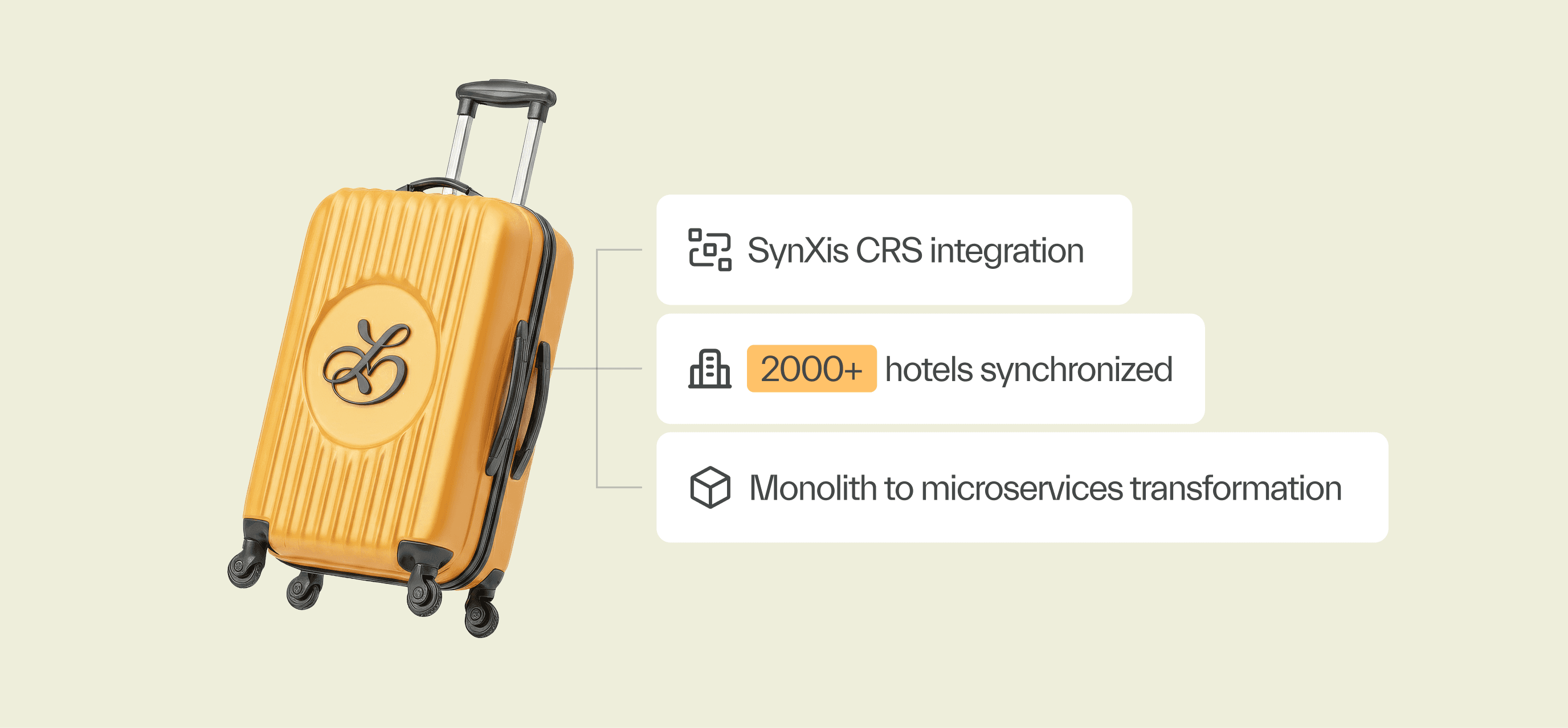

The Software House was brought in to help the Mr & Mrs Smith team modernize their boutique hotel booking platform for global scalability and to integrate its software with the new parent company's system.
When Hyatt acquired Mr & Mrs Smith, the new parent company’s first priority was a deeper integration between the two systems. Mr & Mrs Smith's app faced increased traffic and had to modernize swiftly to meet Hyatt's requirements.
The client had a capable team, but partnered with us so that they could integrate complex hospitality systems and execute an architectural transformation at the same time.
Partnership goal:
To assist our client in integrating Mr & Mrs Smith’s platform with Hyatt's SynXis and transforming it into a scalable microservices-based system.
Mr & Mrs Smith
Mr & Mrs Smith is a curated boutique hotel booking service. It offers access to carefully selected luxury hotels worldwide.
Founded as an independent platform, the company built strong relationships with unique properties and developed a loyal customer base seeking remarkable experiences.
After being acquired in 2023, Mr & Mrs Smith set out to become an integral part of Hyatt's ecosystem.

INDUSTRY
Hospitality/Travel

COUNTRY
United Kingdom

SERVICE PROVIDED
Product development, architecture modernization
Challenge
Phase one: World of Hyatt integration
The first task post-acquisition was to integrate with the World of Hyatt loyalty program.
The goal was to enable seamless booking of Mr and Mrs Smith’s hotels within the World of Hyatt platform, complete with loyalty points redemption and deposit payments.
Phase two: SynXis integration
Hyatt expected all acquired properties to eventually operate within its technological ecosystem, fully integrated with SynXis by Aven Hospitality, its central reservation platform of choice.
The hospitality data models of both Mr and Mrs Smith and SynXis encompassed property management, content, reservations, and booking engines, resulting in a complex domain.
What’s more, Mr & Mrs Smith’s PHP-based application was a monolith that couldn’t be easily tweaked to cooperate with SynXis.
Challenges included:
Working with a PHP monolithic application
Transforming monolithic architecture to microservices
A legacy system struggling under increased traffic loads
Understanding complex hospitality industry business logic
Resolving differences in architectural choices between the two systems
Limited client resources for parallel work streams
Without integration, Mr & Mrs Smith couldn't serve Hyatt's customer base. The platform risked becoming a bottleneck rather than an asset, limiting partnership value.
:quality(75))
Integration with SynXis makes it easier for admins to manage the new hotel ecosystem’s complex data
Solution
In cooperation with the client’s internal team, we laid out a plan to jointly modernize the PHP app and integrate it with SynXis simultaneously.
Phase one approach
For World of Hyatt, we designed a lightweight solution utilizing AWS Lambda functions and message queues to push hotel data directly to Hyatt's platform through dedicated API endpoints.
Phase two approach
SynXis required a different strategy. Rather than a direct integration, we left the monolith intact and, together with the client’s team, developed a gradual modernization plan to extract some functionality into microservices that handle SynXis communication.
We planned two specialized microservices:
Properties data flow service (Symfony/PHP)
to handle properties, rooms, amenities, and other types of data that change infrequently,
ARI (availability, rates, and inventory) data flow service (Golang)
to manage availability, rates, and inventory.
Both services would communicate asynchronously via AWS SNS and SQS, allowing independent scaling.
Future phases would introduce an API Gateway that routes external data directly to microservices, bypassing the monolith.
Technology stack
AWS Lambdas and queues for World of Hyatt integration
PHP/Symfony for the properties data flow microservice
Golang for the ARI data flow microservice
AWS RDS Aurora (MySQL) for persistence
SNS and SQS for async communication
Redis for caching
SOAP integration with SynXis
:quality(75))
Separate services handle different data types for maximum scalability
Process
Phase One
Our team built a serverless integration layer using AWS Lambdas and SQS queues.
The system pushed MMS hotel data and offers directly to Hyatt's platform, with dedicated API endpoints exposed for Hyatt to consume.
This established the baseline data flow and proved the partnership model before tackling the more complex SynXis work.
Phase Two
Before writing integration code, the combined TSH-MMS team spent months learning SynXis through hands-on exploration. Together, we mapped MMS concepts to SynXis terminology and figured out certification requirements.
The team identified all required integrations, grouped them logically, and implemented them in batches.
The properties data flow service came first, synchronizing properties and room types.
Once stable, the Golang-based ARI data flow service followed for availability, rates, and inventory updates.
Data mapping challenges required business decisions from MMS stakeholders, adding coordination overhead but ensuring the integration served actual needs.
Architecture transformation
The migration followed a strangler pattern – extracting functionality piece by piece while the monolith continued serving users.
Each extraction followed the same sequence:
remove the functionality from the monolith,
build the microservice around it,
validate it against SynXis,
redirect the traffic.
Current state
Three microservices are operational with a fourth in development, positioning the client for further evolution toward a service-oriented architecture.
:quality(75))
We made sure systems stay updated no matter where the booking comes from – whether Hyatt, Mr & Mrs Smith, or the hotel itself
Outcome
Mr & Mrs Smith integrated with Hyatt's SynXis, completing the requirements for operating within Hyatt's enterprise ecosystem while positioning its platform for global scale.
→ Integration with SynXis enabled Mr & Mrs Smith to serve the parent company’s customers.
→ Platform architecture transitioned to microservices, eliminating system crashes and enabling independent scaling.
→ Development capacity unlocked by establishing clear patterns and knowledge for continued microservices transformation.