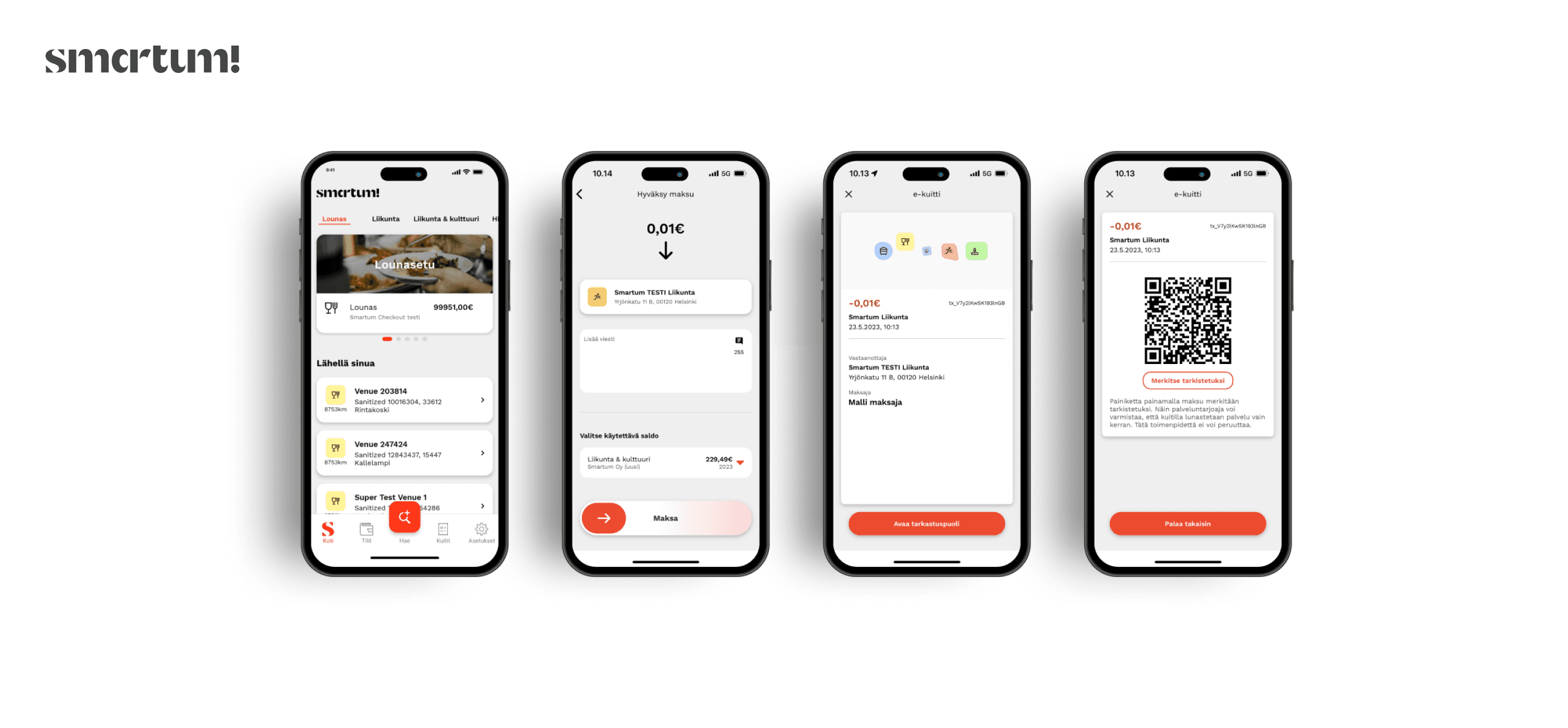

The Software House was chosen to modernize Smartum's outdated employee benefits platform with new mobile apps and a revamped web application built on React and Symfony.
Smartum was Finland's go-to provider for employee benefits, but their growth hit a wall. Their system relied on printed coupons and outdated software that couldn't keep up with their expanding business. To maintain their market position and continue growing, they needed a complete platform modernization.
Partnership goal:
→ Transform Smartum's paper-based benefits system into a modern, scalable digital platform that could serve over 1 million users across Finland.
Smartum
Smartum is Finland's leading employee benefits provider. Their mission is to support people's well-being by giving employees the freedom to choose benefits that matter to them—from exercise and culture to commuting and lunch.

INDUSTRY
Employee Benefits / HR Tech

COUNTRY
Finland

SERVICE PROVIDED
Mobile App Development, Platform Modernization, UX/UI Design
Challenge
For years, Smartum dominated the Finnish employee benefits market. But as they grew, their infrastructure started showing cracks.
Their web application was running on an outdated technology stack that needed serious attention. The old Symfony version and PHP setup created security vulnerabilities and made the codebase harder to maintain. The existing mobile app was basic and lacked features users expected, like an intelligent search system to find venues that accepted their benefits.
Corporate clients were asking for more too. Employers wanted the ability to customize and brand their company profiles within the system, but the platform's rigid structure made that nearly impossible.
Key challenges:
-> Replace paper-based coupon system with digital solution using QR codes
-> Modernize outdated technology stack (old Symfony and PHP versions)
-> Develop native mobile apps for iOS and Android with intuitive interfaces
-> Implement smart venue search functionality
-> Enable white-label customization for corporate clients
-> Improve security and code scalability
-> Maintain system stability while serving existing user base during transition
Solution
The Software House proposed a comprehensive modernization strategy built around two core components: new native mobile applications and a completely revamped web platform. Instead of trying to patch the existing system, we rebuilt it from the ground up using React for the frontend and an updated version of Symfony for the backend.
The solution centered on eliminating the paper voucher system entirely. We introduced digital vouchers accessible through the mobile apps, allowing users to make payments with QR codes instead of carrying physical coupons. This single change streamlined the entire benefits redemption process for over 1 million users.
For the web application, we created a custom white-label design system that solved Smartum's corporate customization challenge. Companies could now brand their profiles quickly, and we built dedicated admin panels for each user type.
"We can give them requirements, discuss how to do the work, and have it delivered on time and on budget."
Daniel Miles
Smartum
Process
Team Composition
Over the three years, Smartum worked with a diverse group of TSH professionals: three PHP backend developers specialized in Symfony, a React specialist, native mobile developers for iOS and Android, a Product Designer, a QA Engineer, a DevOps Engineer, and a Project Manager. The team composition changed over time based on project needs.
Development milestones
The Software House started by developing native iOS and Android applications for end users. The apps introduced digital vouchers and a mobile payment system, replacing the need for printed coupons. We also added a smart venue search feature that hadn't existed before.
After the mobile apps launched successfully, Smartum returned with a larger project: modernizing their web application. Our Product Designer created new UX/UI designs, which the development team turned into a scalable application. The web app included dedicated admin panels for every user type-employers, employees, venue owners, cashiers, and admins.
A major part of the project was upgrading the technology stack. Updating Symfony to version 3.4 and PHP to version 7.0 was necessary to eliminate security threats and improve both code efficiency and scalability. We also implemented a custom white-label design system that allowed Smartum's clients to brand their company profiles quickly.
:quality(75))
The Software House team came up with UX/UI designs and turned them into scalable applications introducing new workflows that allowed Smartum to eliminate printed coupons
Outcome
Smartum's modernized platform now serves over 1 million users with a 96% recommendation rate, completely eliminating paper coupons while supporting more than 20,000 partner venues across Finland.
→ 96% user approval rate
→ Scaled to 1 million+ active users
→ 20,000+ partner venues integrated