
The Software House team was asked to support the bank’s transition to cloud infrastructure and address the limitations of its existing commission-based payment system.
One of the biggest challenges was designing an architecture compliant with strict EU banking regulations under a tight, board-imposed deadline, without expanding the internal team.
Partnership goal:
→ To transform a traditional bank into a truly European financial institution with growth empowered by cloud computing services.
The client
* This information describes a real project, but The Software House cannot disclose the client’s name.
The bank provides trade financing for commercial customers through asset-backed capital lending, cash management, structured trade, and retail banking.
It operates in the Dutch, German, and British internet retail markets as a subsidiary of one of Eastern Europe’s largest private investment groups.

INDUSTRY
Fintech

COUNTRY
The Netherlands

SERVICE
Web development, Cloud & Data, Team Augmentation
Challenge
The bank’s system depended on a commission-based payment gateway from a global financial institution, which restricted the choice of currencies and limited transfers to only a few countries — blocking its European expansion plans.
The client’s cloud team faced a fixed deadline from the board, leaving no time to recruit and onboard new developers. There was also concern that expanding the in-house team would only be temporary. Finally, the project required an experienced system architect who could design the infrastructure in compliance with EU banking regulations. This combination of needs made the company seek a reliable external development partner.
Their team sought a unified solution that could:
Migrate payment infrastructure to a compliant cloud setup
Enable SEPA-wide transfers and currency flexibility
Deliver within tight deadlines
Preserve internal resource stability
The client wanted to expand to the cloud but was held back by third-party gateway constraints. Together, we aimed to build a new, AWS-based payment process to support the bank’s technological and geographic growth.
Solution
The Software House hand-picked specialists who joined the partner’s organization under a hybrid model to deliver web development, serverless implementation, DevOps engineering, and frontend/back-end development using React and Node.js.
Our architect designed a new AWS-based infrastructure to implement the payment gateway, integrating Amazon S3 for storage, Form3 for SEPA-compliant payments, and Mambu as a ready-made banking engine.
This solution established the bank’s first fully cloud-based transaction processing environment, integrated with legacy systems and observability processes — enabling the bank to obtain SEPA certification and expand operations across Europe.
:quality(75))
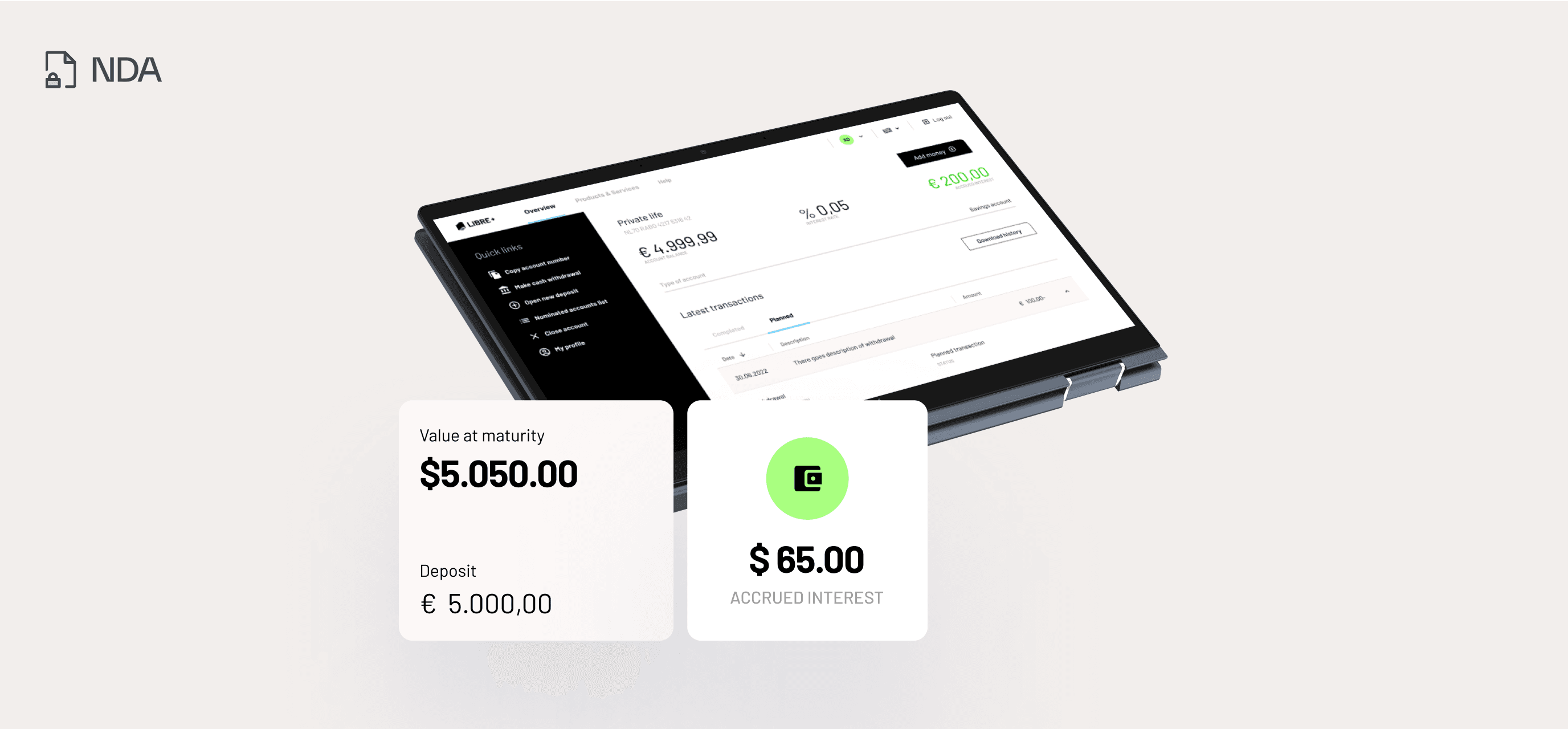
New layout of the digital bank
Process
For the bank cloud infrastructure project, we’ve established the following path:
1. Designing the architecture.
We mapped out a scalable cloud infrastructure and defined integrations with the bank’s legacy systems, focusing on observability and compliance from the start.
2. Choosing the technology stack.
The team selected AWS Serverless, Terraform, React, Node.js, and Mambu — with Form3 enabling SEPA-compatible payment processing.
3. Building and testing the cloud environment.
We established the first cloud-based transaction system, integrated payment services, and ran performance tests to ensure reliability and compliance.
4. Preparing for SEPA certification.
Using the new setup, we met all European Payments Council requirements through documentation, testing, and security validation.
5. Achieving certification and expanding scope.
The bank obtained its SEPA certificate, unlocking euro transfers across 36 countries, and the collaboration extended to developing a new retail banking platform for the Dutch market.
Dedicated team
In a few weeks, we formed a dedicated, versatile development team for the client, assembling a lineup of:
→ 12 Developers
→ 3 DevOps Engineers
→ 2 QA Engineers
→ 2 Product Designers
→ 1 Architect
→ 2 Project Managers
These professionals joined the partner’s ranks under their Product Owner’s leadership and collaborated with technology leads from the Cloud, Testing, and Salesforce units, as well as business analysts.
Technology stack
The project was powered by a modern technology ecosystem designed for scalability, security, and speed:
Frontend: React
Backend: Node.js
Language: TypeScript
Cloud platform: AWS (Serverless architecture, Terraform for IaC)
Analytics & data: Scali (analytics) and Python (data analysis)
Banking platforms: Mambu (core banking engine), Salesforce (CRM and process integration)
Key milestones
1. Establishing the bank’s first cloud infrastructure
Under the guidance of The Software House’s architect, the team mapped and implemented the cloud-native infrastructure to support a next-generation payment gateway. Key components included:
Amazon S3 for secure and scalable storage
Form3 for payment processing, enabling access to the full range of SEPA services
Mambu as a modular banking engine providing ready-made financial functionalities
This foundational phase — completed in just six months — positioned the client for rapid compliance and operational excellence.
2. Obtaining SEPA certification
The newly built cloud infrastructure allowed the bank to meet all SEPA certification requirements established by the European Payments Council. This achievement, granted only a few times each year, marked a major milestone for the organization.
With the SEPA certificate in place, the bank expanded its euro transfer capabilities from a few core markets (Netherlands, Germany, and Austria) to 36 European countries, unlocking new opportunities for both retail and business customers.
3. Expansion into retail banking
Two months into the cooperation, the client extended the project scope by asking The Software House’s team to develop a new retail banking platform for the Dutch market. Together with the client’s developers, we:
Built a modern, customer-facing website
Developed a web application for registering deposit accounts
Conducted early-adopter testing with a pilot group of users
This second phase laid the foundation for the client’s digital-first retail banking experience.
See similar case studies:

→ £10M+ went to British businesses after we automated a loan platform
→ xpate's new data lake built with a $18K AWS grant saves hours of analysis
Outcome
The new cloud architecture enabled the bank to secure SEPA certification, expanding euro transfers from 3 to 36 countries and paving the way for a 12× increase in cross-border transaction reach.
→ Expansion from 3 to 36 SEPA countries
→ Timely SEPA certification enabling new revenue streams
→ Launch of a new retail banking platform for the Dutch market
→ First SEPA-compliant cloud infrastructure in the bank’s history