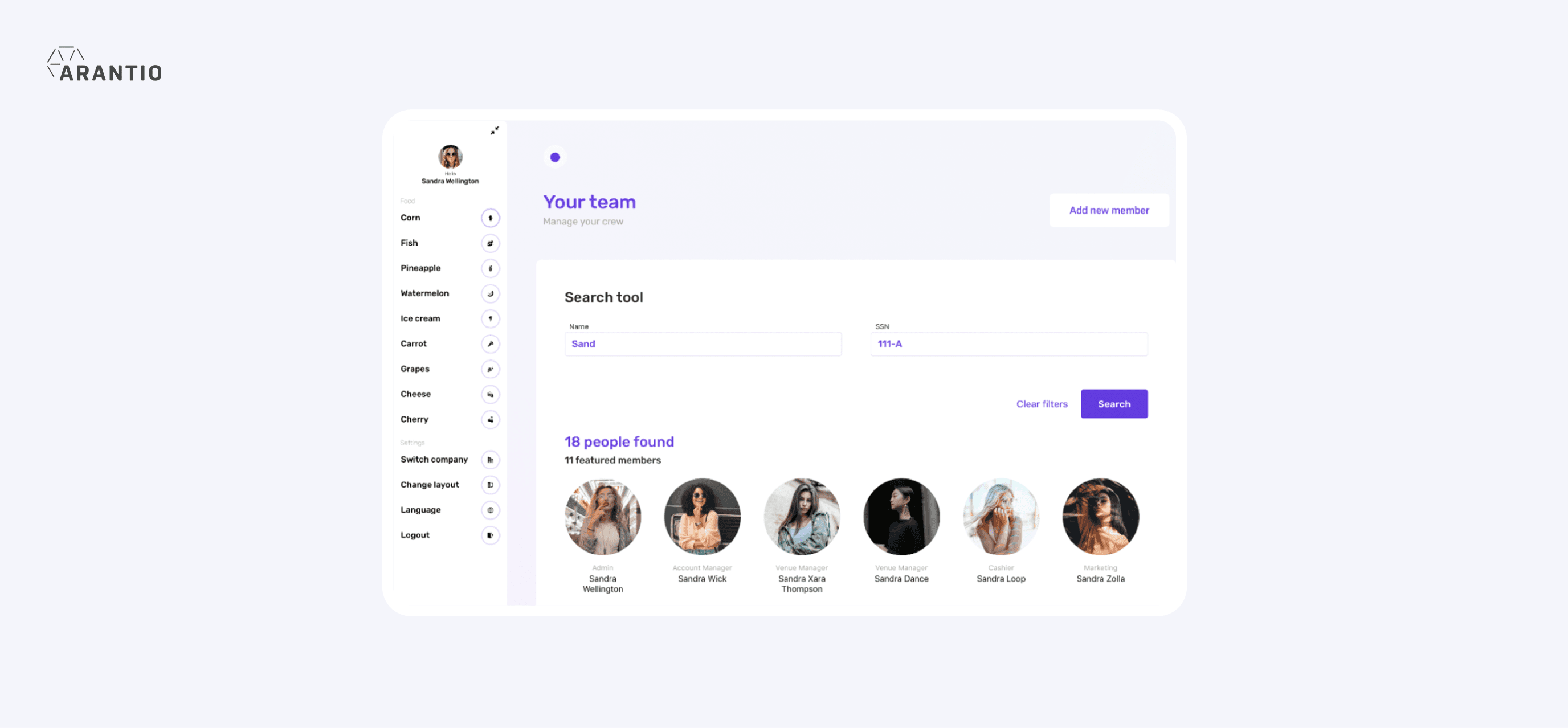

The Software House team was brought in to create a unified backend system that would power all of Arantio's employee benefit applications, enabling the company to scale its platform and launch new products faster.
Arantio had built several successful employee benefit applications serving individual markets.
However, each product ran on its own separate backend, which meant every new feature or integration had to be built multiple times. As the business grew, this approach became unsustainable.
Partnership goal:
→ To upgrade and extend a single backend solution that serves as the foundation for all current and future products.
Arantio
Arantio is a Finnish software company that provides employee benefit systems for businesses across Finland. Their products include Smartum and Vaana, platforms that allow employers to offer meal vouchers, sports benefits, and other employee perks.
The company’s products are among the most popular of their kind in Finland. Smartum alone has 25,000+ partners in its app network.

INDUSTRY
Fintech, Human Resources

COUNTRY
Finland

SERVICE PROVIDED
Backend development, Team augmentation
Challenge
Arantio had developed multiple products for the employee benefits market, each serving a slightly different purpose. Smartum focused on traditional employee benefits, while Vaana targeted Finnish municipalities with specialized requirements. Both were successful, but they shared a problem.
Each product had its own backend. This created redundancies. For example, when the Arantio team needed to add a new shared feature, developers had to implement the same changes across multiple codebases.
Key challenges
-> Multiple products with separate backends created redundant development work
-> Adding new features required implementation across all systems
-> Security updates and PHP version upgrades had to be done multiple times
-> No shared foundation for launching new products quickly
-> Scaling the business model required a more efficient technical architecture
-> Integration with new partners took longer than necessary
Without a unified backend, Arantio's growth strategy was constrained by its own technical infrastructure. Each new product launch required building everything from scratch, rather than leveraging existing work.
Solution
The Software House had already worked with Arantio on Smartum and Vaana, so we understood their business model and technical requirements. When they decided to consolidate their backends into Arantio Core, they brought us in to make it happen.
Our developers worked directly within Arantio's in-house team, ensuring tight collaboration and fast delivery. The approach focused on:
-> Connecting existing systems to a shared API
-> Developing new features that all products could utilize
-> Maintenance work to improve code quality and security
Technologies
We worked with PHP and Symfony to build and maintain Arantio Core, ensuring compatibility with all connected products.
"The Software House is the complete package. Their experience and work methodology fit us perfectly. The team quickly understood both the platform’s function and our intent and was able to offer us immediate, detailed solution suggestions."
Masood Arai
CEO of Arantio
Process
Team Composition:
The team scaled based on project needs and included a varying number of Symfony developers.
Development
The Software House approached the project in phases.
First, we connected the existing systems (Smartum, Vaana) to the Arantio Core API, ensuring that data flowed correctly between products and the shared backend.
Read more about Backend for Frontend implementation details.
Next, we developed new features that all products could use. This included:
-> Vendor management,
-> Setting purchase restrictions by time or location
-> Defining which products and services users could buy with their benefits
Finally, our team also handled technical maintenance, including regular upgrades of the PHP version to keep the system secure and up-to-date.
Outcome
Arantio Core became the foundation for all of the company's products, enabling faster feature development and easier product launches.
→ Created a shared backend infrastructure serving 2+ million users
→ Reduced redundant development work by consolidating features
→ Enabled faster launch by providing a ready-made backend foundation